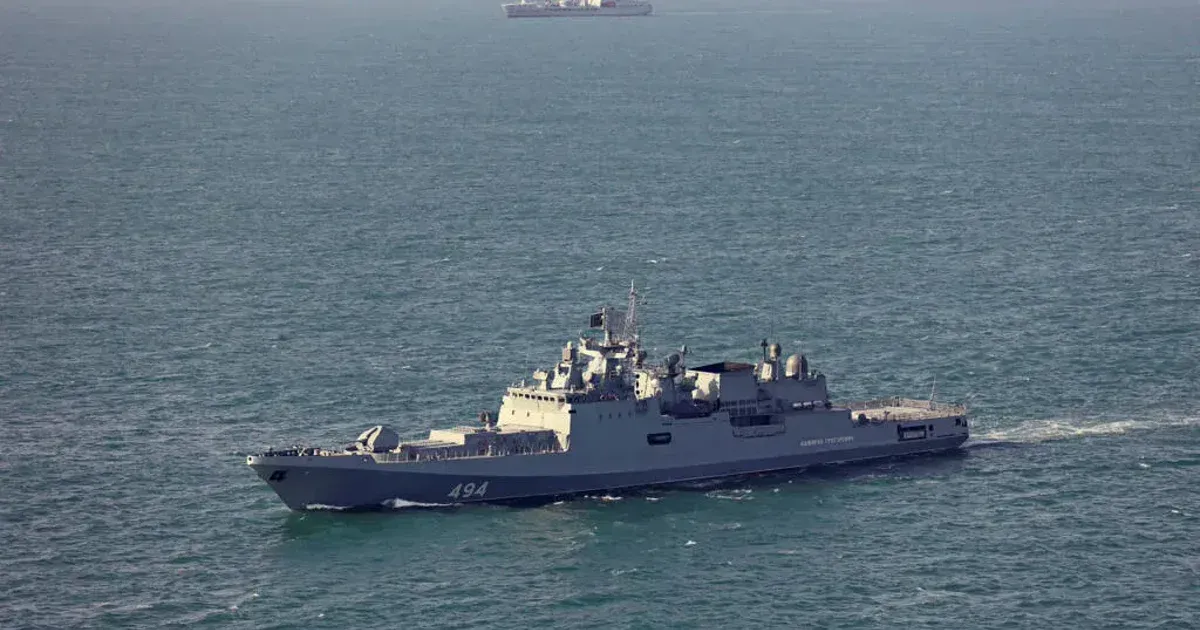
Russian naval forces fired warning shots at a British civilian yacht on Tuesday as the vessel moved toward a frigate in the English Channel. The encounter also shows how quickly civilian navigation can become part of a security dispute. A private yacht is not a naval asset, but warning shots turn the distinction into an international question. Investigators will now study location, radio traffic and escalation protocol. Britain's Defense Ministry confirmed it is investigating the reports involving a UK-registered boat on June 16, 2026. The incident took place in international waters, away from the immediate territorial boundaries of the United Kingdom. Witnesses and military sources identified the Russian vessel as the Admiral Grigorovich, a guided-missile frigate known to be operating in the region.
Civilian sailors reported hearing the discharge of naval weapons after their yacht drifted into the vicinity of the Russian warship. Records indicate the encounter happened approximately 30 kilometers south of the Isle of Wight. France 24 reports suggest the yacht was sailing through one of the busiest maritime corridors in the world when the confrontation began. The Ministry of Defence has not yet released the name of the civilian vessel or the number of crew members on board.
Moscow officials defended the actions of the frigate crew, claiming the yacht made what they termed a dangerous approach. Russian Defense Ministry statements asserted that the warning shots were a necessary measure to prevent a collision or a breach of the warship's security perimeter. One official statement noted that the yacht failed to respond to initial radio contact or visual signals before the weapons were discharged. The Kremlin maintains that its naval assets are operating within the legal frameworks of international maritime law.
Russian Frigate Signals Dangerous Approach
Naval experts indicate that the Admiral Grigorovich is equipped with sophisticated radar and rapid-fire cannons capable of delivering warning salvos at distance. Under standard maritime protocols, military vessels typically issue multiple warnings via radio and signal flares before resorting to live ammunition. The British yacht, however, reportedly drifted toward the frigate, which may have triggered the ship's automated or manual defense responses. Investigators are now reviewing the yacht's GPS logs to determine its exact course and speed during the interaction.
The current investigation seeks to verify whether the Russian crew followed the International Regulations for Preventing Collisions at Sea. This specific maritime treaty governs how vessels must behave when approaching one another to avoid accidents. British authorities are also looking into whether the warning shots presented a direct threat to the lives of the civilians on the yacht. Preliminary data suggests the shots landed several hundred meters away from the yacht's hull.
British officials have expressed concern over the use of live fire in a crowded commercial shipping lane. While the English Channel frequently hosts military vessels from various nations, the use of warning shots against civilian craft is extremely rare. Security analysts suggest the Admiral Grigorovich may have been on high alert due to ongoing regional tensions. The Defense Ministry is coordinating with the Maritime and Coastguard Agency to gather additional witness statements from other nearby vessels.
Maritime Investigation South of the Isle of Wight
Security protocols for civilian yachts usually dictate a wide berth for military ships, though current weather conditions can cause unintended drifting. Most modern yachts carry transponders that allow military radar to identify them as non-combatant vessels. Admiral Grigorovich-class frigates are designed for blue-water combat and carry serious firepower, including the 100mm A-190 naval gun. If the yacht's transponder was inactive or malfunctioning, the Russian crew might have treated it as an unidentified potential threat.
The encounter highlights the friction between civilian navigation and military presence in the Channel. Any use of weapons near the British coastline, even in international waters, triggers a high-level response from the Royal Navy. Vessels from the British fleet have been monitoring the Russian frigate since it entered the Channel earlier this month. This surveillance typically involves keeping a safe distance while tracking the foreign ship's movements and electronic emissions.
Within the UK government, lawmakers are calling for a formal diplomatic protest if the investigation finds the Russian response was disproportionate. The incident adds another layer of complexity to the already strained relations between London and Moscow. Vessels operating in the Channel are now being advised to exercise increased caution when navigating near foreign naval groups. The final report from the Ministry of Defence is expected to be shared with NATO maritime command.
Live Fire Raises the Risk of a Channel Miscalculation
Escalating naval interactions in the English Channel present a direct challenge to the safety of civilian transit in one of Europe's most critical economic arteries. When a guided-missile frigate like the Admiral Grigorovich chooses to engage a civilian yacht with live fire, the margin for error disappears. The use of warning shots is a kinetic escalation that bypasses traditional bridge-to-bridge communication, suggesting a posture of high-readiness or intentional intimidation. For the UK, the proximity of this event to the Isle of Wight forces a difficult choice between maintaining maritime freedom and avoiding accidental combat.
Risk management for civilian sailors now includes the possibility of being targeted by military hardware if they enter sensitive zones. Defense officials must determine if the yacht's proximity was a genuine tactical threat or a pretext for a display of force. If naval commanders continue to use live fire as a primary warning mechanism, the likelihood of a fatal accident increases. The shift in maritime behavior threatens to transform a commercial waterway into a zone of constant tactical uncertainty. Maritime lawyers will also watch the warning-shot sequence because small factual details can decide whether an encounter is treated as lawful signaling or reckless escalation.