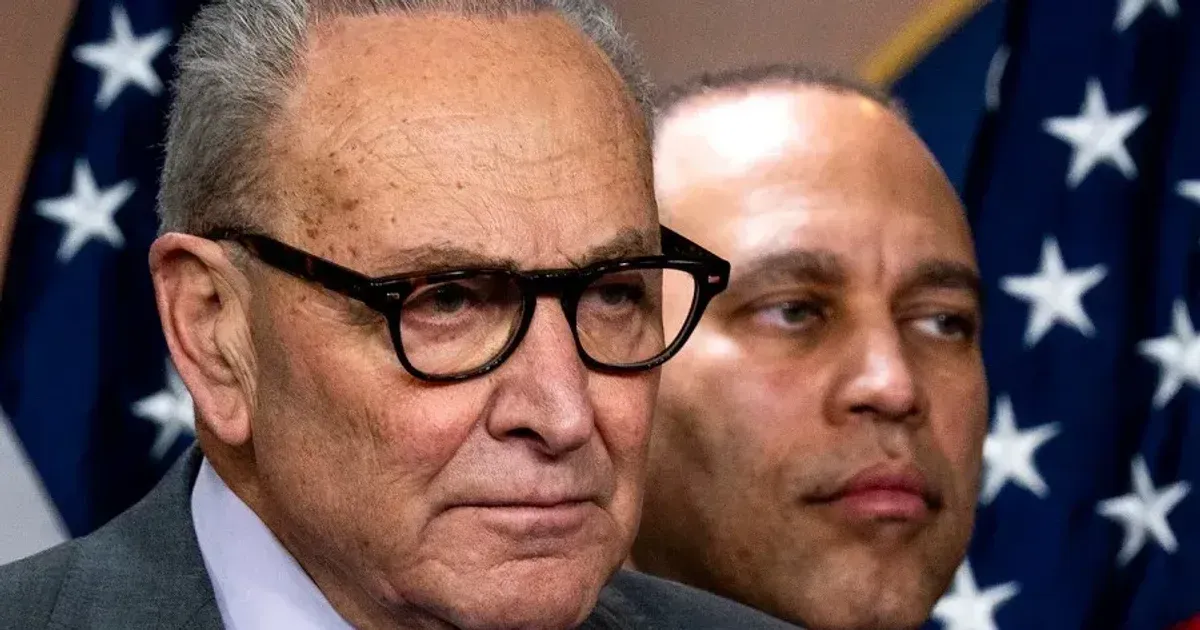
Senate Majority Leader Chuck Schumer denounced the SAVE America Act on the Senate floor Monday morning as Republicans prepared to force a vote on the controversial voting reform package. Standing before a nearly empty chamber, the New York Democrat used uncharacteristically harsh language to describe the legislation, which aims to tighten proof-of-citizenship requirements for federal elections. Schumer described the bill as one of the most despicable pieces of legislation he has encountered in his decades-long career in the capital. His remarks centered on the potential for the law to disenfranchise millions of eligible voters who may lack immediate access to required identification documents. High-ranking members of the Democratic caucus gathered behind him as he laid out a case against what he termed a coordinated attack on the franchise. The speech marked a major escalation in the rhetorical war between the two parties as the 2026 midterm elections approach. Republican leaders have framed the Safeguard American Voter Eligibility Act as a necessary measure to ensure that only U.S. citizens participate in federal contests. They point to the 1993 National Voter Registration Act as a source of legal loopholes that allow non-citizens to register when applying for driver licenses. Under the proposed GOP bill, every individual registering to vote would need to provide documentary proof of citizenship, such as a birth certificate or a passport. Existing federal law already prohibits non-citizens from voting in federal elections, but proponents of the new measure argue that the current system relies too heavily on an honor system. House Republicans previously passed a version of the bill with near-unanimous party support. The Senate version now faces a much steeper climb in a chamber where Democrats hold a razor-thin majority.
Schumer Condemns Voting Bill
Senate Minority Leader Mitch McConnell has signaled that his conference will use every procedural tool available to ensure the bill receives a full floor debate. For instance, several Republican senators have threatened to withhold support for upcoming spending bills unless the voting measures are included in the final package. They argue that the influx of migrants at the southern border has created a crisis of confidence in the electoral system. Schumer argued that the bill is a solution in search of a problem that does not exist. He cited data from the Department of Homeland Security suggesting that instances of non-citizen voting are statistically microscopic. The political utility of the issue remains high for Republicans looking to energize their base before the November contests. The floor fight is expected to consume the remainder of the legislative week.
"Nothing is more important than defeating this dagger to the heart of our democracy."
Schumer's sharp reaction to the bill stems from provisions that he claims would disproportionately affect naturalized citizens, elderly voters, and students. The bill would require the Social Security Administration to share records with election officials to verify citizenship status. Critics worry this would create a major administrative backlog that could delay registrations for months. Civil rights organizations have promised immediate legal action if the bill ever reaches the president's desk. This legislation would effectively rewrite the rules of engagement for every local election board in 36 states that now use the federal registration form.
Schumer insisted that the GOP is trying to create a barrier to entry that mimics the literacy tests of the Jim Crow era. His comparison drew a sharp rebuke from Republican sponsors who called the analogy offensive and inaccurate.
SAVE America Act Heads Toward Vote
Administrative costs associated with the bill have also become a point of contention in the Senate Budget Committee. Estimates from non-partisan groups suggest that implementing a national proof-of-citizenship requirement could cost local governments hundreds of millions of dollars. But Republicans argue that the price of election integrity cannot be measured in dollars and cents. They believe that a single fraudulent vote is enough to undermine the entire democratic process. Meanwhile, Schumer has directed his staff to prepare a series of amendments designed to highlight the bill's potential impact on military voters stationed overseas. These voters often rely on simplified registration processes that might be invalidated under the new requirements. The tension between security and access has never been more visible in the upper chamber.
Voting rights advocates have organized rallies outside the Capitol to coincide with Schumer's floor speech. Many of these groups represent the very demographics that would be most impacted by the bill's documentation requirements. Records from the 2024 election cycle show that several million Americans do not have a current passport or easy access to their original birth certificates. For these individuals, obtaining the necessary paperwork could require significant time and travel to government offices. Schumer emphasized that the burden would fall hardest on low-income families who cannot afford to take time off work.
The debate has evolved from a simple policy disagreement into a broader fight over the nature of American citizenship. The Senate gallery remained packed with observers as the debate stretched into the afternoon.
Civil Rights Groups Warn of Barriers
Internal polling from both parties suggests that the issue of voter eligibility is one of the most divisive topics among the American public. Some surveys show broad support for the idea of showing ID, but that support often drops when the requirements of the SAVE America Act are explained in detail. According to sources within the Democratic National Committee, the party plans to use the GOP's push for the bill as a central theme in their 2026 fundraising appeals.
They view the legislation as a gift that allows them to paint Republicans as extremists on the issue of voting rights. At the same time, Republicans are betting that their focus on border security and election integrity will connect with swing voters in battleground states. This tension is unlikely to be resolved before the next election cycle.
Constitutional scholars have also entered the fray, questioning whether Congress has the authority to mandate such strict registration requirements for the states. Some argue that the Elections Clause of the Constitution gives the federal government broad power to oversee federal contests. Others point to the Tenth Amendment as a shield for state-level control over the voting process. Several states have already passed their own versions of the SAVE America Act, leading to a patchwork of rules across the country. Schumer's office has been in constant communication with legal experts to build a case for why the bill violates existing federal statutes. The legislative text is now under intense scrutiny by both sides.
Voting Rules Became Campaign Theater
Legislative bomb-throwing has replaced governance in a Senate that now functions primarily as a soundstage for campaign commercials. Chuck Schumer's use of the word "despicable" to describe a bill requiring proof of citizenship is a calculated piece of political theater designed to mask his party's own vulnerabilities on the issue of border security. While it is true that non-citizen voting is rare, the Democratic refusal to even discuss modernizing the 1993 National Voter Registration Act is a dereliction of duty.
By framing any attempt at verification as a "dagger to the heart" of democracy, Schumer is effectively admitting that his party views the current administrative chaos as a strategic advantage. Conversely, the Republican obsession with the SAVE America Act is equally cynical. They are well aware that the bill has zero chance of passing in the current Senate and even less of surviving a presidential veto. It is not a serious attempt at reform; it is a fundraising exercise dressed up in the language of constitutional duty. Both parties are guilty of weaponizing the mechanics of our elections to distract from their inability to solve the actual crises facing the nation. The losers in this performative struggle are the American voters who are left to handle a system that is being intentionally complicated by both sides for partisan gain.