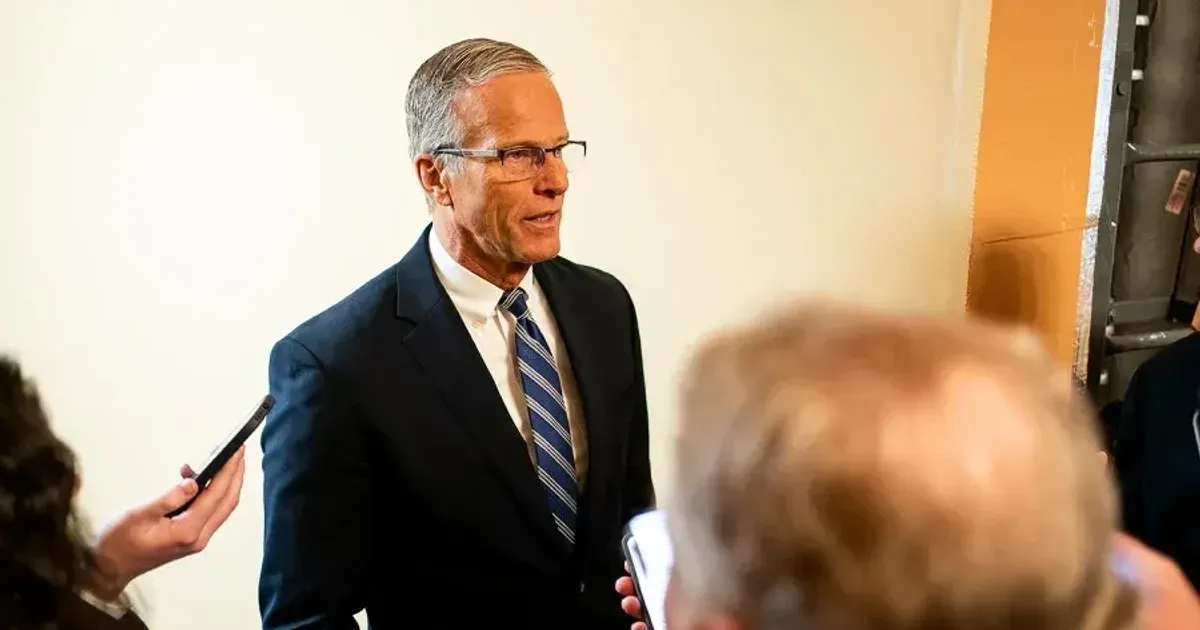
Reporters gathered in the Senate press gallery to watch the start of a legislative week that may redefine Republican leadership. President Trump and John Thune are fighting for control over the SAVE America Act in a conflict that centers on federal voting requirements. Senators returned to Washington on Monday to face a procedural vote that has been months in the making. Trump allies in the upper chamber prepared to occupy the floor, signaling a willingness to grind legislative business to a halt. Thune, the South Dakota Republican, must now balance the demands of his party's populist wing with the practical realities of a slim majority. But the pressure is not only internal. Trump has used his social media platform to insist that the Safeguard American Voter Eligibility Act is the only way to ensure future election integrity. The bill requires individuals to provide documentary proof of U.S. citizenship when they register to vote in federal elections. Meanwhile, the proposed legislation targets the 1993 National Voter Registration Act. Current federal law allows voters to attest to their citizenship status under penalty of perjury. Critics argue that physical documentation is redundant, while proponents claim the honor system is insufficient to prevent non-citizen participation in elections.
Trump Allies Pressure the Senate
Trump spent the weekend rallying his base around the key provisions of the SAVE America Act. He argued that the current system is vulnerable to exploitation by those who reside in the country illegally. His supporters in the Senate have echoed these claims, preparing a strategy to dominate the floor debate for as long as necessary. Some Republican moderates have expressed private concerns about the logistical hurdles of the bill. Providing birth certificates or passports during registration could alienate voters who do not have easy access to these documents. One internal memo suggested that the policy might inadvertently suppress turnout among elderly rural voters. The debate has become a proxy war for the future of the Republican party. Trump sees the bill as a litmus test for loyalty. Thune sees it as a procedural hurdle that could derail other legislative priorities, including tax reform and judicial appointments. Yet the MAGA base is not interested in legislative efficiency. They want a public fight that highlights what they perceive as a fundamental flaw in the American electoral system. Several senators have promised to use every tool in the parliamentary handbook to force a vote.
Voting Bill Tests Thune's Control
Thune took the gavel as Majority Leader with a promise to restore regular order. His predecessor often bypassed committees to bring bills directly to the floor, a practice Thune criticized. But the SAVE America Act has skipped several traditional steps due to the urgency demanded by the White House. According to reports from Hill staffers, the planned floor takeover involves a rotating group of eight senators. They intend to speak for hours at a time, preventing the consideration of any other business. This strategy involves a calculated risk of irritating colleagues who have their own parochial interests to protect. The White House has suggested that Thune's leadership could be challenged if the bill fails to reach the president's desk. This legislative push is the largest test of Thune's ability to manage a fractured caucus. He must decide whether to cave to the floor protesters or seek a bipartisan compromise that Trump would likely veto. The Democratic minority has remained largely silent, content to watch the Republican infighting. They view the bill as unconstitutional and believe it will eventually die in the courts. The Supreme Court has previously ruled that states cannot add their own requirements to federal registration forms without congressional approval.
Election Rules Become a Floor Fight
Constitutional scholars have spent the last few weeks dissecting the language of the SAVE America Act. Steve Vladeck, a professor at Georgetown Law, has been vocal about the potential legal ramifications of the bill. He argues that the federal government is overstepping its bounds by mandating how states manage their voter rolls.
The SAVE America Act is not just a voting bill; it is an attempt to centralize electoral control in a way that contradicts decades of federalist tradition.
The legal argument centers on the Elections Clause of the Constitution. This provision grants states the primary authority to oversee the times, places, and manner of holding elections. Vladeck contends that the proposed bill could trigger a wave of litigation from states that already have their own verification systems. For instance, several western states rely almost entirely on mail-in ballots and have simplified registration processes. They argue that the SAVE America Act would create a bureaucratic nightmare for local election officials. These officials would need to hire thousands of new workers to verify documents for every new registrant.
The political momentum behind the bill seems to outweigh the legal concerns in the eyes of the Trump administration. They believe that a court battle would only serve to further highlight the issue for their voters. The tension between legal theory and political reality has left many senators in a difficult position.
The Senate operates on a system of unanimous consent for most day-to-day activities. When a single senator objects, the entire process slows down. The plan for a floor takeover relies on this lack of consensus to force Thune's hand. He cannot easily move to other business without a cloture vote, which requires 60 senators to agree. The House of Representatives passed a similar version of the bill with a simple majority. The lower chamber's rules allow for much tighter control by leadership. The Senate is designed to be a slower, more deliberate body, which often frustrates presidents who want rapid results.
In practice, the debate over the SAVE America Act has stalled a critical defense spending bill. Military leaders have warned that delays in funding could impact readiness in the Pacific. But the senators leading the charge on the voting bill argue that election integrity is a national security issue of the highest order.
At the same time, the public is divided on the necessity of the bill. Recent polling shows that a majority of Republicans support proof-of-citizenship requirements. Independent voters are more skeptical, citing concerns about government overreach and the cost of implementation. The Congressional Budget Office has not yet released a final score for the legislation. Legislative analysts expect the floor takeover to begin on Tuesday afternoon. If Thune cannot reach a deal with the protesters, the Senate could remain in session through the weekend. The move by the MAGA wing reflects a broader shift in how legislative power is wielded in the modern era.
Procedure Became the Main Weapon
Institutionalists believe the Senate functions as a cooling saucer for the hot tea of populism, but that saucer is now cracked and leaking all over the floor. The spectacle of the SAVE America Act is not a debate about policy; it is a performance of power intended for an audience of one at the White House. John Thune finds himself in the unenviable position of a night manager at a restaurant where the customers are now setting fire to the menus. This is not leadership.
It is a hostage situation where the ransom is a piece of legislation that most legal experts believe is a constitutional dead end. The MAGA faction has realized that they do not need a majority to govern if they have the stamina to speak until everyone else gives up. By weaponizing the very traditions Thune claims to protect, they have rendered the Majority Leader a spectator in his own chamber. If the Senate cannot handle a procedural vote without a week of theatrical floor-hogging, it has ceased to be a deliberative body and has become a soundstage.
The result of this battle will tell us if the Republican party is still a coalition or simply a fan club with subpoena power.