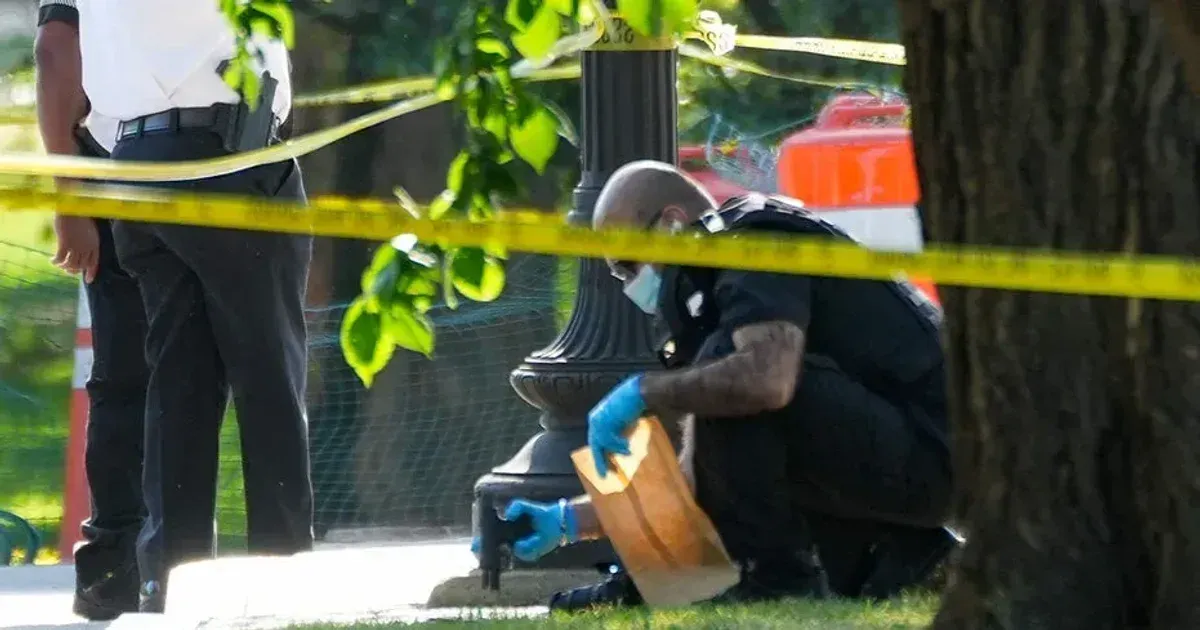
Secret Service officers shot an armed suspect near the Washington Monument after officials said he opened fire during a confrontation with law enforcement. On May 4, 2026, the agency said plainclothes personnel had spotted the man in the vicinity of the White House complex before uniformed officers moved in near 15th Street and Independence Avenue.
Deputy Director Matt Quinn said surveillance personnel noticed what he described as the "visual print of a firearm" under the man's clothing. The officers followed the suspect briefly and called for uniformed support. When those officers approached, officials said, the man fled, drew a firearm and fired toward the officers. Secret Service personnel returned fire and struck him.
A minor bystander was also shot and transported to a hospital with injuries officials described as not life-threatening. No Secret Service officers were reported injured. The suspect was taken to a local hospital, and officials had not released his name or a detailed medical condition as of the initial agency briefing.
How the Confrontation Unfolded
The shooting occurred in one of Washington's most heavily patrolled public corridors, close to the National Mall and several blocks from the White House grounds. The location matters because it sits at the intersection of public tourism, federal property and routine executive-branch security movements. The Secret Service said the suspect was detected before he reached a protected perimeter.
Quinn said Vice President JD Vance's motorcade had passed through the area not long before the shooting, but officials said there was no indication that the motorcade was the target. That distinction is important. A shooting near a motorcade route immediately raises the political temperature, but the public facts so far point to an armed encounter identified by surveillance teams rather than a confirmed plot against the vice president.
The agency also said there was no known nexus between the shooting and the White House. That language narrows the public record. It does not explain why the suspect was armed near a sensitive federal corridor, but it does prevent the incident from being described as an attempted attack on the White House or on the vice president without evidence that officials have not provided.
The timing still leaves the Secret Service with a public communication problem. Any gunfire near the Mall, the White House complex and a recent motorcade route invites immediate political interpretation. The agency's burden is to separate what officers saw, what the suspect allegedly did and what investigators have not yet established.
The incident came a little more than a week after a separate armed security breach at the White House Correspondents' Dinner. That earlier case had already placed the Secret Service under renewed scrutiny. Monday's shooting adds another test of how the agency explains fast-moving threats in crowded civilian spaces.
Investigation Still Has Open Questions
The core facts released so far are narrow: officers spotted a concealed weapon, the suspect allegedly fled, the suspect allegedly fired and officers returned fire. Investigators still need to establish the suspect's motive, the precise sequence of shots and whether any additional charges will be filed. Those questions should not be filled with assumptions before the agency or prosecutors release more information.
The bystander injury will also receive close attention because it occurred in a dense public area rather than inside a controlled security checkpoint. Ballistics work, officer statements and any available video will shape the final account of how the minor was struck. Until those findings are public, the safest description is that a minor was shot during the exchange and was expected to survive.
The public should also separate confirmed facts from the political noise that surrounds any incident near the White House. The presence of executive security, a nearby motorcade route and a recent dinner attack make the story sensitive. They do not, by themselves, prove a coordinated threat. That distinction is the difference between responsible security reporting and speculation.
What the Mall Shooting Shows
The National Mall is difficult to secure precisely because it is meant to remain open. It is a civic space, a tourist destination and a buffer around some of the most sensitive government sites in the country. That openness creates the permanent tension at the center of this case: security teams must identify armed threats quickly without turning the capital's public spaces into sealed compounds.
The strongest part of the official account is also the part that deserves the most scrutiny. Plainclothes detection appears to have identified the weapon before the suspect reached a harder security line, but the confrontation still ended with gunfire and an injured child. That is not a clean success story. It is a reminder that even a rapid intervention can carry serious civilian risk once an armed suspect chooses to fire in a crowded place.