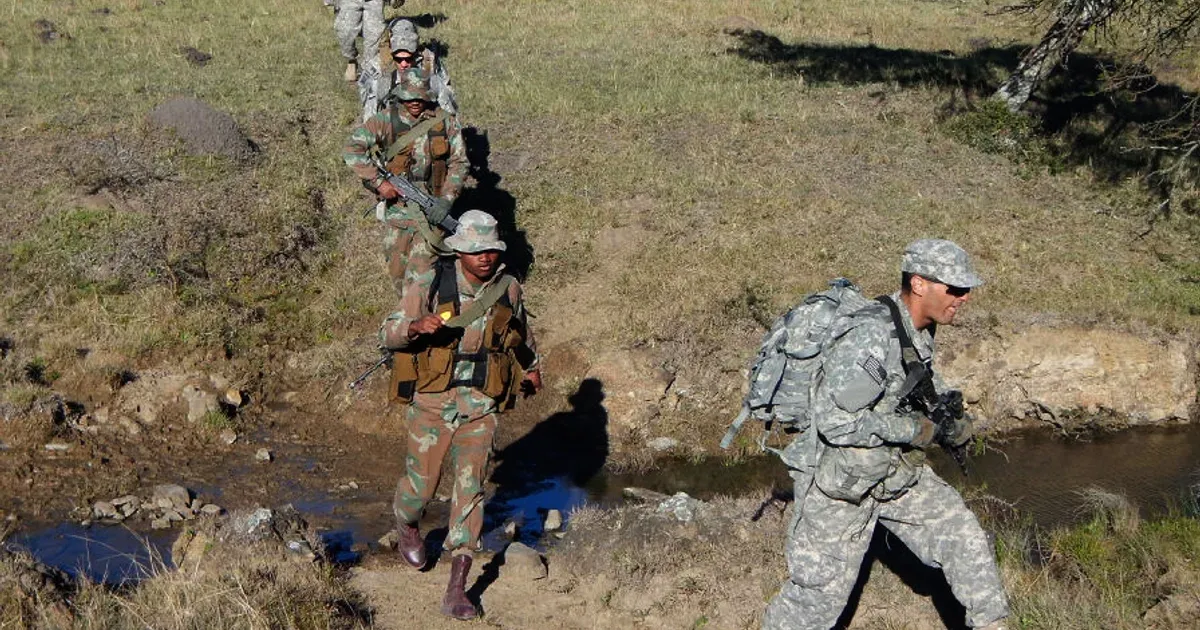
Soldiers on Johannesburg streets show how far South Africa’s security crisis has moved from ordinary policing into military-backed public order.
Soldiers Enter Johannesburg Streets
Steel-clad Ratel infantry vehicles rumbled through the narrow arteries of Johannesburg early Wednesday morning. Soldiers in camouflage gear stood behind mounted machine guns, their eyes scanning the dilapidated high-rises that define the city's skyline. Residents watched from balconies, some waving, others retreating behind heavy iron gates. Armed patrols now occupy key intersections in a city that has long struggled to maintain order against an encroaching tide of organized crime. The patrols expanded on March 11, 2026, as Johannesburg residents demanded security that ordinary policing had not delivered. President Cyril Ramaphosa authorized this military intervention to supplement a police force overwhelmed by a wave of violent crime. Gang syndicates and illegal mining operations have effectively seized control of entire districts. These paramilitary-style units, often referred to as Zama Zamas, have turned abandoned gold mines into fortresses. Military boots on the ground represent a desperate attempt to restore the authority of the state. Criminal networks in South Africa have grown so sophisticated that they now rival the tactical capabilities of local law enforcement. Johannesburg, the nation's economic heart, has seen its murder rate climb steadily over the past three years. Small businesses shutter their doors at sunset, and major corporations spend millions on private security details that resemble small armies. Security experts argue that the South African Police Service (SAPS) lacks the resources and the clean record necessary to dismantle these syndicates alone. Corruption within the lower ranks of the police often alerts criminals to upcoming raids, rendering traditional enforcement efforts useless. Fear is the primary currency in the city center.
Soldiers were seen setting up checkpoints in Hillbrow and Yeoville, neighborhoods known for high concentrations of gang activity. Searching vehicles and checking identification, the troops moved with a precision that contrasted sharply with the often-disorganized police response. While Bloomberg suggests the deployment is a temporary measure to calm investors, Reuters' sources claim the military presence could last for up to a year. The scope of the mission includes protecting critical infrastructure and clearing illegal mining camps that have sprouted around the Witwatersrand basin. These camps are not just clusters of desperate individuals; they are managed by international cartels with links to global gold markets.
Illegal Mining Shows State Weakness
Illegal mining operations cost the South African economy billions of rand every year. Armed groups fight for control of the shafts, leading to frequent skirmishes that spill into residential areas. Gold smuggling networks stretch from the deep tunnels of the Witwatersrand to international markets in Dubai and Zurich. Police officers find themselves outgunned by mercenaries who use high-caliber rifles and explosives. Violence between rival factions of Zama Zamas has left hundreds dead in recent months, with bodies often discovered in shallow graves near abandoned mineshafts.
This military intervention was designed to break the supply chains of these illicit operations by blockading the entrances to the mines. Success remains elusive because the problem is deeply rooted in the country's economic disparities. Many illegal miners are migrants from neighboring Lesotho, Zimbabwe, and Mozambique who have no other means of income. They live in squalid conditions underground for months at a time, surfacing only to trade gold for food and ammunition. Cutting off their access to the mines may stop the flow of gold, but it does little to address the poverty that fuels the industry.
Critics of the deployment argue that the government is treating a socioeconomic symptom with a military bandage. But for the residents of Johannesburg who live in the line of fire, the presence of the army provides a fleeting sense of security. Guns have replaced the rule of law. Ramaphosa now faces significant political pressure as the 2026 electoral cycle approaches. Voters have expressed outrage over the government's inability to provide basic safety in urban areas.
President Ramaphosa faces significant political pressure as the 2026 electoral cycle approaches.
By deploying the South African National Defence Force (SANDF), the administration aims to project strength and decisiveness. Still, the history of domestic military deployment in South Africa is fraught with controversy. During the apartheid era, the military was used to suppress political dissent in the townships. Modern civil rights groups worry that the current deployment could lead to similar abuses if the soldiers are not strictly monitored.
Communities Pay the Security Price
Soldiers are trained for combat, not for the delicate nuances of civilian interaction and evidence collection required for successful criminal prosecutions. Legal experts question the constitutionality of using soldiers for domestic policing. South African law permits the use of the military in support of the police, but the lines of command are often blurred during active operations. If a soldier kills a civilian during a street patrol, the legal repercussions are far more complex than a standard police shooting. Human rights organizations have already begun documenting reports of harassment at checkpoints.
They argue that the focus on high-visibility patrols ignores the white-collar criminals who finance and profit from gang violence. This environment created by the military presence might suppress street-level crime while the masterminds remain untouched in their luxury estates. International observers are watching the Johannesburg deployment closely. Foreign direct investment in South Africa has cooled due to concerns over infrastructure stability and crime. If the military can successfully clear the illegal mining sites and reduce the murder rate, it may restore some confidence in the local economy.
But a failure to produce results would signal that the state has truly lost control of its most important city. Mining companies, which still form the backbone of the national economy, are particularly concerned. They have seen their operations disrupted by extortion rackets and the theft of copper cabling, which frequently shuts down production lines for days at a time. The gold still glitters under the rubble. Logistical challenges for the SANDF are immense.
Soldiers must navigate the labyrinthine tunnels of the old mines, many of which are structurally unsound. Using heavy machinery to seal the shafts is a slow and dangerous process.
Why Militarized Policing Is a Bad Substitute
Nations that rely on their armies to perform the work of beat cops are usually nations in the process of failing. South Africa's decision to flood Johannesburg with soldiers is not a sign of strength; it is a confession of systemic collapse. By treating organized crime as a military target rather than a failure of governance, President Ramaphosa is merely kicking a very dangerous can down a very broken road. The Zama Zama phenomenon is a direct result of the state's inability to provide economic opportunity and its failure to secure its own natural resources. Deploying the SANDF might clear a few street corners for a month or two, but it does nothing to dismantle the high-level corruption that allows these syndicates to thrive in the first place.
History shows that once the military is invited into domestic life, it rarely leaves without extracting a price in blood or liberty. If the police are too corrupt to handle the gangs, the solution is to fix the police, not to weaponize the infantry. We are watching a slow-motion surrender of the civilian state to the rule of the gun. It is a desperate play by a fading administration that has run out of ideas and out of time.