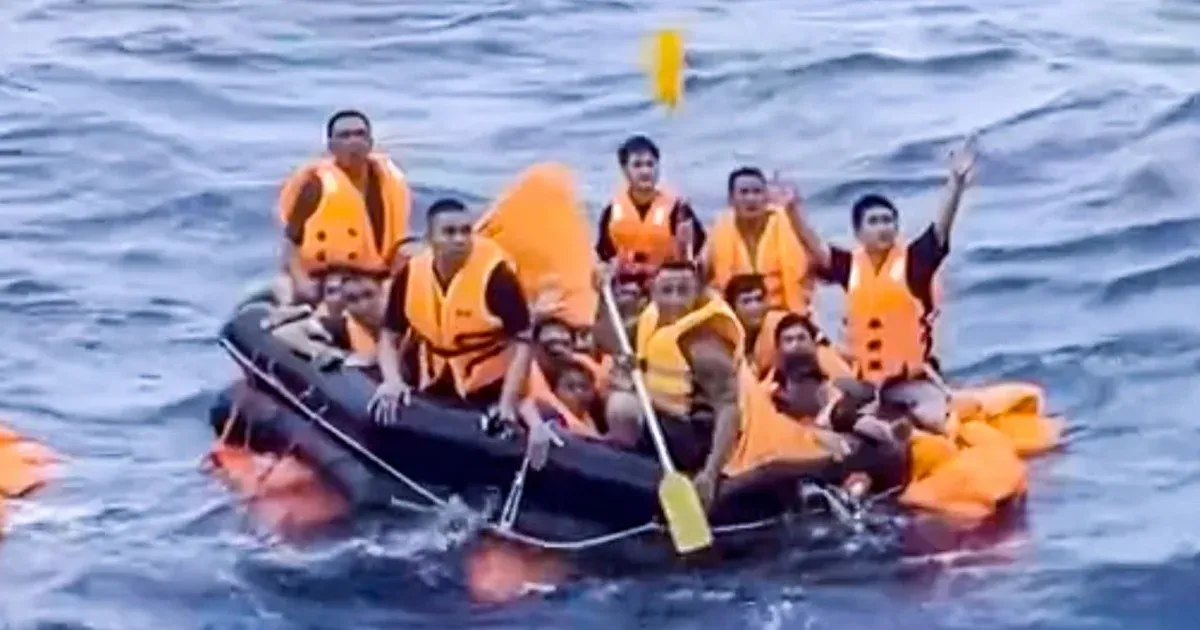
Rescue teams were searching the South China Sea for 17 crew members after a Vietnamese cargo ship sank near Fiery Cross Reef. Forty-five of the 62 people aboard the Khoi Nguyen 18 had been brought to safety by Sunday afternoon, according to Chinese state media and Vietnam's Foreign Ministry.
The vessel ran into trouble on the evening of July 25, 2026, while operating in bad weather. All of those aboard were Vietnamese nationals. The Vietnam-registered ship measured just under 70 meters, or about 230 feet, according to information carried by China's Xinhua news agency. Neither of the two published accounts identified its cargo or destination.
The rescue began shortly before 6:30 p.m. Beijing time, when the Chinese salvage vessel Nanhai Jiu 115 detected what appeared to be a distress signal. Roughly half an hour later, its crew reached a life raft carrying 29 people. That first recovery accounted for nearly half of everyone who had been on the freighter and gave search teams an early confirmed survivor group.
Other Chinese vessels later found a second raft with seven people. A helicopter lifted two more survivors the following morning. Those reported recoveries explain how 38 people reached safety, while the official total stood at 45. The accounts did not describe where or when the other seven survivors were found, so the broader number cannot be turned into a more precise timeline.
Ships and a Helicopter Widen the Search Area
Six Chinese vessels, a Chinese rescue helicopter and a Vietnamese vessel were involved in the operation. Vietnam also said ships already near the area were assisting, while fishing boats continued looking for the missing crew. The mix of surface ships and air support gives coordinators different ways to cover rafts, debris and people who may no longer be in one place.
The helicopter extended the search beyond what crews could inspect from a ship's deck, while the vessels could remain in the area and recover people directly from the water. The reports did not publish a formal search boundary or say how the assets divided the zone. They did establish that the response continued through the night and into Sunday rather than ending after the two rafts were located.
Weather remained the largest stated operational constraint. CCTV reported that changing sea and weather conditions were making the work more difficult during the height of typhoon season. The available accounts did not identify a mechanical failure, collision or cargo problem. Bad weather was the only explanation publicly given for why the vessel went down.
Vietnam's Foreign Ministry said the ship “sank while operating in bad weather.”
The accident occurred near Yongshu Reef, China's name for the feature widely known as Fiery Cross Reef. It is part of the disputed Spratly Islands, where overlapping territorial claims have made the surrounding waters politically sensitive. China, Vietnam, the Philippines, Malaysia, Brunei and Taiwan claim all or parts of the wider South China Sea. A 2016 international tribunal rejected the legal basis for China's broad claims, a ruling Beijing does not accept. Those disputes explain the geographic sensitivity but not the cause of this sinking. In this operation, the reports described Chinese and Vietnamese assets working on the same rescue problem.
Weather and Asset Coverage Define the Remaining Rescue Window
The first distress signal produced a large recovery within about 30 minutes, but finding the remaining crew is a different task. The two known rafts were not recovered together, and the published sequence already stretched from Saturday evening into the following morning. Each passing period of rough weather can widen the area that ships and aircraft must examine, even when the last known position is clear.
The confirmed total creates a strict accounting line for coordinators: 45 people are safe, 17 are still unaccounted for and the crew list totals 62. It also prevents the rescue narrative from outrunning the evidence. A large majority survived, but that success does not resolve the fate of those still missing. No end time had been announced, and the published missing-person count remained unchanged. Until teams find them or establish what happened, the operation remains governed by search coverage, visibility and sea conditions rather than by the contested map beneath the vessels.