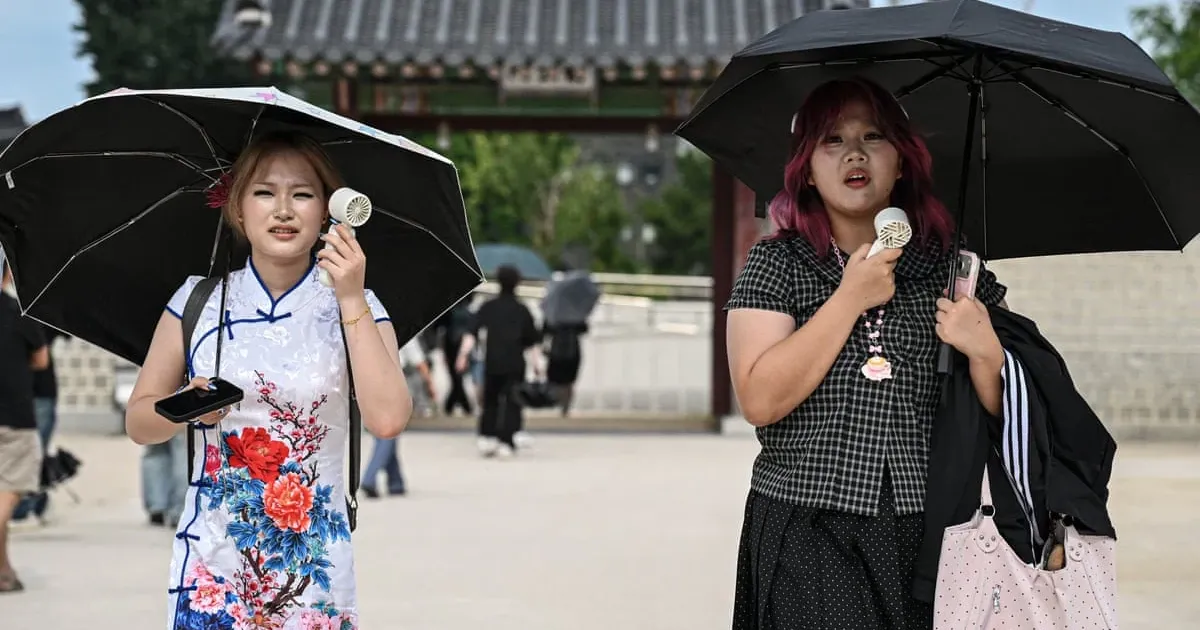
South Korea has moved from routine heat advice to emergency restrictions after a southeastern city recorded the highest temperature in the country's modern observation history. The warning covered outdoor activity, indoor spaces without cooling and the need to reach designated relief sites rather than simply endure the afternoon heat. It arrived as several major cities were already experiencing temperatures in the high 30s.
On August 2, 2026, the Korea Meteorological Administration measured 42.5C in Yangsan, surpassing every national reading since systematic weather observation began in 1904. Yangsan had already spent four consecutive days above 40C, and Sunday's reading extended that run to five. Daegu and Busan were also caught in the same regional heat, although their readings remained below Yangsan's record. Their lower readings still put them near the 39C actual-temperature trigger used for an emergency alert. Because KMA's comparison reaches back to 1904, Yangsan's measurement resets a national benchmark built across 122 years rather than only topping a recent series.
South Korea activated its strongest heat warning across more than 20 localities. Officials created the category this year as higher temperatures demanded a more direct response. Officials can activate it on either of two forecasts: 38C on the perceived scale or 39C on the thermometer. The two-part rule allows an emergency declaration when either the measured heat or the conditions people are expected to experience cross the specified level.
Warnings Shifted Heat Policy Into Immediate Action
The weather agency told people in affected districts to stop outdoor activity immediately. It directed residents toward designated cooling centres or shaded areas, advised them to drink water while resting and warned that rooms without air conditioning could themselves become dangerous. The instruction did not leave residents to infer what an emergency alert meant; it named both the risky settings and the safer places available.
Residents were already changing how they used the city. Air-conditioned shopping centres and cafes became temporary refuges, including for families who had abandoned outdoor plans. Ju Dong-yeol, a 27-year-old office worker, went to a Seoul cafe with his parents because remaining outside no longer offered a workable way to spend the day. He described cooled homes, malls and cafes as the only realistic choices. His account placed the official warning in an ordinary household decision rather than an abstract national statistic.
Professional sport supplied a second operational signal. At 39.5C, Changwon lost another scheduled professional baseball game, following a cancellation the day before. League officials kept play suspended because the continuing severe warning put both spectators and players at risk. Repeating the cancellation on consecutive days showed that the response was tied to continuing local conditions, not only to Yangsan's one national record.
The record sits within a longer rise in dangerous heat. KMA data show that South Korea averaged 19 heatwave days a year over the past five years, more than double the previous annual level cited by the agency. Its statistical definition begins when the daily maximum reaches 33C, well below the temperatures that activated Sunday's emergency category. The comparison matters because the record followed several years in which extreme days had already become more common, rather than appearing as an isolated reading outside the recent trend. Scientists link the growing frequency and intensity of heatwaves to human-driven climate change. A second influence is El Nino, which has returned to raise Pacific surface warmth. The cycle usually appears at intervals of two to seven years. The two influences operate on different timescales, but both form part of the conditions surrounding the current heat.
Clear Thresholds Now Carry the Public-Safety Load
The temperature levels serve different jobs. The 33C measure tracks how often heatwave days occur, while the 38C perceived or 39C actual threshold activates the country's strongest alert. Yangsan's 42.5C reading sat beyond both. That gap helps explain why the response reached public movement, access to cooled buildings and scheduled events instead of stopping at a general request for caution.
The cancelled baseball games also show why local readings matter alongside national records. A countrywide figure describes the scale of the heat, but municipal alerts determine where activity stops and which cooling options residents need. Five straight days above 40C in Yangsan make duration part of the safety problem as well as peak temperature. The response therefore depends on repeating clear instructions and maintaining access to cooled places for as long as the dangerous readings persist.