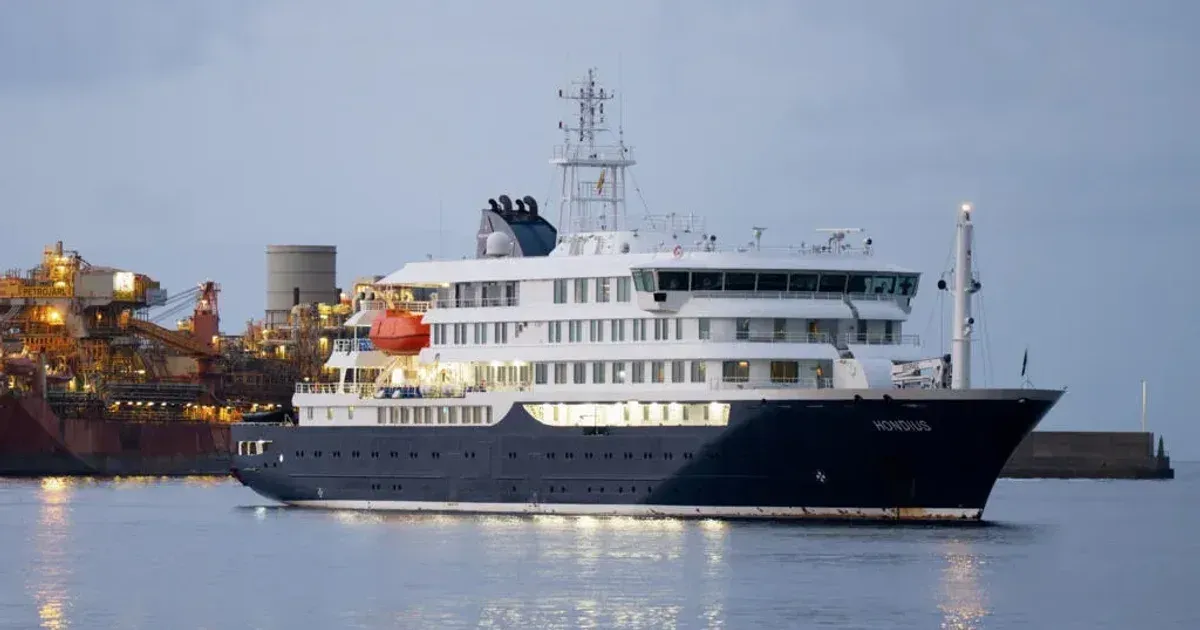
Spanish health officials initiated a high-stakes quarantine operation early Sunday morning. The arrival of the cruise vessel at Santa Cruz de Tenerife triggered a military-style mobilization of emergency services. Medical teams were positioned on the docks to manage the 147 passengers and crew members remaining on board. Records indicate the vessel reached the Canary Islands on May 10, 2026, after an emergency transit from Cape Verde. Spanish authorities now have to manage a viral outbreak as both a shipboard health incident and a test of medical, transport and quarantine responsibilities.
Three people died during the voyage. Several other individuals on the ship fell ill, prompting the Spanish Ministry of Health to classify all remaining occupants as high-risk contacts. Logistics for the landing were finalized under tight time constraints as authorities anticipated worsening weather conditions in the region.
MV Hondius, a polar expedition vessel, became the focus of an international health alert after the virus spread among those on board. Reports from Renée Boskaljon in Las Palmas suggest the operation is following a precise, minute-by-minute timeline to minimize contact with the local population. Security cordons were established around the port terminal to prevent unauthorized access while the evacuation takes place.
Logistics of the Tenerife Quarantine Operation
Spanish medical personnel are overseeing the complex process of offloading everyone from the vessel. Each passenger will undergo rigorous screening before being transported to designated facilities. Officials intend to repatriate most of the foreign nationals to their respective countries via chartered flights. This logistical feat requires coordination between the Spanish military, regional health departments, and international embassies.
National police units secured the perimeter of the docking area to maintain a sterile environment. Ambulances and specialized transport vehicles were staged in rows near the gangway to enable rapid movement. Spanish health officials described the situation as a controlled but high-priority evacuation. Medical staff wearing full protective gear entered the ship to assess the stable passengers before the first group moved toward the dock.
Timing remains critical due to approaching maritime weather shifts.
Local authorities in Santa Cruz de Tenerife have cleared specific roads to ensure the transport of passengers to the airport happens without delay. Personnel from the Red Cross and civil protection agencies provided support for the operation, which spans multiple government departments. Sources in Tenerife indicate the evacuation will continue through the night until the ship is entirely cleared of non-essential crew.
Viral Transmission and Public Health Containment
Hantavirus is a severe respiratory disease that typically spreads through contact with infected rodents. While the virus is usually transmitted through the inhalation of dust contaminated with rodent urine or droppings, rare cases of human-to-human transmission have occurred in past outbreaks. Spanish investigators are now working to determine how the pathogen entered the MV Hondius during its itinerary.
Recent data from the World Health Organization suggests that certain strains of the virus, particularly those found in South America, show a higher tendency for person-to-person spread. Officials have not yet confirmed the specific strain involved in the Tenerife incident. Cases involving cruise ships are particularly difficult to manage because of the enclosed environments and shared ventilation systems.
Isolation is the only effective method for preventing further spread.
The uncertainty around the exact exposure route is why authorities are treating the operation with unusual caution. Hantavirus outbreaks are not managed like ordinary respiratory clusters, and officials have to account for the ship's enclosed spaces, shared systems and the possibility that passengers were exposed at different points during the voyage.
Laboratory teams in Madrid are currently analyzing samples taken from the deceased to confirm the viral footprint. Public health experts note that the incubation period for hantavirus can range from one to eight weeks, making the monitoring of the 147 contacts a long-term commitment. Spain continues to follow established maritime health protocols to ensure the virus does not reach the mainland or the broader Canary Islands archipelago.
Containment Test for Tenerife
The Canary Islands function as a critical gateway between Africa, Europe, and the Americas, making the arrival of a vessel carrying a serious infectious-risk event a matter of extreme sensitivity. For the Spanish government, the management of the MV Hondius is a test of its rapid response capabilities in a high-traffic maritime hub. Any failure to contain the virus within the port perimeter could have immediate consequences for the tourism-dependent economy of Tenerife. Local officials are balancing the humanitarian need to evacuate the ship with the absolute necessity of protecting the permanent population.
Neighboring countries are watching the Tenerife operation closely, as many of the passengers are European citizens slated for immediate repatriation. This incident highlights the vulnerabilities inherent in long-distance expedition cruising, where medical facilities are limited and help is often days away. Spanish investigators will likely focus on the ship’s stop in Cape Verde to identify the point of origin. Success in this operation will be measured by the prevention of secondary infections on Spanish soil and the safe return of the survivors to their home nations.
Health officials will begin the complex process of evacuating passengers and most crew members while keeping each national group inside a documented chain of medical custody. The success of the operation will depend less on speed alone than on whether every transfer, sample, symptom check and flight manifest can be verified after the ship is emptied.