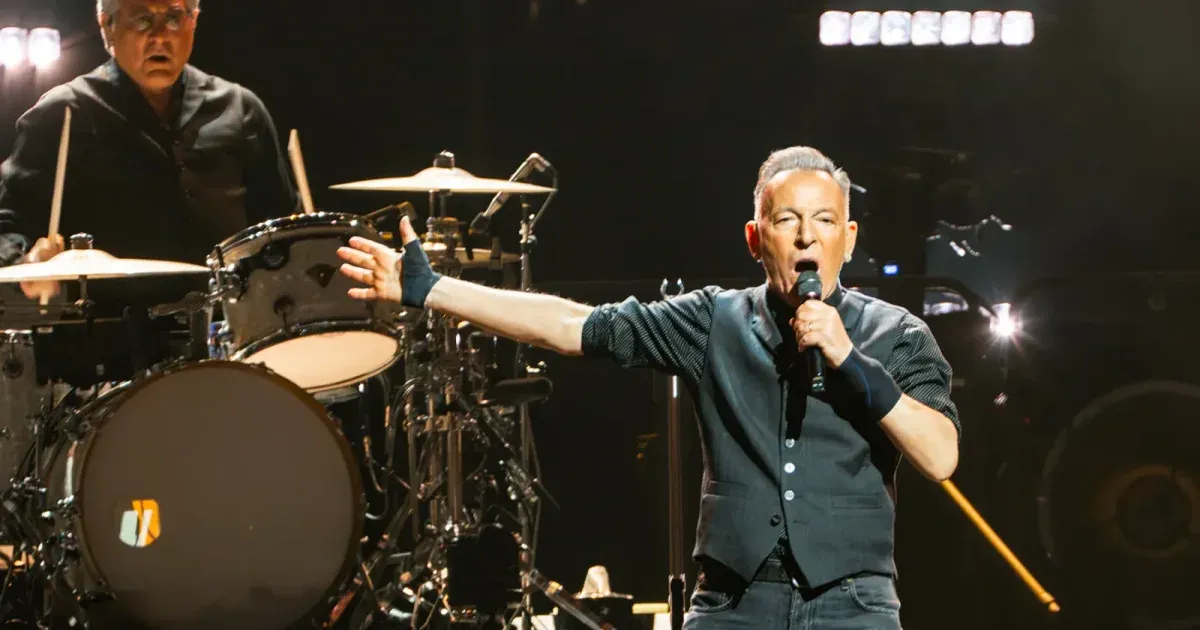
Bruce Springsteen launched his 2026 world tour in Minneapolis by condemning the administration of President Donald Trump before a sold-out audience. On April 1, 2026, his performance arrived at a moment of intense legal friction as the Supreme Court prepares to rule on the executive branch's attempt to eliminate birthright citizenship. Rolling Stone reported that the administration aims to dismantle protections for children born on American soil to non-citizens. These legal maneuvers seek to reinterpret the Fourteenth Amendment which has long been the foundation for American identity since the post-Civil War era. Springsteen used his first night back on stage to address these policy shifts directly through a setlist designed for confrontation.
Bruce Springsteen Attacks Administration in Minneapolis
He opened the show with a visceral declaration of what he termed a war against corruption and incompetence. Fans gathered at the arena heard a blistering critique of current federal leadership. Springsteen described the current state of the nation as one held in the hands of a treasonous administration. He specifically targeted the rhetoric surrounding immigration and the legal challenges facing families across the United States. His voice echoed through the venue as he cataloged the failures he perceives in the executive branch. This specific performance was his first public appearance since the newest immigration filings reached the high court. Fans reacted with a mixture of roars and silence as he transitioned into his most political material.
Critics often suggest that rock stars should avoid partisan debates, but Springsteen has spent decades building a career on the struggles of the working class. He told the Minneapolis crowd that the America he loves acted as a beacon of hope for the world. That image now feels threatened by reckless policies. He argued that the current administration treats the Constitution as a suggestion rather than a mandate. This sentiment connected with the audience during a stripped-down version of his acoustic hits. No one in the building could ignore the weight of his accusations. He moved through the set with a speed that suggested urgency and frustration.
Supreme Court Reviews Birthright Citizenship Challenge
Judges are currently reviewing a bid by the administration to do away with birthright citizenship. Such a move would reverse over a century of legal precedent established by the 1898 case of United States v. Wong Kim Ark. The executive branch claims that the Fourteenth Amendment does not apply to the children of undocumented immigrants. Lawyers for the administration argue that the phrase "subject to the jurisdiction thereof" excludes those whose parents are not citizens. Rolling Stone indicates that the reach of this case extends far beyond simple immigration enforcement.
It threatens who can claim to be an American citizen. A ruling in favor of the president would lead to immediate deportations for thousands of young adults. The recent show in Minneapolis marks a return to the stage for Bruce Springsteen as he blends music with activism.
“The America that I love, that’s been a beacon of hope and liberty around the world, is in the hands of a corrupt, incompetent, racist, reckless, and treasonous administration,” Springsteen said.
Legal analysts suggest that a victory for the administration would create a two-tiered system of residency. Families might be required to produce genealogical proof of their parents' legal status to secure passports or social services. The burden of proof would shift from the state to the individual. Documents from the Justice Department indicate a readiness to implement these changes through executive order if the court permits. This is a serious expansion of executive power over the definition of personhood. Protesters have gathered outside the Supreme Court building for several weeks. Their signs demand that the justices uphold the clear language of the post-war amendments.
Political Consequences for Donald Trump
Republican strategists remain divided on whether the attack on birthright citizenship will help or hurt in the next election cycle. Some believe it motivates the core base of voters who prioritize border security. Others worry it alienates suburban voters who view the move as an overreach of federal authority. Donald Trump has consistently made the removal of birthright citizenship a central foundation of his platform. He claims the policy acts as a magnet for illegal migration. Public polling shows that a slight majority of Americans support maintaining the current interpretation of the Fourteenth Amendment. The rift is growing wider as the 2026 midterm elections approach. Candidates in swing states are already being asked to clarify their positions on the matter.
Springsteen’s tour opener provides a cultural trigger point for these political anxieties. Musicians have often been at the forefront of social movements, and Springsteen is using his platform to organize opposition. He mentioned during the concert that the values of the country are being tested by a leadership that lacks a moral compass. His fans, many of whom come from the very industrial towns the administration targets, are now forced to choose between their musical hero and their political affiliations. Data from recent rallies suggests that the electorate is becoming increasingly polarized by these specific legal debates. Every song in the Minneapolis setlist was a reminder of the stakes involved. The atmosphere was charged with a sense of impending change.
Fourteenth Amendment Protections Under Judicial Scrutiny
Constitutional scholars maintain that the text of the Fourteenth Amendment is unambiguous regarding birthright. It states that all persons born or naturalized in the United States are citizens of the United States. Reinterpreting this clause would require the court to ignore decades of settled law. Some conservative jurists argue that the original intent was much narrower than modern application. They believe the amendment was meant solely to protect formerly enslaved people. However, the 1898 ruling broadened that scope sharply. The current challenge seeks to revert to a pre-1898 understanding of national belonging.
The legal theory has gained traction within specific segments of the federal judiciary. Lawyers representing the administration have filed hundreds of pages of historical analysis to support their claim.
History shows that attempts to restrict citizenship often lead to long-term social unrest. The administration, however, insists that its plan is necessary for national security. Officials argue that birthright citizenship is an outdated concept that encourages legal bypasses. They want to align American policy with that of most European nations. Most democracies do not grant citizenship based solely on the location of birth. The United States is one of the few countries that maintain such a broad standard. The uniqueness is what Springsteen referred to when he spoke of a beacon of hope.
Changing this policy would align the nation with more restrictive global norms. The outcome of the case will determine the fate of $11 billion in annual tax contributions from the families affected.