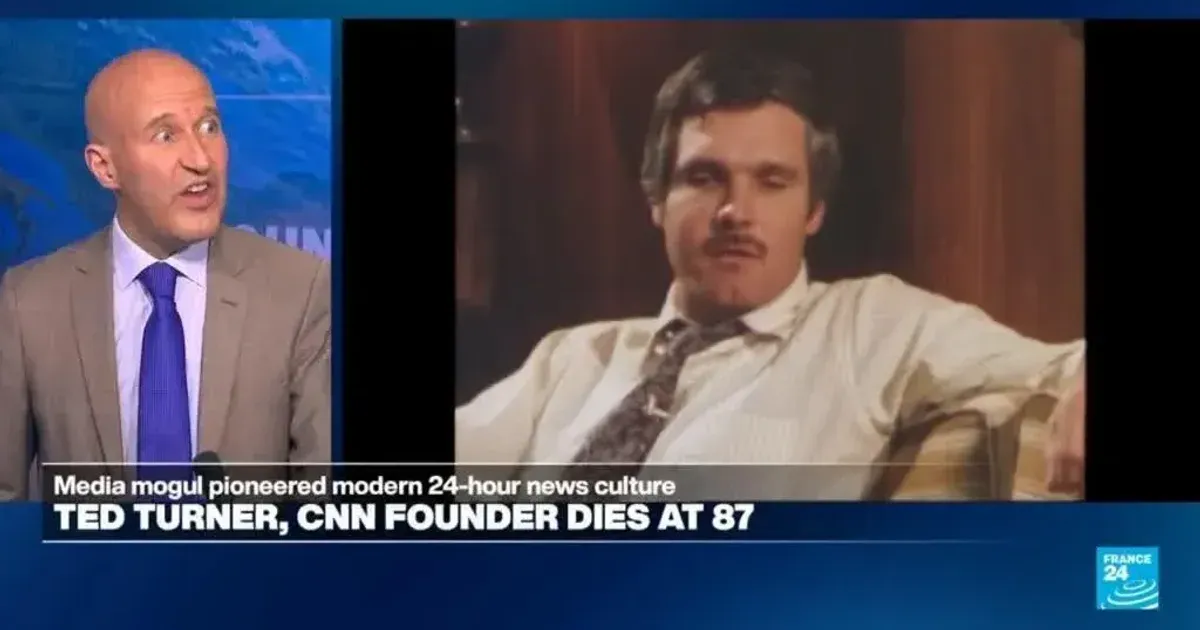
Ted Turner's death brings one of television's most disruptive media careers back into focus. His influence reached news, cable distribution, sports and environmental philanthropy. Turner changed how audiences expected live global events to reach them. The announcement on May 7, 2026, immediately drew attention to CNN's role in making 24-hour news a normal part of public life. Ted Turner, the media entrepreneur who founded CNN and changed the pace of television news, has died at 87. International outlets including the BBC, Al Jazeera, DW and France 24 reported his death on Wednesday, marking the end of a career that moved from billboards and local television to global cable news, sports, film libraries and philanthropy. Turner's legacy is not only CNN. He helped normalize cable as a national force, made sports programming more central to television strategy and used his wealth for public causes that kept him visible long after he stepped away from daily management.
Turner's importance rests on a simple but radical idea: news did not have to wait for the evening broadcast. Before CNN, the American television news schedule was largely built around fixed network bulletins. Turner believed cable and satellite distribution could support a channel that treated news as a continuous public service and commercial product. The industry doubted him, then spent decades adapting to the model he forced into existence, first on cable and later across digital platforms.
Building the CNN Model
Turner inherited and expanded his family's outdoor advertising business before moving into television. In 1970, he bought a struggling Atlanta UHF station that became WTCG, later WTBS. The station's use of satellite distribution turned it into a national "superstation," showing how a local broadcaster could reach cable systems far beyond its original market.
CNN launched on June 1, 1980, with a format many competitors treated as unrealistic. The channel had limited resources, a young staff and no guarantee that audiences would watch news outside the traditional evening window. Turner accepted those constraints because he saw cable not as a supplement to broadcast television, but as a new infrastructure for national and international attention.
The 1991 Gulf War proved the force of that decision. CNN's live coverage from Baghdad gave viewers a direct window into a major international conflict and made the network central to the global news conversation. The phrase "CNN effect" later became shorthand for the pressure real-time coverage could place on governments, militaries and diplomats. Turner did not invent public urgency, but he built one of the platforms that made it constant.
That legacy is complicated. Continuous news expanded access to information, but it also increased pressure for speed, spectacle and permanent reaction. Turner's model helped create the environment in which political leaders, markets and audiences expect immediate updates. The modern information cycle, including digital news and live streaming, still carries the imprint of his original bet.
From Superstation to Media Empire
Turner's ambitions were never limited to CNN. He owned the Atlanta Braves and Atlanta Hawks, using sports programming to strengthen his cable outlets. He also acquired the MGM film library in 1986, a deal that helped support later Turner brands including Turner Classic Movies and Cartoon Network. The strategy was clear: control distinctive content, then use cable distribution to make it national.
His business style was aggressive, theatrical and often risky. Critics saw him as impulsive; supporters saw him as willing to move before established companies understood the shift in distribution. Both readings contain truth. Turner made large, sometimes messy bets, but his larger insight was correct: cable television could break the old geography of media markets.
The 1996 Time Warner merger reduced Turner's direct control over the company he built, and later corporate changes pushed him further from daily operations. Even so, the Turner name remained attached to a set of brands that shaped how audiences consumed news, sports, film and animation. His influence survived the loss of control because the structures he created had already become part of the media system.
Turner also changed how media companies thought about archives. The MGM library, sports rights and syndicated programming showed that old content could become new cable value if packaged with a strong brand. That lesson now looks obvious in the streaming era, but Turner was applying it when cable still had to prove it could compete with broadcast networks for attention and advertising.
Philanthropy and Later Legacy
Turner's later years were defined by philanthropy as well as media history. In 1997, he pledged $1 billion to United Nations causes, a gift that helped create the United Nations Foundation. The donation focused attention on global health, climate, women's rights and international cooperation, and it placed Turner among the most visible corporate philanthropists of his generation.
He was also known for environmental conservation and large land holdings in the United States. Those interests fit a broader pattern in his public life: Turner liked scale. He built national television distribution from a local station, turned a news channel into a global institution and made philanthropy in a form large enough to change institutional agendas.
Turner disclosed in 2018 that he had been diagnosed with Lewy body dementia, speaking publicly about a condition that affects cognition and movement. His family and the outlets reporting his death did not need to settle his entire legacy in one announcement. The factual record is already substantial: CNN, the superstation model, sports broadcasting, cable film channels, Cartoon Network and the UN Foundation all carry pieces of his career.
The strongest measure of Turner's legacy is that his once-improbable idea became ordinary. News now flows continuously across television, websites, alerts and live feeds. That world has problems Turner did not solve, but it exists partly because he refused to accept that audiences should wait for a scheduled bulletin. His death closes a life, not the debate over what the 24-hour news culture he helped build has done to public life.