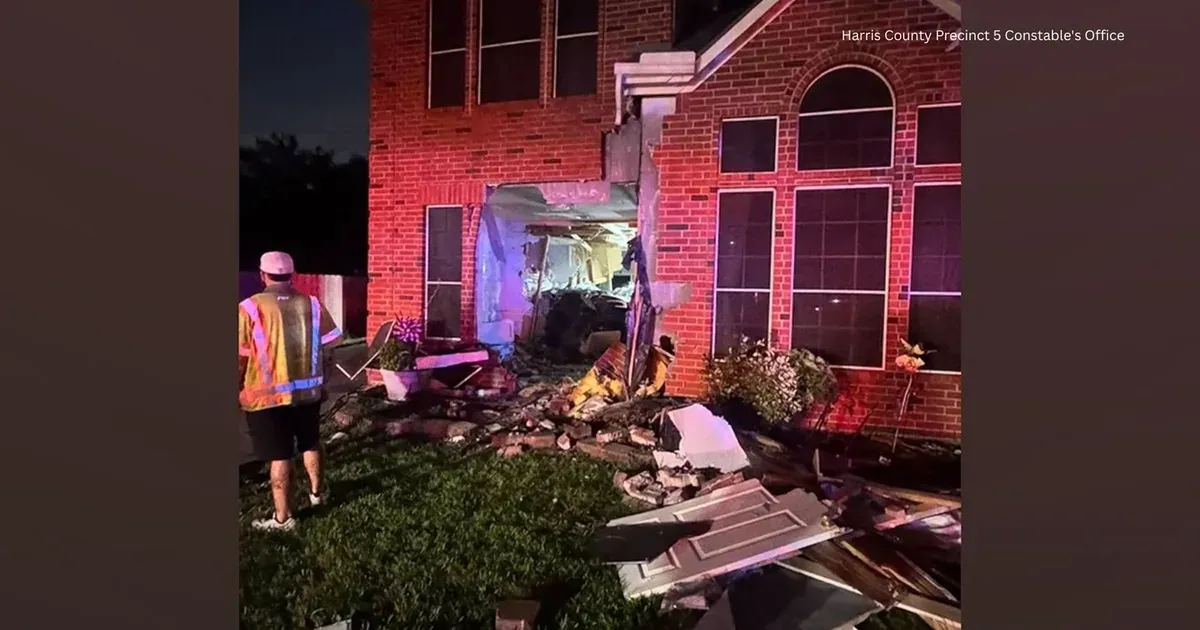
A Tesla crashed into a home in the Katy area near Houston, killing a 76-year-old woman inside and renewing scrutiny of how automated driving assistance is used on ordinary neighborhood roads. The case also adds a local crash record to a national dispute over how drivers understand systems that still require human supervision, especially when the route is outside highway-style conditions.
Investigators said the driver told deputies the vehicle was operating with an automated driving assistance system before it left the roadway and struck the residence. The crash happened on June 20, 2026, around 8 p.m. in Harris County, according to local reports citing sheriff's officials, and it immediately turned a neighborhood crash into a broader safety question.
The Katy-area Tesla crash is not yet a final finding about Autopilot, driver fault or product design. It is a fatal crash investigation in which the driver's statement makes the vehicle's assistance system part of the evidence that authorities must examine.
Investigators Focus on the Vehicle Path
ABC7 reported that Michael Butler was driving a Tesla Model 3 when the car failed to maintain a single lane, left the road and entered the brick home. ABC13 reported that the woman inside the house was taken for medical care and later died, while the driver was also injured and transported to a hospital.
Officials described the investigation as active, with deputies and crash specialists looking at what happened before the car left the lane. That includes the driver's account, the vehicle's data, the physical evidence at the scene and any roadway conditions that could have shaped the crash sequence.
ABC13 quoted a Harris County official saying investigators were still evaluating what caused the car to fail to control its speed before impact. That language matters. A driver's claim that Autopilot was engaged does not by itself prove the system caused the crash, but it does require investigators to test the claim against vehicle logs, roadway conditions and driver behavior.
Automated driving assistance systems are not the same as driverless cars. Tesla's public-facing branding has long created confusion around what the system can and cannot do, while safety officials have repeatedly stressed that the driver remains responsible for supervision. A residential street is also not a controlled highway environment. Driveways, parked vehicles, uneven markings, pedestrians, curves and low-speed turns can expose the gap between assisted driving features and full autonomy.
Autopilot Claims Carry Legal Weight
The crash now sits at the intersection of a local death investigation and a national debate over assisted driving. If the vehicle data confirms the system was engaged, investigators still have to determine whether it behaved as designed, whether the driver misused it or whether both factors contributed.
That distinction will shape any civil or regulatory consequences. A driver who relies too heavily on a driver-assistance feature presents one kind of safety problem. A system that fails to manage a foreseeable road environment presents another. The Katy crash is especially stark because the victim was not a vehicle occupant. She was inside a home, which widens the safety question beyond drivers and passengers to people who have no role in choosing whether a vehicle assistance system is used.
Tesla's robotaxi ambitions show how quickly the company wants to expand automated mobility. Fatal incidents involving assisted driving can affect public trust in those plans even when the technology involved is not the same as a fully driverless service.
What Safety Officials Need to Establish
The key evidence will likely include event data, speed, braking, steering input, driver attention indicators and the exact system state before impact. Investigators also need to know whether the road design, lighting, lane markings or vehicle condition affected the crash sequence. For investigators, the public label on the feature is less important than the actual operating state. They will need to know whether lane keeping, adaptive cruise, driver monitoring or other functions were active, and whether the system issued warnings before impact.
For the public, the lesson should be precise rather than theatrical. This is not proof that all automated driving systems are unsafe, and it is not proof that driver behavior alone explains the death. It is a reminder that partial automation creates a shared-control problem: the car may assist, but the human still has to supervise a moving machine that can injure people far outside the vehicle.
The strategic pressure on Tesla is that every serious crash involving an assistance system becomes part of a larger credibility file. Regulators, courts and consumers will not judge the company's future autonomy claims only by technical demos. They will also look at whether current systems are named, marketed and monitored in ways ordinary drivers understand. A fatal crash through a Texas home gives that question a human cost that no software label can soften.