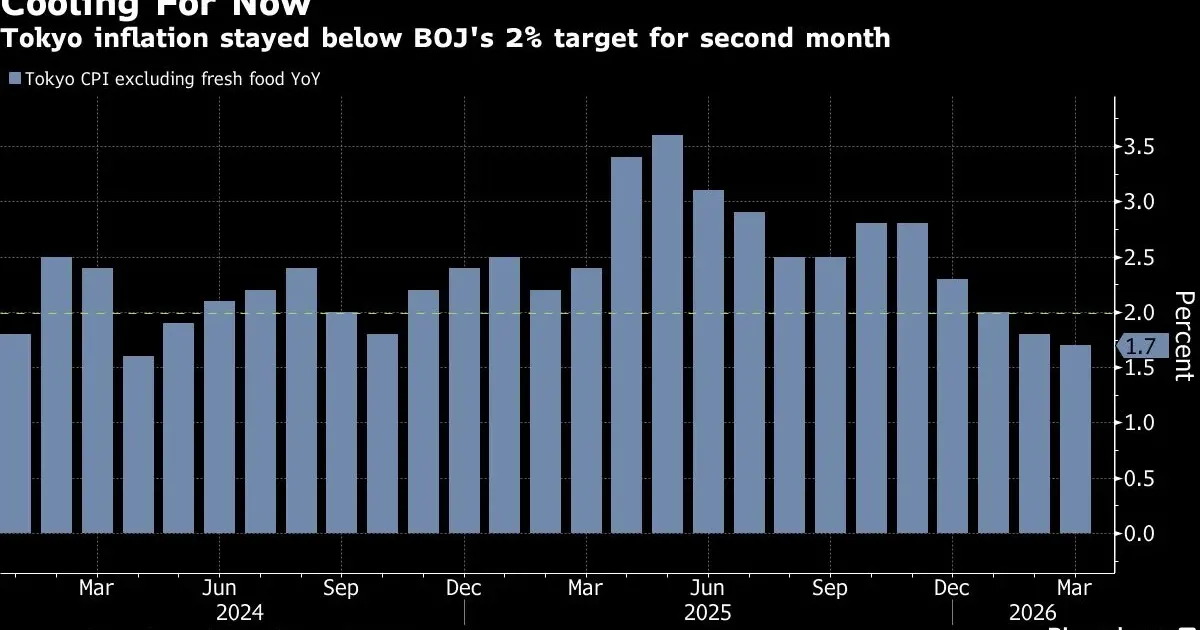
Tokyo consumer prices rose at their slowest pace in nearly two years according to government data released in the capital. Bureaucrats at the Ministry of Internal Affairs and Communications reported that the cooling trend stems primarily from a deceleration in food cost increases. By March 31, 2026, that split between domestic cooling and imported energy risk was central to the policy debate. While the primary headline figure shows signs of moderation, officials at the Bank of Japan remain focused on external inflationary pressures. Iranian military actions in the Middle East have created a volatile environment for global energy markets. Policymakers now face a divergence between domestic price cooling and the rising cost of imported fuel.
Latest figures indicate that the consumer price index for the capital, which is a leading indicator for national trends, moved closer to the official 2% target. Fresh food prices, a volatile component of the basket, showed marked stabilization compared to the aggressive spikes recorded throughout 2024 and 2025. This moderation provides some relief to Japanese households that have struggled with declining real wages for several years. Energy costs, however, tell a different story as geopolitical tensions escalate.
Iranian conflict dynamics are now the primary concern for central bankers in Tokyo. Global oil benchmarks have surged as traders weigh the possibility of supply disruptions in the Strait of Hormuz. Because Japan imports nearly all its fossil fuel requirements, any sustained increase in crude prices flows directly into domestic utility bills and transportation costs. Governor Kazuo Ueda must determine if this energy-driven inflation warrants further adjustments to the short-term interest rate. Current data suggest the underlying inflationary pressure from domestic demand is softer than initially projected.
Energy Markets and Iranian Conflict Impact
Petroleum and liquefied natural gas imports remain the structural weakness of the Japanese economy. Escalation in Iran has already triggered a risk premium in the energy markets, which often takes several weeks to reflect in consumer-facing utility rates. Analysts at major brokerage houses note that the current cooling in Tokyo prices may be a temporary phenomenon. Sustained military action in the Persian Gulf could easily reverse the progress made on price stability. Japanese manufacturers are particularly sensitive to these shifts, as higher input costs squeeze profit margins in a competitive global landscape.
"Tokyo inflation cooled to its slowest pace in nearly two years as gains in food costs continued to slow," according to a Bloomberg Economics report released on March 31, 2026.
Refining companies in Japan have begun to adjust their procurement strategies to reduce the risks associated with the Middle East. Shipping lanes have become more expensive to insure, adding a layer of hidden costs to every barrel of oil that reaches Japanese shores. These logistical expenses eventually reach the end consumer through higher prices for manufactured goods and services. While the current CPI data looks favorable, the progressive indicators for energy imports are flashing red. Economists expect the headline inflation rate to bottom out before climbing again in the third-quarter of the year.
Bank of Japan Policy Under Kazuo Ueda
Governor Kazuo Ueda faces a delicate balancing act as he navigates the first notable shift in Japanese monetary policy in a generation. Moving away from the negative interest rate regime was the first step, but the path toward normalization remains full of difficulty. The central bank has signaled a desire to see a virtuous cycle of wage growth and price increases. Slower inflation in Tokyo might suggest that the window for aggressive rate hikes is closing. By contrast, the threat of cost-push inflation from energy sources could force the bank to act to protect the yen. A weak yen makes energy imports even more expensive, creating a dangerous feedback loop for the national economy. Rising tensions and Iranian military actions have shaped global supply chains and energy security.
Monetary policy committees in Japan have historically been cautious about raising rates during periods of global uncertainty. Internal debates at the bank likely center on whether the current inflation is truly sustainable or merely a product of temporary supply shocks. If the bank raises rates too quickly, it risks stifling a fragile domestic recovery. If it waits too long, the currency could depreciate further against the dollar and the euro. Recent communications from the bank suggest a preference for data-dependent approach that prioritizes long-term stability over short-term market reactions.
Market participants are closely watching the results of annual spring wage negotiations, known as the Shunto. Strong wage growth would provide the Bank of Japan with the justification needed to continue its tightening cycle despite the cooling CPI. Without clear pay raises for workers, the cooling prices in Tokyo might signal a return to the stagnant demands that plagued Japan for decades. The intersection of domestic labor trends and international energy shocks defines the current policy dilemma. No clear consensus has emerged among the board members regarding the timing of the next rate adjustment.
Food Price Normalization and Consumer Sentiment
Processors of wheat, soy, and dairy have finally begun to pass on lower wholesale costs to the public. For the past eighteen months, food was the primary driver of inflation in the Tokyo metropolitan area. Supply-chain improvements and a stabilization in global commodity prices have allowed retailers to slow the pace of price hikes. Supermarket data shows that consumers are still price-sensitive, often opting for private-label brands over premium alternatives. This behavior suggests that while the rate of inflation is slowing, the absolute price level remains a burden for many residents.
Dining out and service-related costs have also shown signs of plateauing. The tourism boom in Japan has supported prices in the hospitality sector, but the broader service economy is not seeing the same level of momentum. Employment data indicates a tight labor market, yet this has not translated into the kind of runaway service inflation seen in the United States or the United Kingdom. Japan remains an outlier in the global inflationary context. The cultural expectation of price stability continues to influence how firms set their annual targets.
Retailers in the capital are bracing for the impact of higher electricity rates scheduled for the coming months. Even if food prices stay flat, the rising cost of keeping the lights on will eat into discretionary spending. Consumer confidence surveys reflect a cautious optimism that is easily undermined by news of regional conflict. The psychological impact of the war in Iran cannot be ignored by economists trying to forecast Japanese spending patterns. Fear of a broader conflict often leads to increased household savings and decreased consumption. This contraction in demand would further complicate the central bank's efforts to maintain the 2% inflation target through organic growth.
BOJ Inflation Test
Reliance on energy imports has long been the Achilles heel of the Japanese economy. The latest data from Tokyo provides a deceptive sense of calm that masks a brewing storm in the Middle East. While the central bank may celebrate a cooling CPI in the short term, they are essentially walking into a geopolitical trap. Governor Kazuo Ueda is attempting to normalize policy based on domestic variables that are increasingly irrelevant in a world where energy is used as a weapon of war. The idea that Japan can achieve a stable, wage-driven inflation cycle while Iran threatens the world's most essential oil transit point is a fantasy.
The Bank of Japan must stop pretending that it can control the domestic price level through incremental interest rate adjustments. If energy prices spike due to military escalation, the yen will collapse regardless of what the central bank does with its short-term rate. We are looking at a scenario where the BOJ is forced to hike rates into a recession simply to stop the currency from becoming worthless. It is not the virtuous cycle the planners in Tokyo envisioned. It is a desperate defensive maneuver.
The leadership in Tokyo lacks the strategic flexibility to handle a dual shock of domestic cooling and international energy spikes. A policy failure is not just possible; it is probable. Brace for the yen to test new lows as the reality of the Iranian conflict sets in. The central bank is out of options.