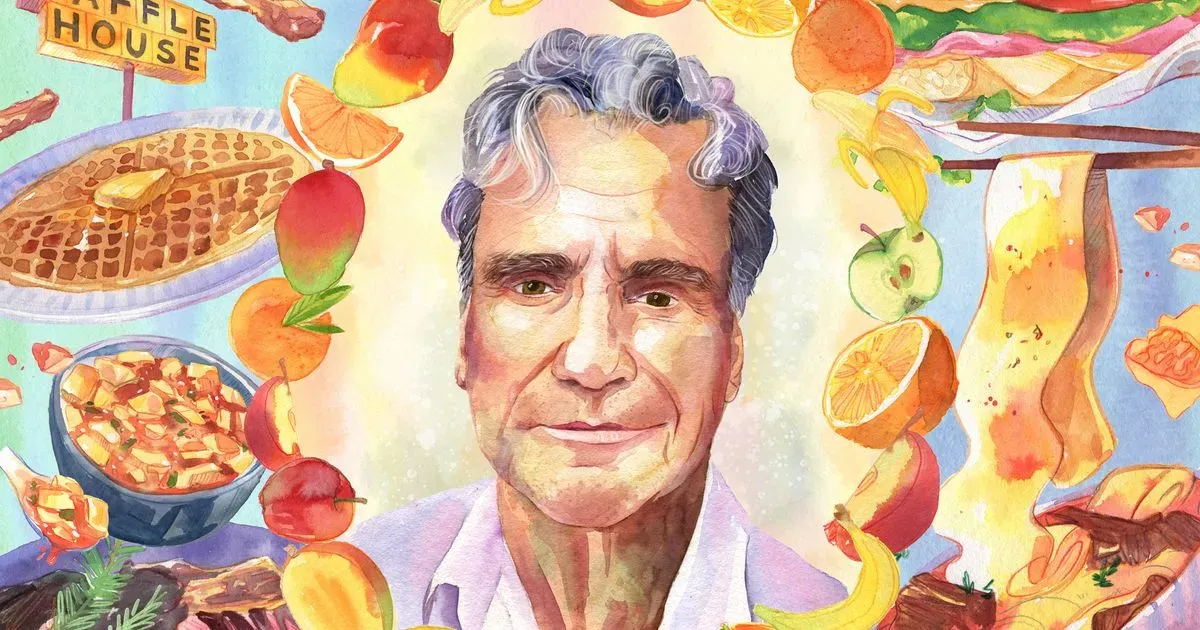
Tom Junod remembers the precise weight of his father’s reputation in the kitchen, a legacy built not on professional accolades but on the singular, aromatic power of a family tradition. Lou Junod was a man whose identity in the domestic sphere was inseparable from his signature spaghetti and clam sauce. Within the Junod household, the preparation of this dish was treated with the reverence of a high-stakes performance. Friends and family would gather, whispering about whether today would be the day they finally tasted the legendary sauce, a mixture that seemingly defined the culinary boundaries of Tom’s childhood. It was a time when food was an event, a celebration of technique and paternal pride that left an indelible mark on the young writer.
The Culinary Inheritance of a Master Stylist
Lou Junod’s spaghetti and clam sauce functioned as a rite of passage for those entering the family’s social circle. Tom Junod describes the experience with a mix of nostalgia and analytical detachment, noting how the phrase "Dad is making his sauce" carried the pressure of a royal proclamation. Such a upbringing instilled a deep appreciation for the rituals of the table, though the son’s path eventually led him away from the labor-intensive stovetop toward the predictable, rhythmic efficiency of the American diner. The transition from the intricate, home-cooked meals of his youth to the utilitarian grease of a commercial griddle is peculiar evolution in his personal gastronomy. Lou Junod remained famous for that one dish until the end of his days.
Journalistic rigor often requires a certain degree of anonymity, a need to disappear into the background to observe the world without the interference of one's own celebrity. Junod, a writer known for his penetrating profiles of figures like Fred Rogers and his evocative essays for Esquire, has found this necessary stillness in an unlikely location. The yellow-and-black signage of the Waffle House has become his sanctuary. It is a space where the complexities of his father’s kitchen are replaced by a limited menu and a standardized service model that has barely changed since the mid-twentieth century. He has become a regular, a fixture at the counter where the staff knows his order and his presence is part of the morning furniture. Most patrons do not recognize the man who once humanized the most beloved figures in American media.
Anatomy of the Waffle House Ritual
Waffle House operates as a 24-hour theater of the mundane, a place where the social hierarchies of the outside world are flattened by the shared experience of hashbrowns and high-fructose corn syrup. For a writer who has spent decades dissecting the nuances of American culture, the diner offers a relief from the burden of interpretation. Everything is visible, from the open kitchen where short-order cooks flip eggs with mechanical precision to the jukeboxes that provide a low-fidelity soundtrack to the clink of ceramic mugs. This preference for the mundane over the gourmet suggests a desire for grounding in a profession that often feels increasingly abstract and digital. The restaurant chain operates more than 1,900 locations across 25 states. Each one follows a layout designed to minimize the distance between the grill and the customer.
Standardization is the core appeal of the Waffle House experience. Junod sits on a vinyl stool, surrounded by the smell of clarified butter and the hum of industrial ventilation. He observes the world through the large plate-glass windows that wrap around the building, a vantage point that offers a panoramic view of the American roadside. The menu itself is a document of consistency, offering a limited selection of proteins and starches that are assembled according to a strict code of terminology. To order hashbrowns "scattered, smothered, and covered" is to participate in a linguistic tradition that spans the American South. This ritualized consumption of hashbrowns provides a sense of continuity that high-end dining can rarely replicate. The price of a cup of coffee remains one of the few constants in a volatile economy.
The Intersection of Writing and Regularity
Routine is defense mechanism against the chaos of the creative process. For Junod, the act of returning to the same booth or stool is a way to anchor his day before the demands of his prose take over. He is not looking for a culinary epiphany when he walks through those double doors. Instead, he seeks the comfort of the expected. The Waffle House provides a sensory environment that is both stimulating and predictable, a combination that many writers find conducive to internal reflection. This connection remains the heartbeat of his daily schedule. Critics might find it strange that a man of such literary sophistication spends his time in a place often mocked by the coastal elite, but such a view ignores the fundamental human need for a "third space." The term refers to social surroundings separate from the two usual social environments of home and the workplace.
Lou Junod’s spaghetti and clam sauce was an exercise in uniqueness, a dish that could only be made by one man in one specific way. In contrast, the Waffle House offers the comfort of the universal. A waffle in Georgia tastes identical to a waffle in Ohio, a feat of logistics and training that Junod seems to find deeply reassuring. The culinary lineage, moving from the singular to the mass-produced, reflects a broader shift in how modern Americans relate to their food and their communities. He has traded the pressure of being the son of a famous home cook for the ease of being a nameless regular. The staff at his local branch treat him with a casual familiarity that requires no performance of status. One waitress remembers him simply as the man who reads the newspaper while he eats.
The Social Fabric of the Diner Counter
Diners like Waffle House function as the last vestiges of a truly public square. On any given morning, Junod might sit next to a long-haul trucker, a local politician, or a group of students coming home from a late-night shift. These interactions are brief and surface-level, yet they provide a vital link to the lived reality of his neighbors. That adherence to a specific diner stool is an act of civic participation, however quiet it may be. The writer is not there to interview his companions, though his presence allows him to absorb the cadence of their speech and the concerns of their lives. Such observations often find their way into the subtext of his work, providing a layer of authenticity that cannot be manufactured in a home office. Waffle House reported record revenues in the previous fiscal year despite rising labor costs.
Food in the Junod family was once a marker of prestige and special occasions. The spaghetti and clam sauce was a trophy, a sign that the patriarch was in good spirits and the family was thriving. Today, Junod’s food choices are marked by a deliberate lack of pretense. He finds value in the utilitarian nature of the diner, where the focus is on efficiency and caloric density rather than presentation or provenance. Such a shift does not represent a rejection of his father’s legacy but rather a maturation of his own relationship with the table. He has found a way to honor the memory of the kitchen without being trapped by its expectations. The average time for a Waffle House order to reach the table is under seven minutes.
The Elite Tribune Perspective
Critics who dismiss the American diner as a relic of a bygone, unhealthy era are fundamentally misreading the sociological importance of the griddle. Journalism thrives on the friction of the real world, yet most modern commentators spend their lives behind glass screens in air-conditioned pods, disconnected from the very people they claim to analyze. Tom Junod’s presence at a Waffle House counter is not an act of kitschy slumming or a search for blue-collar street cred. It is a necessary immersion into the only remaining space in American life that refuses to cater to the hyper-fragmented, algorithmic bubbles of the internet. In a Waffle House, you cannot filter out the person sitting next to you based on their political affiliation or tax bracket. You are forced to share the same air, the same grease, and the same mediocre coffee. It is a radical act in an age of total insulation. If more writers abandoned their artisanal sourdough for a plate of scattered hashbrowns, the national discourse might regain some of its lost sanity. The elite’s obsession with culinary purity is a thinly veiled form of class warfare that seeks to pathologize the habits of the working public. Junod understands that the secret to a meaningful life isn't found in a recipe for clam sauce, but in the willingness to sit at a communal counter and wait for the sun to come up.