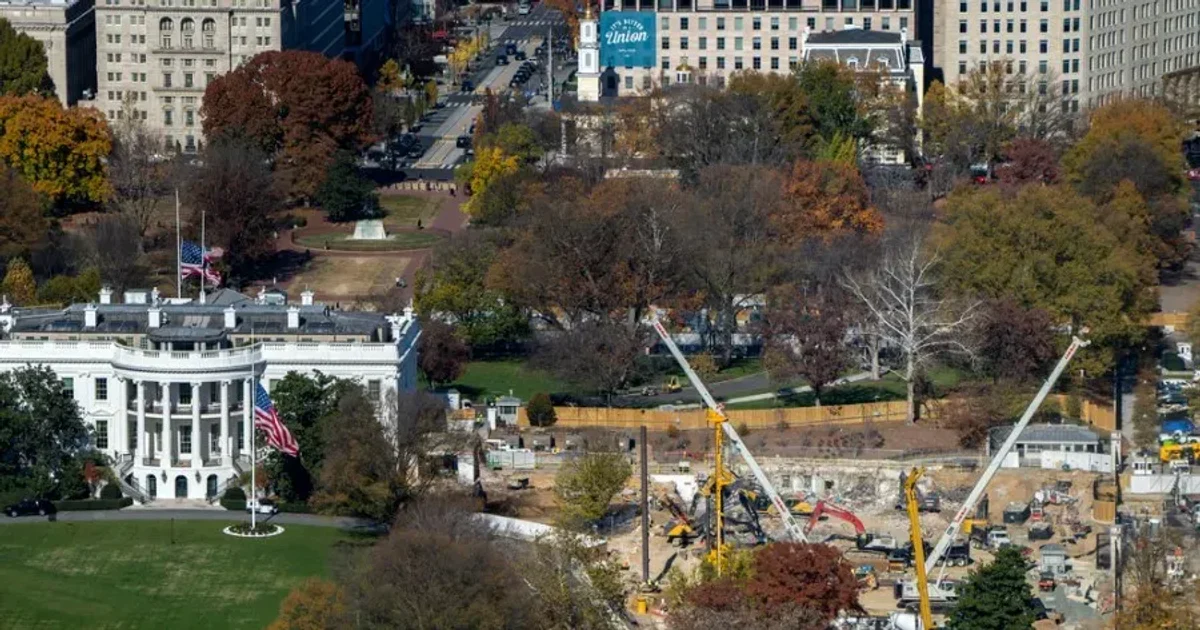
Donald Trump filed an emergency appeal in federal court on April 4, 2026, to prevent a legal injunction from halting the construction of a controversial ballroom at the White House. Lawyers representing the Justice Department submitted the filing after a lower court issued a stay on the multi-million dollar project. Legal filings argue that any delay in the construction schedule presents a direct physical threat to the commander-in-chief. Construction has already cleared large portions of the White House grounds where the former East Wing once stood.
Government attorneys characterized the legal pause as a dangerous intrusion into executive branch safety protocols. Documentation suggests the project serves a dual purpose beyond hosting state dinners and social functions. Beneath the gold-leaf ceilings and expansive dance floor lies a sophisticated military installation. Project managers have described the site as an overhaul of a deep underground facility designed for emergency operations. Delaying the structural completion of the upper floors allegedly compromises the integrity of the subterranean bunker.
Federal Court Battles over Presidential Construction
Judges previously expressed skepticism regarding the necessity of an enormous new ballroom during an active administration. Opponents of the plan argue that the construction destroys the historic fabric of the executive mansion without sufficient oversight. While the Justice Department maintains that the project is essential for modernizing the campus, critics point to the lack of competitive bidding. Federal statutes usually require extensive vetting for any modification to the National Park Service-managed site. Legal experts note that the use of emergency military funds has bypassed several traditional layers of Congressional approval.
Court records indicate that the litigation has entered an accelerated phase. Judges must decide whether the executive branch possesses the unilateral authority to reshape the White House footprint for unspecified security reasons. Previous administrations typically consulted the Commission of Fine Arts before breaking ground on visible exterior changes. This administration has largely ignored those consultative bodies in favor of direct military oversight. Security requirements frequently override transparency in matters involving the continuity of government. Architects familiar with the plans suggest the scale of the ballroom has tripled since the initial design phase. Original drafts showed a modest reception area meant to replace aging temporary structures. Current blueprints reveal a cavernous space capable of holding over one thousand guests. Such a large footprint requires reinforced concrete pilings that reach deep into the Potomac Basin soil. These pilings serve as the main structural support for the military complex buried below the surface.
Military engineers have worked around the clock to excavate the site near the East Wing since early last year. Sources indicate the United States Army Corps of Engineers is leading the development of what insiders call a “super-bunker.” The facility is intended to replace the outdated Presidential Emergency Operations Center. Technicians are installing advanced communication arrays and life-support systems that require a sealed environment. Any opening in the overhead ballroom structure exposes these sensitive systems to environmental degradation and potential surveillance. The Department of Justice continues to push for executive priorities while facing notable internal and external personnel shifts.
“Time is of the essence!” Justice Department lawyers wrote, saying a ruling to pause construction puts the president at risk. Security analysts suggest the bunker provides a level of protection unavailable in existing facilities. High-altitude electromagnetic pulse shielding and bio-chemical filtration units are reportedly part of the underground specifications. Construction crews must finish the ballroom shell to provide the necessary cover for the installation of secret equipment. If the site remains an open pit, foreign intelligence satellites could map the layout of the secure zones. Avoiding such exposure is the main justification for the emergency appeal filed this morning.
Logistical challenges have plagued the site since the first shovel hit the dirt. Trucking specialized materials into a high-security zone requires careful planning and substantial manpower. Contractors have faced multiple delays due to archaeological discoveries and unstable soil conditions. Despite these setbacks, the administration has pushed for a completion date before the next election cycle. Speed has become the defining characteristic of the project management office.
Department of Justice Arguments for National Security
Federal lawyers emphasized that the judiciary lacks the expertise to second-guess presidential security needs. The appeal states that the President of the United States must have a secure location to gather with world leaders. Arguments in the brief suggest that current venues within the mansion are vulnerable to modern eavesdropping technologies. A new, purpose-built structure allows for the integration of technical surveillance counter-measures during the initial build phase. Lawyers contend that retrofitting older rooms is no longer a viable option for the Secret Service.
Private contractors have remained silent about their specific roles in the project due to strict non-disclosure agreements. Public records show that hundreds of millions of dollars have flowed to defense firms specializing in hardened structures. This spending has drawn the ire of budget hawks in the Senate who demand a full accounting of the ballroom costs. Efforts to subpoena the financial records have so far been blocked by executive privilege claims. Transparency remains a distant second to the stated goal of presidential protection.
Military personnel have established a permanent perimeter around the construction zone. Drones and electronic sensors monitor all movement within three hundred yards of the East Wing excavation site. Local residents in the District of Columbia have complained about the noise and the constant vibration from heavy machinery. These grievances have mostly fallen on deaf ears at the Justice Department. National security often acts as a trump card in local zoning and nuisance disputes.
Ballroom Appeal Keeps Executive Power Fight Alive
The ballroom appeal keeps a construction dispute inside a broader executive-power argument. The courts will decide whether the White House can preserve the project while legal challenges continue.