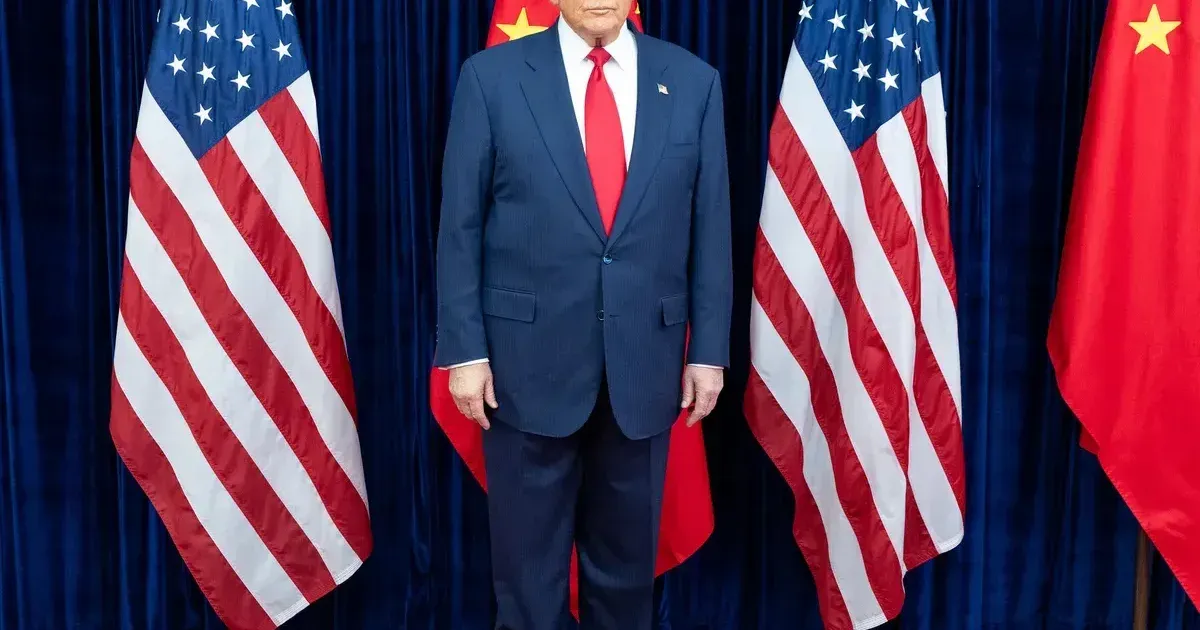
Donald Trump touched down in Beijing on Wednesday evening to initiate a high-stakes summit with Xi Jinping. The trip gives both governments a chance to lower economic tension without pretending the rivalry has disappeared. His arrival on May 13, 2026, represents the first visit by a United States president to the Chinese capital in nearly a decade. Success in these negotiations depends on stabilizing a global power dynamic shaken by the ongoing war in Iran, which has redirected American military resources and diplomatic focus away from the Pacific.
White House officials prepared a delegation heavy on private-sector influence to strengthen the administration's economic leverage. Apple and Tesla both secured seats at the table as Tim Cook and Elon Musk joined the presidential entourage. These executives represent the core of the American manufacturing and technological interface with Chinese markets. Their presence suggests that supply-chain security and market access remain central to the presidential agenda despite broader geopolitical tensions.
Musk, whose interests span from satellite communications to electric vehicle production, faces increasing pressure regarding Tesla’s operations in Shanghai. Simultaneously, Cook must navigate the delicate balance of Apple's reliance on Chinese assembly while Washington pushes for technological decoupling. Beijing remains the primary manufacturing hub for these corporate giants, making their participation in the summit a pragmatic necessity.
Corporate Leaders Anchor Beijing Trade Talks
Trump expressed high expectations for the personal reception he would receive from the Chinese leader during a preview of the trip. Addressing reporters before the flight, he offered a characteristic assessment of the upcoming diplomatic protocol.
“give me a big, fat hug when I get there”
Reports from Beijing indicate that the Chinese government intends to provide a lavish display of pomp and protocol to match the president's affinity for spectacle. Officials in China view these ceremonies as essential for maintaining the appearance of mutual respect between two competing superpowers. Security in the capital has tightened sharply as both leaders prepare for discussions that cover the future of Taiwan and the regulation of artificial intelligence.
Washington has notably shifted its tone regarding trade aggression as the summit approached. This shift reflects a strategic recalibration required by the conflict in the Middle East. While Trump initially planned to implement harsher trade moves against China than any other nation, those ambitions have been scaled back to avoid a dual-front economic and military crisis.
Softened Economic Demands and War Contingencies
National security advisors argue that the United States cannot afford a full-scale trade war while its prestige is challenged by the war in Iran. The goal is now a series of headline-grabbing deals that demonstrate American strength without triggering immediate market collapses. Financial stability in the West depends on avoiding a sudden rupture in the flow of electronics and industrial components from Chinese ports.
Recent data indicates that the administration is prioritizing short-term agricultural and energy purchases over the structural reforms once demanded by trade hawks. Trade representatives have signaled that they will accept increased Chinese commitments to buy American grain and liquefied natural gas in exchange for a delay in new tariff tranches. Beijing remains open to these concessions as it seeks to stimulate its own cooling economy.
Trump also weighed in on his relationship with British Prime Minister Keir Starmer during a podcast preview before the visit. He suggested that London must align more closely with Washington's stance on Taiwan if it expects to benefit from future trade arrangements. The British government, however, has maintained a more cautious approach to the dispute over the island’s sovereignty.
Strategic Focus on Artificial Intelligence and Taiwan
Artificial intelligence is a critical friction point where economic interests and national security overlap. Beijing has invested heavily in sovereign AI capabilities, leading to US restrictions on high-end semiconductor exports. Negotiators hope to establish a basic framework for the ethical use of autonomous systems in military applications to prevent accidental escalation in the South China Sea.
Chinese officials continue to insist that Taiwan is a non-negotiable internal matter. US planners remain concerned that any perceived weakness in Washington’s commitment to Taipei could embolden regional actors. Stability in the Taiwan Strait is a requirement for the continued operation of global shipping lanes that carry trillions of dollars in annual trade.
Future policy directions will likely be determined by the chemistry between the two leaders during private sessions. Strategy documents suggest that the White House is seeking a period of predictable competition rather than open hostility. Diplomacy in the coming days will focus on managing the inevitable frictions that occur between two nations vying for global dominance.
The Beijing Summit Tests US Trade and Security Leverage
How does the administration balance a desire for domestic manufacturing resurgence with the immediate needs of corporate titans like Musk and Cook? The presence of these tech leaders in Beijing suggests a return to a mercantilist diplomacy where corporate interests are leveraged as state assets. By bringing Apple and Tesla into the room, the president is acknowledging that American power is as much about consumer technology and market dominance as it is about carrier strike groups.
This strategy carries substantial risks if China interprets the scaling back of trade threats as a sign of exhaustion from the Iran conflict. A perception of American overextension could lead Xi to push harder on territorial claims in the South China Sea. By contrast, a successful series of high-profile trade agreements could provide the president with the domestic political capital needed to sustain long-term engagements elsewhere.
The ultimate verdict on this summit will not be found in the ceremonial hugs or the length of the red carpets. Instead, it will be measured by whether advanced semiconductor flows and the status of the Taiwan Strait remain stable through the 2026 fiscal year. Strategic patience is the new currency in a Washington stretched thin by global crises.