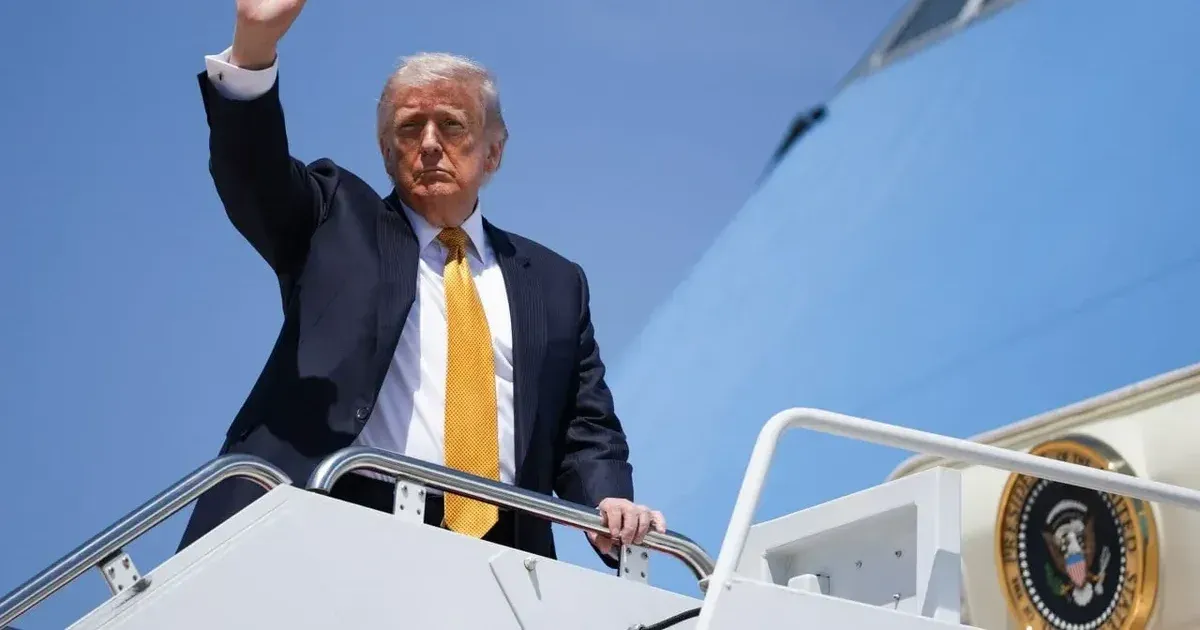
Donald Trump arrived in Beijing on Wednesday for a high-profile summit with Chinese President Xi Jinping. The visit puts commercial access and security bargaining in the same frame. His landing on May 13, 2026, marked the start of a multi-day state visit intended to address trade imbalances and escalating global security concerns. Air Force One touched down following a logistics stop that signaled a last-minute expansion of the presidential inner circle.
Jensen Huang, the chief executive of Nvidia, boarded the presidential aircraft during a refueling stop in Alaska. His late addition to the roster highlights the administration's focus on semiconductor parity and artificial intelligence policy. Trump confirmed the inclusion of the tech mogul on social media, describing the delegation as a group of "brilliant people" capable of renewing international commerce.
Negotiations involving American semiconductor access and the ongoing conflict in the Middle East are the primary friction points between the two superpowers. Trump stated he would immediately pressure his counterpart to lower barriers for US corporations. The visit, characterized by a mix of personal diplomacy and hard-line economic demands, seeks to redefine the terms of engagement for the world's two largest economies.
Jensen Huang Joins Presidential Refueling Stop in Alaska
The sudden addition of Huang to the delegation followed weeks of speculation regarding which technology leaders would participate in the Beijing talks. While the initial manifest included high-profile figures like Elon Musk and Tim Cook, the Nvidia chief executive remained unconfirmed until the Alaska stop. Trump clarified the situation on Truth Social, noting his intent to use the expertise of these executives to influence Chinese market policy.
"I will be asking President Xi, a Leader of extraordinary distinction, to ‘open up’ China so that these brilliant people can work their magic," Trump wrote.
Musk and Cook have maintained solid operations within China for years, navigating complex regulatory environments and supply-chain constraints. Their presence alongside the President suggests a coordinated push to secure more favorable operating conditions. The administration intends to leverage the combined market cap of these technology giants as a bargaining chip in broader trade discussions.
Financial analysts suggest the inclusion of Huang specifically targets the ongoing rivalry in high-end chip manufacturing. Chinese officials have restricted various US tech components in recent years, citing national security concerns. The presence of the world's leading AI chip designer on the presidential plane indicates a direct challenge to those restrictions. Trump maintains that the expertise of the American entourage provides the necessary leverage to extract concessions from the Chinese government.
Beijing Summit Focuses on Trade and Regional Security
Security protocols across the Chinese capital tightened sharply as the presidential motorcade moved toward the Diaoyutai State Guesthouse. Beyond the economic agenda, the summit faces the difficult task of addressing the Iran war and its impact on global shipping lanes. China, a major purchaser of Iranian energy, holds substantial influence over Tehran that Washington hopes to activate to de-escalate the regional conflict.
Diplomatic sources indicate that the Taiwan Strait remains a core topic for the bilateral discussions. Xi has repeatedly stated that Taiwan is a non-negotiable interest, while the Trump administration continues to balance defense support for the island with economic pragmatism. These talks represent the first face-to-face meeting between the leaders in over a year, providing a rare opportunity to address miscommunications that have plagued the relationship.
National security advisors anticipate a series of private working sessions following the formal state dinner. These meetings, which often exclude the broader delegation, typically focus on sensitive intelligence sharing and the establishment of "red lines" regarding military maneuvers. Chinese state media reports have emphasized a desire for stability, though officials in Beijing have yet to offer specific concessions on trade or the semiconductor industry.
The Iranian conflict, meanwhile, complicates the diplomatic calculus for both sides. Washington seeks a commitment from Beijing to reduce oil imports from Tehran to drain the resources fueling the war. Chinese negotiators, however, are expected to link any change in energy policy to the removal of US tariffs on consumer goods. This transactional approach has become the hallmark of the current administration's foreign policy.
Trade and Taiwan Pressure
Geopolitical stability now depends on the ability of these two leaders to find a middle ground between protectionism and global integration. The inclusion of the billionaire entourage is more than a show of economic strength; it is a tactical deployment of private-sector power to achieve public policy goals. If Trump successfully secures greater market access for companies like Nvidia and Tesla, the move will validate his strategy of using corporate titans as diplomatic proxies.
By contrast, a failure to make progress on trade or the Iran crisis would suggest that personal rapport with Xi has reached its limits despite entrenched national interests. The stakes for regional security are particularly high given the volatility of the Taiwan situation and the expanding footprint of the war in the Middle East. Success in Beijing could provide the necessary breathing room for global markets, while a stalemate would likely trigger a new round of retaliatory tariffs and heightened military readiness.
Both capitals are operating under the assumption that the current status quo is unsustainable, yet neither appears ready to make the first major concession without a guaranteed return.
The Summit Will Shape Technology Access and Iran Diplomacy
The outcome of this summit will dictate the trajectory of the global technology sector for the next decade. For American investors, the focus remains on whether Beijing will lift restrictions on US tech firms or if the trade war will enter a more restrictive phase. For the international community, the primary concern is whether the two powers can cooperate to stabilize the Middle East. The convergence of corporate power and high-stakes diplomacy in this visit makes it a defining moment for the current administration's international standing.