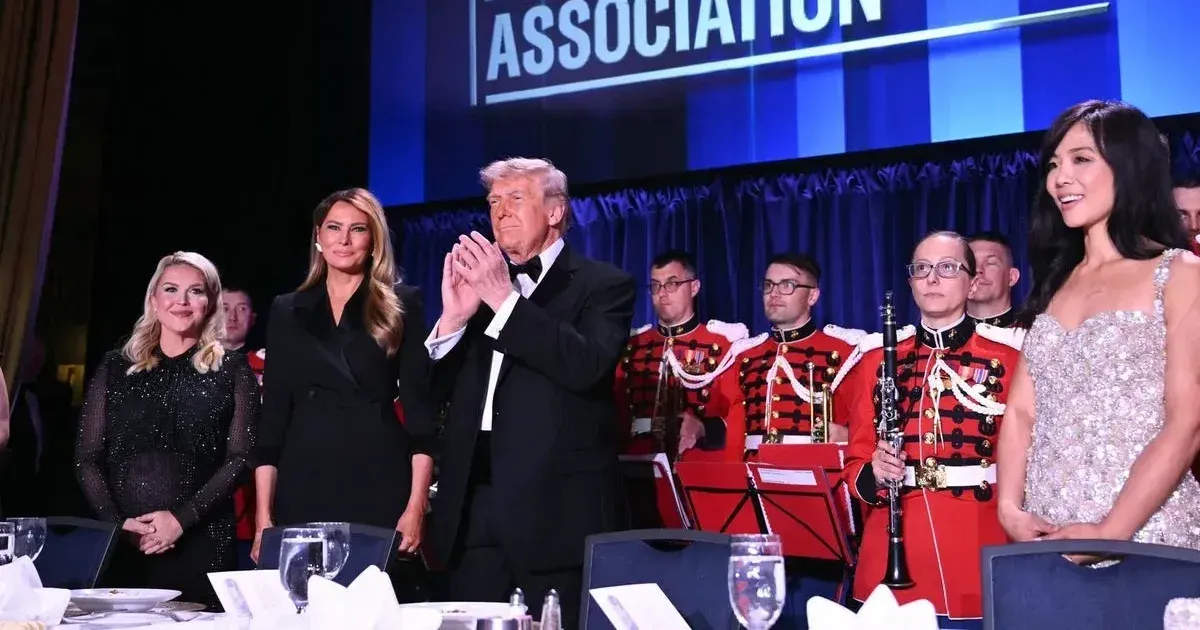
President Donald Trump confirmed he will join the press corps for a rescheduled White House Correspondents' Dinner. The gala plan also forces security teams to treat a ceremonial event as a live political target. Recent years have seen the president skip the event, but the circumstances of the previous attempt in April changed the administration's calculation. The decision, shared publicly on June 2, 2026, indicates a distinct shift in his historical relationship with the annual media gathering.
Security failures during the original spring gala forced an abrupt cancellation before the program could conclude. A gunman reportedly stormed a security checkpoint, creating a direct threat to the journalists and officials gathered inside the venue. Secret Service personnel responded to the breach, yet the disruption rendered the evening's schedule impossible to maintain. No injuries were reported among the high-profile guests, though the incident raised questions about perimeter safety at major political events.
Trump addressed the rescheduling on Truth Social by framing the return as a matter of national resolve. Writing to his followers, he stated that the country could not allow lunatics to change the way of life or the timing of public events. This assertive stance surprised some observers, as it represented a rare moment of defense for an organization the president frequently criticizes.
White House Correspondents Association Sets New Gala Date
The White House Correspondents Association (WHCA) confirmed the move to host a new ceremony to replace the interrupted April event. Officers within the association spent several weeks coordinating with law enforcement to ensure the upcoming venue meets enhanced protection standards. They indicated that the gala is both a social night and a necessary exercise in highlighting the work of the press. Professional persistence became the central theme of the updated planning phase.
Donald Trump praised the association for showing what he called a sign of strength and fortitude. His endorsement of the rescheduling effort highlights a temporary truce between the West Wing and the press corps. While the relationship remains adversarial on policy matters, both sides appear united in the belief that a security threat should not dictate the journalistic calendar.
Records indicate the gunman in April targeted a primary entrance where attendees were being screened. Investigators have not released a full profile of the suspect, but the breach was sufficient to trigger full evacuation protocols. Organizers believe that completing the dinner is the only way to demonstrate that such violence cannot silence institutional activities in the capital.
Shift in Presidential Rhetoric
Attendance from the president marks a departure from his first term behavior, when he often boycotted the dinner to hold competing rallies. His current decision suggests he views the shooting incident as a challenge to his own administration's ability to maintain order. By attending, he aligns his public image with the concept of law and stability. Journalists noted that his praise for the WHCA is among the few times he has used positive language regarding media institutions since his return to office.
'We cannot allow Lunatics to change our way of life, or even its scheduling,' Trump wrote on his social media platform Truth Social.
Many reporters view the upcoming event with a mix of anticipation and caution. Security protocols will likely be the most stringent in the history of the dinner, with additional layers of federal protection expected at every entry point. The presence of the commander-in-chief adds another tier of logistical complexity for the Secret Service teams tasked with securing the ballroom.
Financial implications for the WHCA were also considered during the rescheduling process. Most annual revenue for the association's scholarship programs is generated through gala ticket sales and sponsorships. Completing the event ensures that these educational funds are preserved despite the initial disruption.
Logistical details for the new date are being finalized, with the association expected to release a formal guest list in the coming days. The biggest news organizations have pledged to return, viewing the gala as a symbolic defense of their role in American governance. The president's presence ensures that the event will draw a global audience far larger than a standard press dinner.
The Rescheduled Gala Will Test a Rebuilt Security Perimeter
The expanded safety perimeter must protect a target of this magnitude. The breach in April exposed a vulnerability in the secondary security layer that law enforcement must now address with permanent structural changes. Analysts note that when a gunman successfully reaches a checkpoint, the failure is usually one of intelligence or perimeter depth rather than individual officer response. The upcoming gala is a demanding test for the Secret Service and local police forces to prove they can secure a stationary target against active shooters.
Defensive architecture at political events is undergoing a quiet revolution. Planners are moving away from temporary barriers toward integrated surveillance and biometric screening for all contractors and service staff. This incident proves that even the most prestigious events are susceptible to determined individuals who ignore standard deterrents. If the rescheduled dinner proceeds without incident, it will provide a blueprint for securing other high-profile gatherings in an increasingly volatile political environment. The failure in April was a tactical lapse, but a second failure would be a strategic catastrophe for the agencies tasked with protecting the nation's capital and its most powerful residents.