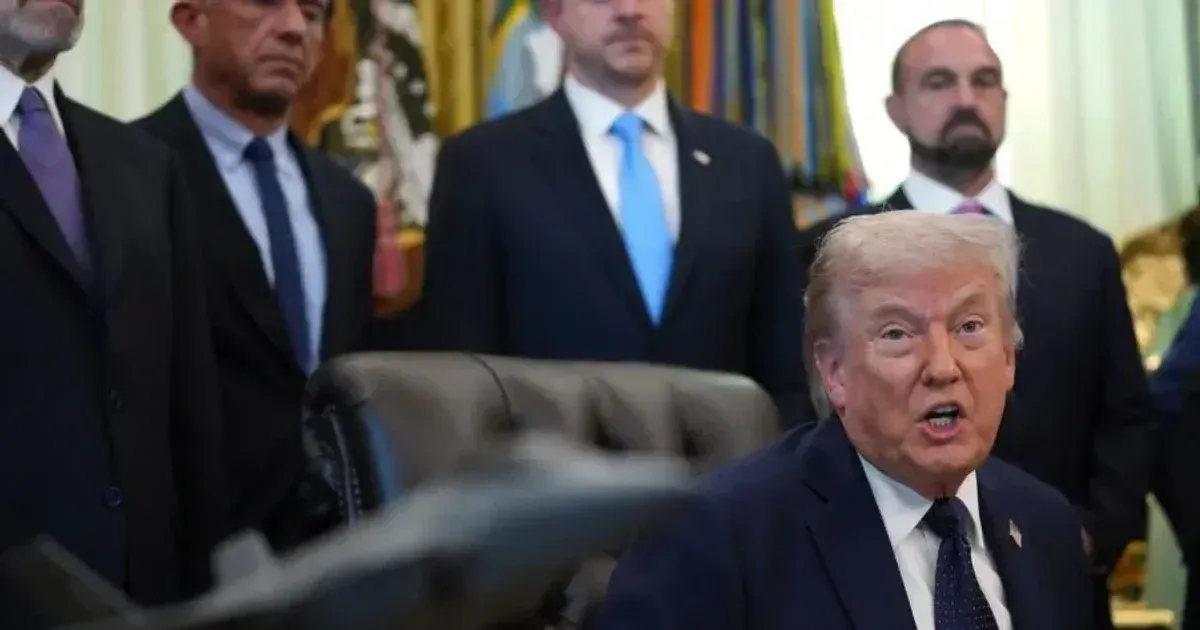
Donald Trump declared on April 23, 2026, that his administration would not deploy nuclear weapons against Iran. Speaking from the Oval Office, the president dismissed the necessity of atomic force by claiming that conventional military strikes had already neutralized the Iranian threat. This stance arrived during an otherwise routine gathering focused on pharmaceutical costs where the conversation pivoted sharply toward escalating Middle East tensions. Questions regarding the potential for nuclear escalation received a blunt dismissal from the president. He characterized the inquiry as stupid. Military force, in its conventional form, has already achieved the desired results according to executive assessments. Presidential advisors suggest the current strategy relies on the overwhelming superiority of standard munitions rather than the nuclear arsenal.
Economic and military pressure continues to define the administration's approach to the Persian Gulf. Trump noted that Iran has been decimated without the need for catastrophic weapons. Conventional air strikes and technological superiority provided the leverage the White House sought. The president appeared confident in the current trajectory of the conflict. He emphasized that the scale of destruction achieved through non-nuclear means made the use of the nuclear triad unnecessary. Officials within the Department of Defense have reportedly aligned with this assessment. Restraint regarding the nuclear option does not imply a cessation of hostilities. Instead, it highlights a preference for precision strikes over mass-scale irradiation.
Conventional Military Success and Nuclear Rhetoric
Senior military officials argue that the efficiency of modern missile systems allows for the systematic dismantling of infrastructure without breaching the nuclear threshold. This specific tactical choice preserves the possibility of future diplomatic engagement. Trump stated that the use of a nuclear weapon would be redundant. The destruction already visited upon Iranian military assets satisfies current operational goals. Planners at the Pentagon have spent months refining the target lists for these conventional missions. They focused on communication hubs and energy infrastructure. Success in these sectors has rendered the nuclear debate moot for the current commander-in-chief. He believes the message to Tehran is clear through kinetic action alone.
Critics often point to the high civilian cost of prolonged conventional campaigns. The White House maintains that these operations are necessary to prevent Iranian nuclear breakout. By focusing on standard weaponry, the administration claims it is adhering to international norms of proportionality. This distinction remains a foundation of the current defense policy. Trump reiterated his belief that the United States possesses the most powerful conventional force in history. He suggested that using the nuclear button would only complicate an already favorable battlefield situation. The president frequently links military success to his personal leadership style. He views the current state of Iran as a direct result of his specific directives.
Iranian Foreign Ministry Responds to Social Media Escalation
Tehran reacted with immediate hostility to the administration's rhetoric and social media activities. Esmaeil Baqaei, the spokesperson for the Iranian Foreign Ministry, issued a statement on April 23, 2026, accusing Washington of actively promoting terrorism. The accusation followed a post shared by Trump on Truth Social. The post in question featured a quote from Marc Thiessen, a contributor at Fox News. Thiessen’s quote suggested that Iranians who opposed a peace deal should be killed. Baqaei argued that such language from a head of state violates every international protocol. The Iranian government views these comments as a direct threat to its sovereignty and the safety of its citizens.
President Trump shared a quote from Fox News contributor Marc Thiessen suggesting that Iranians opposed to a peace deal should be killed, a move Iranian spokesperson Esmaeil Baqaei called the actions of a promoter of terrorism.
Esmaeil Baqaei characterized the American administration as a source of instability. He noted that the endorsement of political assassination is a hallmark of state-sponsored terror. The Iranian Foreign Ministry intends to bring these complaints to international bodies. Tensions between the two nations have reached a point where digital rhetoric carries the weight of official policy. Esmaeil Baqaei remains the primary voice of Iranian discontent on the global stage. He insists that the United States has lost its moral authority. Marc Thiessen, whose words sparked the latest firestorm, has long been a proponent of hardline measures against the regime. His influence on the president's social media feed is a point of contention for diplomats. Esmaeil Baqaei believes this influence is dangerous.
White House Cabinet Influences on Military Engagement
National security dynamics in Washington are currently shaped by a small circle of influential advisors. NPR correspondents Mary Louise Kelly, Franco Ordonez, and Greg Myre have analyzed the internal shifts within the Cabinet. These advisors matter in determining the intensity of the Iran war. Some members of the administration push for even more aggressive conventional strikes. Others advocate for a path toward a structured peace deal. Marc Thiessen often reflects the views of the more hawkish elements within this circle. Trump appears to favor the perspectives of those who emphasize strength without resorting to nuclear deployment. The internal debate often spills over into the public sphere through selective leaks and social media posts.
Franco Ordonez noted that the president’s decision-making process is frequently non-linear. He often weighs the advice of his formal Cabinet against the opinions of media personalities like Marc Thiessen. It creates a volatile environment for foreign policy. Greg Myre pointed out that the professional military establishment prefers the predictable nature of conventional warfare. They worry that nuclear rhetoric, even when dismissed, creates unnecessary global panic. The current Cabinet must balance these concerns with the president's desire for bold, headline-grabbing actions. Their influence is visible in the timing of missile strikes and the tone of diplomatic cables. The process of shaping the Iran war is a constant tug-of-war between varied ideologies.
Media Influence and Presidential Communication Channels
Fox News and its roster of contributors continue to hold substantial sway over executive thought. Marc Thiessen has become a recurring figure in the president's digital ecosystem. His hawkish stances provide the intellectual framework for many of the administration's most aggressive moves. When Trump shares a quote from Marc Thiessen, the world pays attention. These shares are more than endorsements of an individual opinion. They act as signals to both allies and enemies. The Iranian Foreign Ministry tracks these posts with careful detail. They understand that a Truth Social post can precede a policy shift. Marc Thiessen provides the justification that the White House often lacks in formal briefings.
Digital diplomacy has replaced traditional channels of communication. The shift allows the president to bypass the State Department and speak directly to his base. It also allows him to provoke foreign adversaries with minimal oversight. The Iranian response to the Marc Thiessen post demonstrates the effectiveness of this strategy in creating psychological pressure. Tehran is forced to react to a constant stream of varying messages. It creates a state of perpetual uncertainty within the Iranian leadership. Trump enjoys this chaos. He sees it as a tool for negotiation. The refusal to use nuclear weapons is perhaps the only point of stability in an otherwise erratic communication strategy. Conventional power remains the ultimate arbiter of the administration's goals.
Nuclear Signaling
Donald Trump claims nuclear weapons are unnecessary because his conventional forces have already decimated the Iranian state. The assertion reveals a dangerous confidence in the utility of limited warfare that ignores the long-term consequences of regional collapse. By dismissing the nuclear question as stupid, the president is not just rejecting a weapon; he is signaling a terrifying comfort with high-intensity conventional slaughter. His reliance on social media pundits like Marc Thiessen to set the moral tone for conflict is an abdication of traditional statesmanship. Tehran, meanwhile, finds its best defense in the very rhetoric Washington provides. Esmaeil Baqaei uses every presidential post as fuel for a global campaign to paint the United States as a lawless aggressor.
Is the administration truly winning, or is it simply destroying the ground it hopes to eventually occupy? The tactical success of conventional decimation is a hollow victory if it leaves behind a vacuum filled by the very extremism the White House claims to oppose. Trump’s strategy is a gamble on the endurance of a crippled adversary. History suggests that a cornered regime becomes more unpredictable, not less. The refusal to go nuclear is a baseline of sanity, but it does not excuse the reckless digital provocations that define this era. The result is dangerous instability.