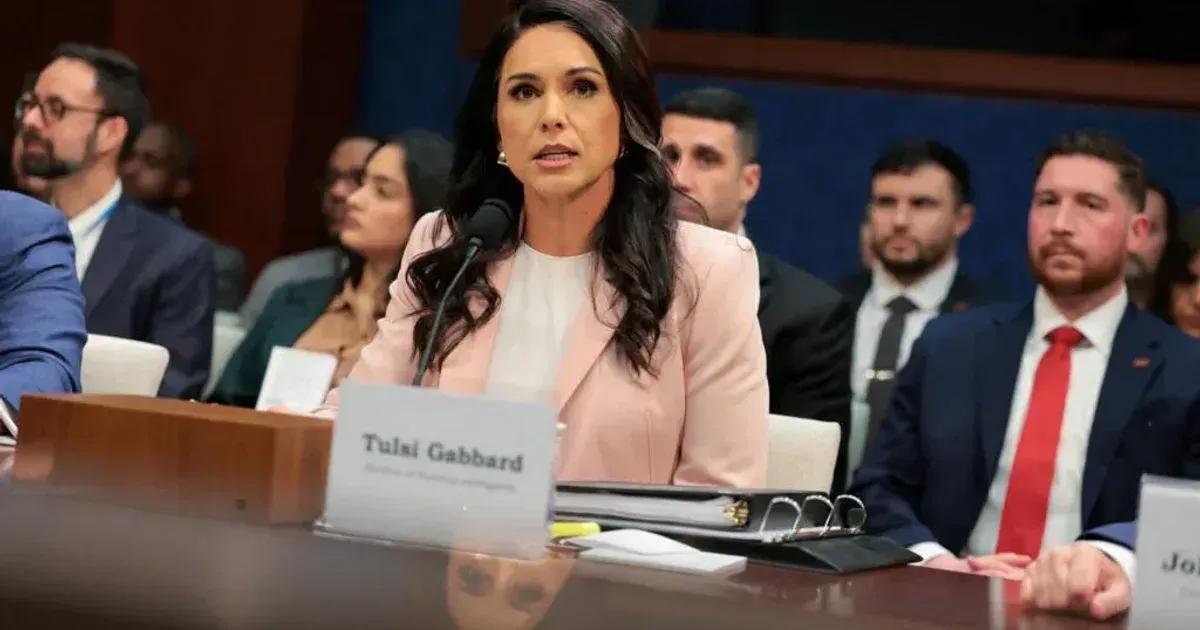
Tulsi Gabbard resigned as director of national intelligence on Friday, saying she needed to leave public service as her husband battles cancer. President Donald Trump said she would leave the administration at the end of June. The May 22, 2026 announcement made Gabbard the fourth Cabinet official to depart during Trump's second term.
Gabbard said in a resignation letter that her husband, Abraham, had been diagnosed with an extremely rare form of bone cancer. She told Trump that her resignation would be effective June 30, giving the administration several weeks to manage the transition at the Office of the Director of National Intelligence.
"At this time, I must step away from public service to be by his side and fully support him through this battle," Gabbard wrote in the letter.
The resignation ends a short and turbulent tenure for a former Democratic congresswoman who became one of the most unusual national-security appointments in the Trump administration. Gabbard oversaw coordination across 18 intelligence agencies, a role created after the Sept. 11 attacks to improve information sharing across the federal government.
Health Crisis and Transition Timing
The personal explanation for the resignation is central to the official account. Trump said Gabbard had done an incredible job and confirmed that Principal Deputy Director Aaron Lukas would serve as acting director after her exit. That statement reduces the immediate risk of a leadership gap, but it does not erase the political pressure surrounding the office.
The June 30 effective date gives the White House time to avoid an abrupt vacancy, yet it also extends a period of uncertainty inside a sensitive post. The acting director will need to keep daily intelligence coordination moving while the administration decides whether to nominate a loyal political ally, a career intelligence figure or another unconventional candidate.
Gabbard had already faced scrutiny from Democrats, intelligence veterans and some national-security observers who questioned whether her office was being pulled into partisan fights. The timing of the resignation means the next nominee will inherit both a family-driven departure and unresolved disputes over the direction of the intelligence community.
Iran War Friction
Friction with the White House had been visible before the resignation. Gabbard testified earlier in the year that the intelligence community had not assessed that Iran was seeking a nuclear weapon, a position Trump publicly dismissed after launching strikes on Iranian nuclear sites. That dispute made her non-interventionist background harder to reconcile with the administration's military posture.
The Iran split also followed the resignation of Joe Kent from the National Counterterrorism Center, who said he could not support the war. Gabbard did not present her departure as a policy protest, but the resignation removes one of the administration's few senior figures closely identified with skepticism toward foreign military intervention.
That distinction matters for allies and adversaries trying to read Washington. A health-driven resignation is not the same as a policy rupture, but it still changes who briefs the president, who manages internal dissent and who decides how sharply intelligence assessments should be separated from political messaging.
Intelligence Office Fallout
The next director will face immediate questions about trust, analytic independence and the boundary between intelligence work and political loyalty. Sen. Mark Warner, the top Democrat on the Senate Intelligence Committee, said the replacement should restore confidence in the office and protect intelligence professionals who need to speak candidly.
Gabbard's exit therefore carries two meanings at once. It is a personal decision linked to her husband's illness, and it is also a transition inside a national-security system already strained by war, turnover and partisan conflict. The administration has time before June 30 to manage the handoff, but the policy argument over intelligence independence will continue well beyond her final day.
For the intelligence agencies, the practical question is continuity. Analysts need a director who can defend analytic tradecraft, move classified findings quickly and resist pressure to bend assessments toward political convenience. That test will begin before Gabbard formally leaves office.
Gabbard's Successor Will Signal the Direction of Iran Policy
Global partners are likely to view this resignation as a sign of continuing internal discord within the American security establishment. When a Director of National Intelligence departs amid a regional war, it creates a perception of strategic incoherence that adversaries may seek to exploit. The policy gap between Gabbard and the President extended beyond a private disagreement and reflected a fundamental clash over the direction of American power in the 21st century.
Replacing her with a traditional hardliner would signal a definitive shift toward escalation in the Iran conflict. By contrast, selecting another unconventional figure might further alienate the career professionals within the CIA and NSA who valued stability over ideology. The administration now faces a choice between finding a loyalist who will echo executive claims or a technocrat who can rebuild the fractured relationship between the White House and the agencies. The vacancy is not just a personnel problem. It forces a decision for a foreign policy that has struggled to reconcile campaign promises with the realities of a multi-front conflict.