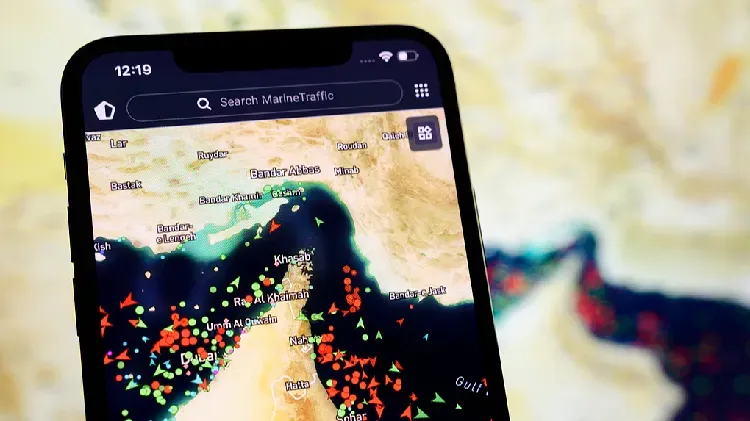
UAE concern over the Strait of Hormuz has moved from strategic anxiety to immediate security pressure. The question is no longer whether Iran might use the waterway as leverage. The latest U.S.-Iran escalation has already disrupted shipping, revived blockade politics, raised energy-market risk and put Gulf governments in the position they most wanted to avoid: dependent on American force while exposed to Iranian retaliation.
For Abu Dhabi, the problem is direct. The UAE sells itself as a stable trade, finance, logistics, tourism and technology hub. That model depends on a belief that Gulf risk can be managed. When tankers are attacked, sailors are killed or wounded, insurers reprice routes and U.S. strikes hit contested points near the strait, that belief weakens. The issue is not only oil. It is the credibility of the whole Gulf stability story.
Hormuz Is More Than an Oil Lane
The Strait of Hormuz is narrow, crowded and central to global energy flows. It does not have to be sealed for the market to suffer. A handful of drone threats, missile launches, seizures, mines, small-boat harassment or ambiguous warnings can slow traffic and lift insurance costs before diplomats even agree on the facts. Energy markets trade on fear as well as barrels.
Gulf geography matters for the UAE because its diversification strategy still sits beside it. Abu Dhabi and Dubai have built brands around finance, ports, aviation, real estate, AI and services. None of those sectors is formally an oil tanker. All of them depend on confidence that people, capital and goods can move through the region without being trapped inside a maritime war.
Washington Must Deter Without Igniting
The United States has long presented itself as the outside power able to keep Gulf sea lanes open. That role buys influence, defense sales, basing access and diplomatic leverage. It also creates expectation. When ships are threatened, Gulf capitals look to Washington for surveillance, escorts, interceptions, mine countermeasures, air defense and public red lines.
The hard part is that Gulf states want protection more than they want a broader war. A weak U.S. response would raise doubts about American credibility. An undisciplined campaign could make Gulf ports, bases, tankers and energy sites larger targets. The UAE needs American force to be visible enough to deter Iran and careful enough not to turn every provocation into another front.
Greater Tunb Makes the UAE Stakes Sharper
The reported U.S. strike on Greater Tunb adds a specific Emirati dimension. Iran has controlled the island since 1971, but the UAE claims it, and its position near the Strait of Hormuz gives it strategic weight. Any military action there touches more than Iranian coastal defense. It touches a long-running sovereignty dispute that Abu Dhabi cannot treat as background.
The sovereignty stake does not mean the UAE wants to become the public face of an anti-Iran campaign. It wants shipping protected, Iranian pressure contained and its own territory claims respected without inviting direct retaliation. The UAE's preferred position occupies a narrow lane. It requires private pressure on Washington, quiet coordination with Saudi Arabia, Qatar, Bahrain and Kuwait, and enough communication channels to Tehran to reduce miscalculation.
China Gets the Benefit Without the Bill
China's position complicates the security ledger. Beijing depends heavily on Gulf energy routes, so it has a major interest in Hormuz staying open. Yet it usually prefers diplomatic positioning and commercial access over visible military responsibility in Gulf waters. The result is familiar: China benefits from a security system still largely policed by the United States.
Gulf capitals understand the imbalance. They also know China may have channels to Tehran that Washington lacks. That makes the credibility contest wider than aircraft carriers and destroyers. The question is who can reduce risk, secure passage and keep Gulf economies functioning without forcing every regional government into a binary alignment.
A Blockade Can Create Its Own Risk
A U.S. blockade aimed at Iranian-linked traffic may be designed to preserve broader freedom of navigation, but maritime coercion is never clean. Iran can answer with deniable attacks, drones, missiles, cyber pressure, small boats or threats against allied infrastructure. Even if non-Iranian vessels are supposed to pass, the market may still treat the strait as dangerous.
There is also a legal and political cost. Freedom of navigation is easier to defend when the policy is tied to clear threats and narrow enforcement. It becomes harder if security begins to look like selective passage, toll bargaining or a system in which Gulf states must constantly pay for American protection. Washington reportedly backed away from a ship-toll idea after Gulf pushback, but the episode exposed the danger. Allies want protection; they do not want the rules of the waterway to become another uncertainty.
The Answer Has to Be Layered
Force may be necessary when ships are attacked, but force alone is a brittle answer in Hormuz. A serious posture needs convoy protection where needed, air and missile defense, mine countermeasures, intelligence sharing, commercial insurance coordination, emergency fuel planning, private warnings to Tehran and diplomatic off-ramps through states that still have channels with Iran.
UAE pressure exposes the real price of U.S. Gulf guarantees. Washington is expected to keep energy moving, reassure allies, punish attacks, manage China, deter Iran and avoid a war that Gulf governments fear would land on their own ports and bases. That is a heavy promise. If the United States delivers it with discipline, its Gulf role survives the crisis. If it cannot, Hormuz becomes more than an energy chokepoint. It becomes a ledger of American credibility.