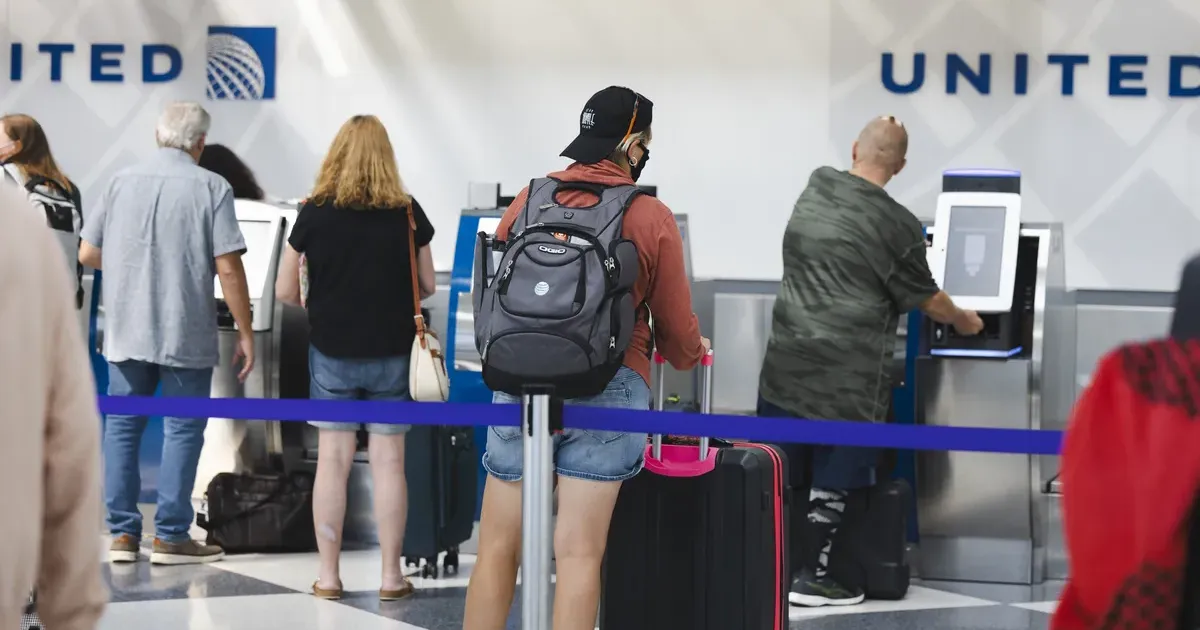
United Airlines announced a broad restructuring of its fare classes and a $10 increase in checked bag fees across its North American and Latin American networks. Decisions regarding these price adjustments emerged during a period of intense volatility in the global energy sector. Travelers booking flights starting today face a revised fee structure that prioritizes early digital payment over airport lobby interactions. First checked bags now cost $45 for those who pay at least 24 hours before their scheduled departure. The April 3, 2026, fee increase arrived as fuel costs and fare segmentation reshaped airline pricing.
Passengers who wait until they reach the airport lobby will pay $50, while those forced to check a bag at the gate will be charged $75. Costs for a second checked bag have similarly increased by the same $10 margin.
United Airlines Implements Strict Bag Fee Increases
Higher operating costs prompted the fee increase, making United the second major American carrier to adjust baggage pricing this week. JetBlue Airways initiated a similar hike on Monday, citing the need to manage rising expenses while attempting to keep base fares competitive. United officials confirmed the new pricing applies to tickets purchased for travel within the United States, Mexico, Canada, and Latin America. The policy change were immediate, as digital check-in systems updated prices at midnight. Bag drop kiosks at Chicago’s O’Hare International Airport showed the updated 24-hour discount rates during the morning rush.
Detailed logs from the airline website indicate that the $45 fee is restricted to domestic and short-haul international routes. Gate agents are instructed to collect the $75 fee for any oversized or late-checked items without exception.
United is raising first and second checked bag fees by $10 for customers traveling in the US, Mexico, and Canada and Latin America beginning with tickets purchased Friday, April 3.
Rising fuel expenditures remain the primary driver behind the sudden pricing shifts. Jet fuel prices have doubled to almost $200 a barrel according to data from the International Air Transport Association. Prices for crude oil benchmarks have not risen with the same velocity, creating a huge disparity in the energy market. Brent Crude oil currently trades at $109 per barrel, marking a 50% increase since late February. Refineries struggle to keep pace with demand while managing the logistical hurdles caused by ongoing international conflict.
Fuel represents the single largest variable cost for most airlines, often accounting for nearly 30% of total operating expenses. Every dollar added to the price of a barrel adds millions in unforeseen costs to the quarterly balance sheet.
Basic Polaris Fares Shift Premium Travel Strategy
United also introduced a restrictive business class option termed Basic Polaris as part of a premium cabin overhaul. The new fare tier offers the physical comfort of a lie-flat seat without many of the traditional perks associated with the Polaris brand. Buyers of these cheaper business class tickets may lose access to airport lounges and advance seat selection privileges. Changes to the fare structure mirror the unbundling strategies successfully deployed in economy cabins over the last decade. Executives believe that offering a lower entry point for premium seating will capture price-sensitive corporate travelers.
Corporate travel budgets have tightened sharply as inflation impacts the broader service economy. Basic Polaris allows United to maintain high load factors in its most profitable cabin while technically raising the price of the full-service experience. Restrictions on refunds and upgrades are expected to be standard for this new category.
Geopolitical instability in the Middle East continues to dictate the financial trajectory of the aviation industry. War in Iran began on February 28, 2026, immediately disrupting global supply chains and energy exports. Market speculators reacted by driving up the price of refined products like kerosene-based jet fuel. Refiners face unique challenges in processing crude into specialized aviation fuel during active military conflicts. Historically, the spread between crude and jet fuel remains narrow, yet current conditions have pushed it to record levels. Most refineries in the Gulf Coast region are operating at maximum capacity to offset the loss of international supply.
Analysts at major investment banks predict that fuel costs will stay elevated through the summer travel season. Demand for air travel remains high despite these rising costs, suggesting a resilient consumer base.
American carriers operate with far more exposure to energy market fluctuations than their European counterparts. Most US airlines do not hedge against fuel costs, preferring to pay the current market rate for every gallon. Financial losses from bad bets on fuel futures in the 2010s led many US executives to abandon the practice entirely. Unlike these domestic players, Ryanair and other European airlines have locked in lower prices for the majority of their supply. The chief executive of Ryanair confirmed that the carrier secured 80% of its fuel at lower rates until next March.
The extra revenue allows European low-cost carriers to maintain stable pricing while US airlines are forced to pass costs to consumers. US carriers must rely on fare increases and ancillary fees to protect their profit margins. Hedging requires substantial capital outlays that many domestic boards are unwilling to authorize in the current interest rate environment.
Basic Polaris Turns Comfort Into a Pricing Wall
Does the unbundling of a lie-flat seat mean the final death of the Golden Age of flying? United Airlines is gambling on the idea that a business-class seat is a piece of real estate rather than an integrated service. By introducing Basic Polaris, the carrier is essentially admitting that the “premium” label is a commodity to be sliced and sold to the lowest bidder. This strategy may fill planes in the short term, but it risks permanently diluting the brand prestige that takes decades to build. If you pay $4,000 for a seat but cannot use the lounge or choose your window, the sense of exclusivity evaporates. It is a race to the bottom disguised as “customer choice.”
Meanwhile, the reliance on bag fees to offset fuel volatility exposes a glaring weakness in US airline management. Refusing to hedge fuel is not a strategy; it is a gamble that passengers will always be willing to foot the bill for geopolitical instability. As fuel stays at $200 a barrel, the $10 bag fee hike is a bandage on a sucking chest wound. Expect further unbundling of the cabin experience as airlines scramble to protect their dividends. The era of the all-inclusive business class ticket is over. Profitability now depends on nickel-and-diming the wealthy. The arithmetic is brutal.