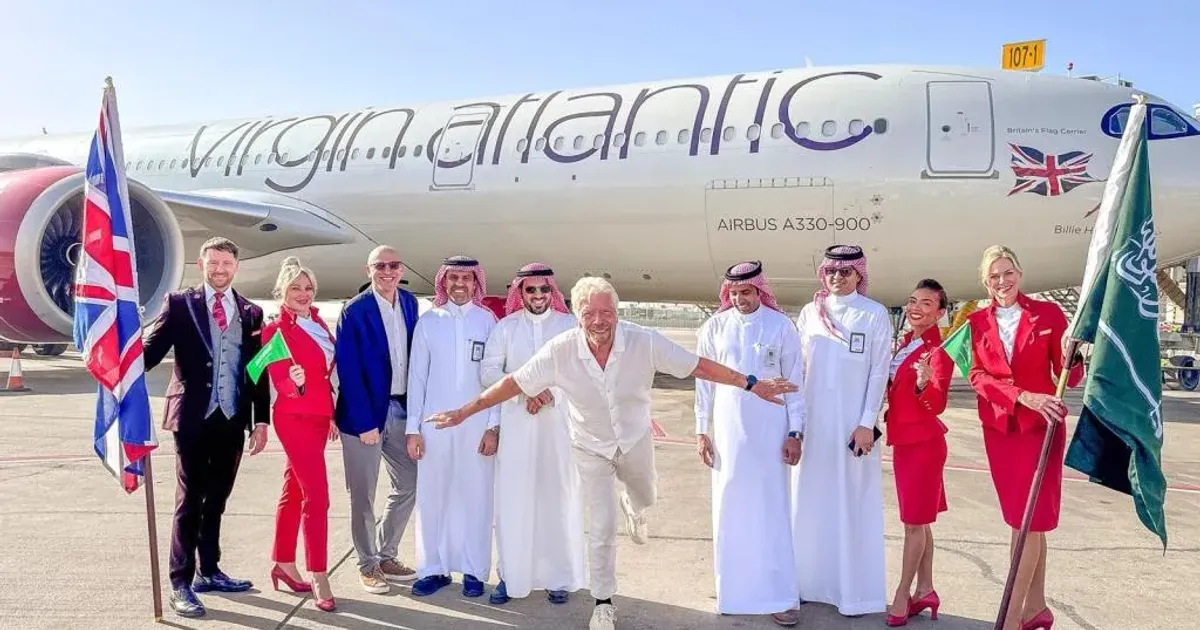
Virgin Atlantic's decision to cancel London Heathrow-Riyadh less than a year after launch shows the limit of prestige-route expansion. A destination can fit a national growth story, attract launch attention and still fail if risk, demand and aircraft use do not line up.
Virgin said it had taken the difficult decision to cancel Riyadh services from April 7, 2026, after continued assessments of the Middle East escalation and regulatory guidance. The airline framed the move around the need to operate a stable and reliable schedule.
The official reason matters. The route was not dropped in a normal competitive vacuum. It was caught between regional instability, commercial performance, Heathrow constraints and Virgin's need to put scarce aircraft where they can earn more dependable returns.
Riyadh Had a Strong Story but Thin Protection
The London-Riyadh corridor looked strategically attractive when Virgin announced the route. Saudi Arabia's Vision 2030 agenda was pushing aviation, tourism, business travel and global connectivity. Riyadh Air was being built as a new national champion, and the capital was being marketed as a future hub.
The national growth story is not the same as a profitable daily service. Virgin is a relatively small long-haul carrier, still shaped heavily by the North Atlantic and joint-venture economics with Delta and Air France-KLM. It cannot keep every strategic experiment alive while demand is uncertain.
Riyadh had to fill premium seats, hold corporate traffic and justify the aircraft against other uses. Once the regional security picture deteriorated, the margin became thinner.
Aircraft Scarcity Changes the Math
Wide-body aircraft are expensive, maintenance-sensitive assets. They are not neutral placeholders on a timetable. A plane assigned to Riyadh cannot be assigned to New York, India, Jamaica, Las Vegas, South Africa or another route with stronger partner support or clearer seasonal demand.
Virgin has also had to manage the broader reality of long-haul fleet pressure, including delivery timing, engine reliability history and the need for schedule resilience. When airlines talk about a stable programme, they are usually talking about aircraft, crews, maintenance and spare capacity as much as customer demand.
A route cut therefore is not always a verdict on the destination itself. Sometimes it is a verdict on opportunity cost.
Middle East Instability Became the Immediate Trigger
The Iran war changed how airlines assessed Gulf and Middle East flying. Carriers across Europe and North America suspended, rerouted or trimmed services as airspace risk, insurance, demand and crew planning shifted.
Virgin initially managed disruption through rebooking policies and temporary cancellations. The full Riyadh exit showed that management no longer saw the service as worth preserving through uncertainty.
For passengers, the result is fewer direct choices between London and Riyadh. For the airline, it reduces exposure to a route where safety assessment, demand and aircraft productivity were moving in the wrong direction at the same time.
Heathrow Slots Raise the Stakes
Heathrow is one of the world's most constrained airports. Every slot used on a marginal long-haul route carries a hidden cost because it may be more valuable elsewhere in the network.
Virgin's Heathrow position is strategically important but smaller than British Airways'. Scarcity makes discipline essential. A route that looks prestigious can still lose to a route that feeds stronger partnerships, steadier premium demand or better aircraft rotation.
The Riyadh decision therefore says as much about Heathrow economics as it does about Saudi Arabia. Scarce airport access punishes symbolic flying.
The Saudi Market Is Not Disappearing
Virgin is not cutting Saudi Arabia out of its commercial thinking entirely. Partnership options, especially through Saudia, can preserve some customer access without operating Virgin metal on the route.
The partnership model creates a different kind of presence: lower brand visibility, lower operational risk and less control over the customer experience. It is less glamorous than flying the route directly, but it may make more sense while regional risk and demand are unstable.
Riyadh's aviation story will continue through Saudia, Riyadh Air and other carriers. Virgin simply decided it was not the right airline to carry the direct-route risk now.
The Lesson Is Network Discipline
Prestige routes are useful only when they survive the same tests as ordinary routes: aircraft productivity, slot value, safety confidence, partner economics and fare strength.
Virgin's Riyadh retreat is not proof that Saudi aviation demand is weak. It is proof that a midsize long-haul airline cannot treat strategic narratives as a substitute for durable route economics.
Network ambition only counts when the aircraft can earn its keep, and when the schedule can operate reliably enough for passengers to trust it.