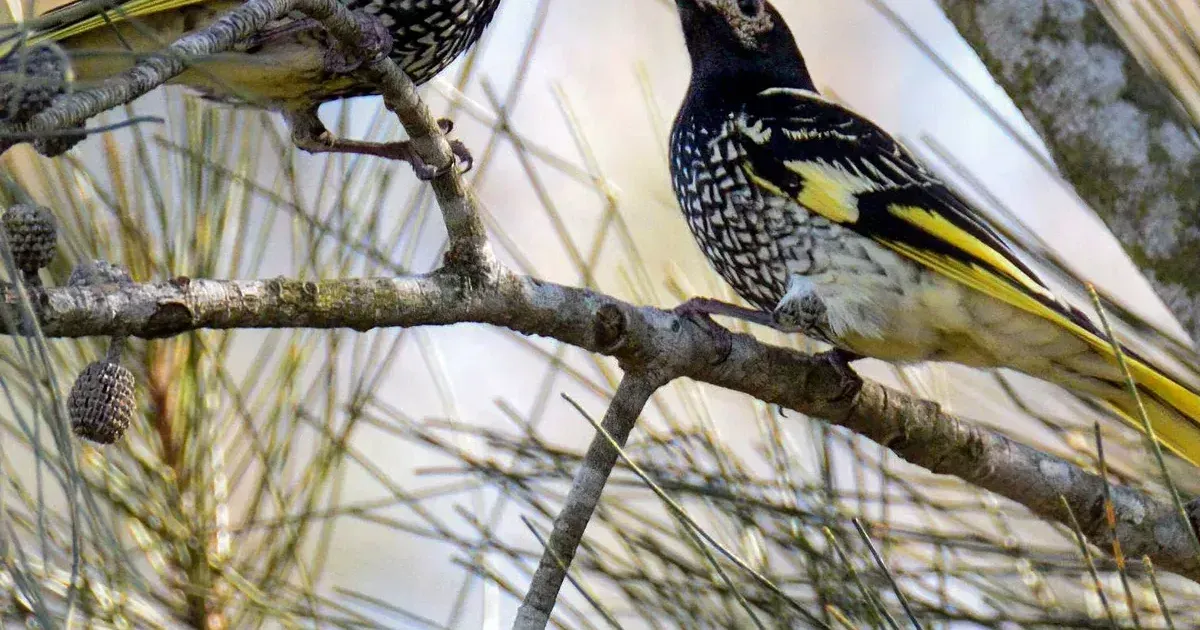
Wild mentor birds are helping endangered regent honeyeaters relearn the songs they need to survive. On March 17, 2026, the work showed how saving a species can require protecting culture as well as habitat. Young males raised in isolation can lose the complex calls required to attract mates, weakening recovery efforts even when conservationists succeed in breeding more birds. The project is a reminder that extinction risk can damage learned behavior before a species disappears. The regent honeyeater's problem is unusual but logical. If too few adult males remain in the wild, young birds have fewer chances to learn the correct vocal patterns.
A captive-bred bird released without the right song may struggle to find a mate. Regent honeyeaters need social learning, not only population numbers. Birdsong is often treated as background sound, but in this species it functions as a reproductive signal. A male that sings the wrong notes may be ignored, even if it is otherwise healthy. Conservationists have used recordings and exposure to wild mentors to rebuild that learning process. The goal is to give young birds the vocal map they would have received naturally in a denser population.
Song Becomes Survival
Breeding more birds is essential, but it does not automatically restore behavior. Animals also need the skills that let them feed, navigate, compete and reproduce after release. Wild mentors can fill part of that gap. They transmit behavior in a way a laboratory cannot fully replicate. The approach requires careful timing. Young birds need exposure when they are ready to learn, and the mentor population has to be protected enough to keep teaching the next generation.
The lesson extends beyond one species. Conservation programs often focus on numbers because numbers are easy to count. Behavior can be harder to measure, but it may decide whether a recovery plan works. For the regent honeyeater, the song is not a decorative trait. It is part of the species' survival system. Restoring that system gives the birds a better chance to become more than a managed population.
The approach also requires patience. A bird may be healthy enough to release but still poorly prepared to join a wild population if it lacks the right social signals. That makes monitoring after release essential. Conservationists need to know whether trained birds sing correctly, whether females respond and whether the behavior spreads to younger birds. Habitat remains the foundation. Mentor songs cannot compensate for landscapes without food, nesting sites and enough birds to create a functioning population.
The conservation lesson is broader than one bird. Recovery plans often count nests, releases and habitat, but learned behavior can disappear before population charts show the full damage. Saving the regent honeyeater means protecting the adult teachers that make young birds viable in the wild.
Captive Breeding Has Limits
Still, the song work gives conservation teams another lever. It acknowledges that animals inherit more than genes; they also inherit behaviors from the communities around them. For a critically endangered species, every lever matters. A recovered song will not save the regent honeyeater by itself, but it may help the birds use the recovery work humans have already done. The regent honeyeater effort also shows why small population size creates hidden damage. Even before a species disappears, the social environment that teaches young animals how to behave can collapse.
That collapse is hard to reverse because it is not stored in a freezer or seed bank. It lives in adult animals, repeated interactions and landscapes where young birds can hear the right sounds at the right time. Conservationists are therefore trying to rebuild a learning network. The goal is not only to release birds, but to release birds that can participate in a wild culture. If the program succeeds, it may influence other recovery projects where learned behavior has been underestimated. Saving a species may require saving its teachers too.
There is also an ethical dimension. Human intervention is teaching birds a song that humans helped endanger by fragmenting habitat and shrinking wild populations. The work is restorative, but it also shows how deep the damage can go. That makes success more meaningful. If young males relearn the right calls and pass them forward, conservationists will have rebuilt a piece of living behavior, not just increased a headcount. The work also gives the public a more precise way to understand extinction.
A species can lose language, memory and mating behavior before it loses its last individual.