Pringle, South Dakota, welcomed travelers with a sprawling sculpture of welded bicycles that forced passing motorists to hit their brakes. On March 31, 2026, the route offered a reminder that roadside art still shapes how travelers remember the plains. Dozens of frames and wheels sit fused together on the roadside, forming a series of metallic arches that serve no functional purpose. Children often run through the hollow tunnels while parents document the site with digital cameras. Most visitors stay for less than fifteen minutes before continuing their westward journey toward the Wyoming state line.
Custer County records indicate the installation has become a staple of local tourism despite its lack of official historical designation. Welders combined hundreds of salvaged frames to create the structure, which is a silent monument to vernacular art. Passing through these arches offers a tactile experience that contrasts with the sterile environment of high-speed interstate travel. The sculpture sits stationary, yet it conveys a sense of kinetic energy through its chaotic geometry.
Quaal Windsock Aviation History and Restoration Costs
Sundance sits just off Interstate 90, housing a 1950s Beechcraft Twin Bonanza airplane mounted high above the ground. Known locally as the Quaal Windsock, the aircraft features a 45-foot wingspan and rests atop a 70-foot steel pole. Aviation enthusiasts recognize the Twin Bonanza as a premier executive transport vessel from the post-war era. Mick Quaal purchased the aircraft decades ago but faced a financial wall when assessing its airworthiness.
Restoration specialists quoted $200,000 to get the Beechcraft back into the clouds. Mick and Jean Quaal decided to elevate the plane after determining that a full restoration was financially unfeasible. Wind currents now dictate the direction of the nose, and the propellers continue to rotate in the breeze. Local residents now use the spinning propellers to judge wind speed across the open plains.
Mick and Jean Quaal loved the old plane but couldn't justify the $200,000 it would have cost to restore it to flying condition. Travelers who pull over at this site often find themselves looking upward for several minutes, watching the heavy twin-engine craft pivot with ease. The engineering required to mount a multi-ton aircraft on a single pivot point suggests a high degree of local technical skill. No motors drive the rotation, relying instead on the natural aerodynamics of the airframe. It remains a functional piece of meteorological equipment for the surrounding ranching community.
Devils Tower Cultural Significance and Lakota Traditions
Devils Tower rises abruptly from the plains northeast of Hulett as a large column of igneous rock. Lakota people refer to the site as Bear Lodge, holding it sacred through centuries of oral tradition. Ancient stories describe the vertical grooves as claw marks from a giant bear pursuing children. Modern visitors find prayer flags tied to trees at the base, marking the spiritual significance of the area for indigenous tribes.
Theodore Roosevelt designated the site as the first national monument in 1906 under the Antiquities Act. Basalt columns form the bulk of the structure, created by the cooling of magma deep underground. Geologists still debate the exact formation process of the surrounding terrain. Climbers must follow strict voluntary closures during the month of June to respect Native American ceremonies. 1,267 feet is the total height of the monolith from the riverbed below.
Rock climbers frequently scale the basalt columns to reach the flat summit. These athletes move slowly up the vertical cracks, appearing as tiny specks against the dark gray stone. Park rangers monitor the environmental impact of these ascents to ensure the integrity of the rock faces. Binoculars are essential for visitors who wish to track the progress of those attempting the technical routes.
Hulett Taxidermy and Local Wyoming Commerce
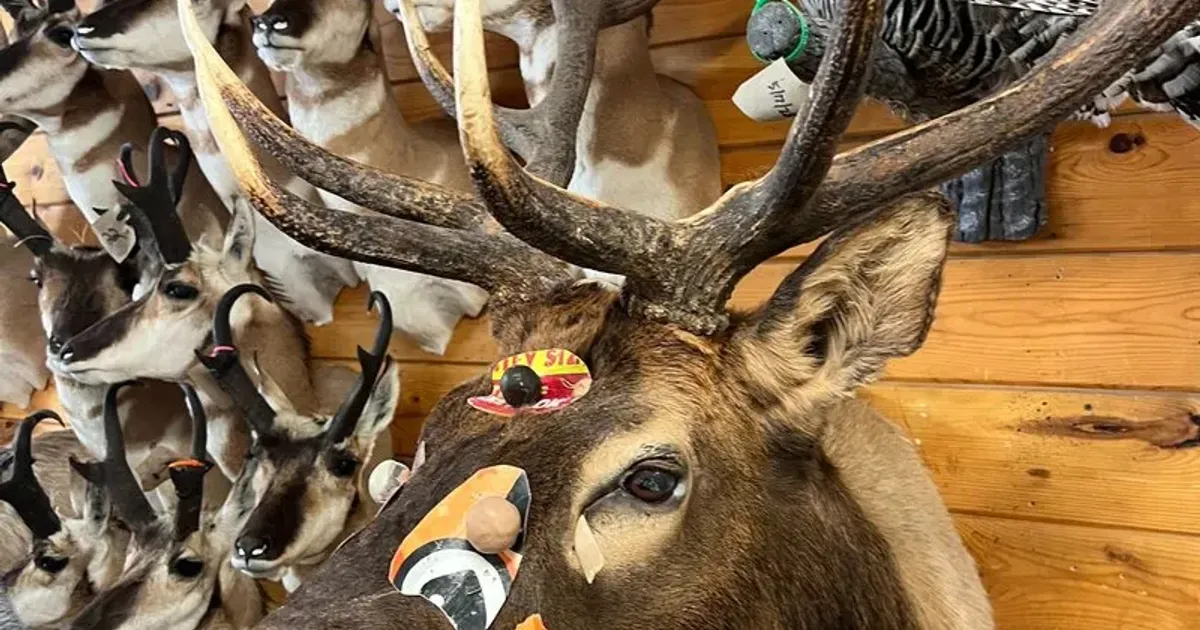
Hulett maintains its status as a traditional Wyoming outpost where local businesses like Deer Creek Taxidermy define the main street. Shop windows display preserved wildlife and hunting trophies that represent the region's deep connection to the outdoors. Many travelers stop in the town to refuel after visiting the nearby national monument. Local commerce relies heavily on the steady flow of tourists driving between the Black Hills and the Bighorn Mountains.
Taxidermy is an essential record of regional biodiversity, documenting the species that inhabit the surrounding forests. Skilled artisans in Hulett transform biological specimens into long-lasting displays for museums and private collectors. Processing a single elk or deer requires weeks of careful labor, involving tanning, sculpting, and detail work. The presence of such a specialized trade highlights the cultural importance of the hunting season in rural Wyoming.
Traditional architecture characterizes the storefronts of Hulett, where wooden boardwalks still exist in some areas. Businesses cater to both the local ranching population and the seasonal influx of motorcycle enthusiasts. Every August, the town sees a large surge in traffic during regional rallies, momentarily transforming the quiet streets. Despite these seasonal shifts, the core identity of the town persists as a center for rugged individualism.