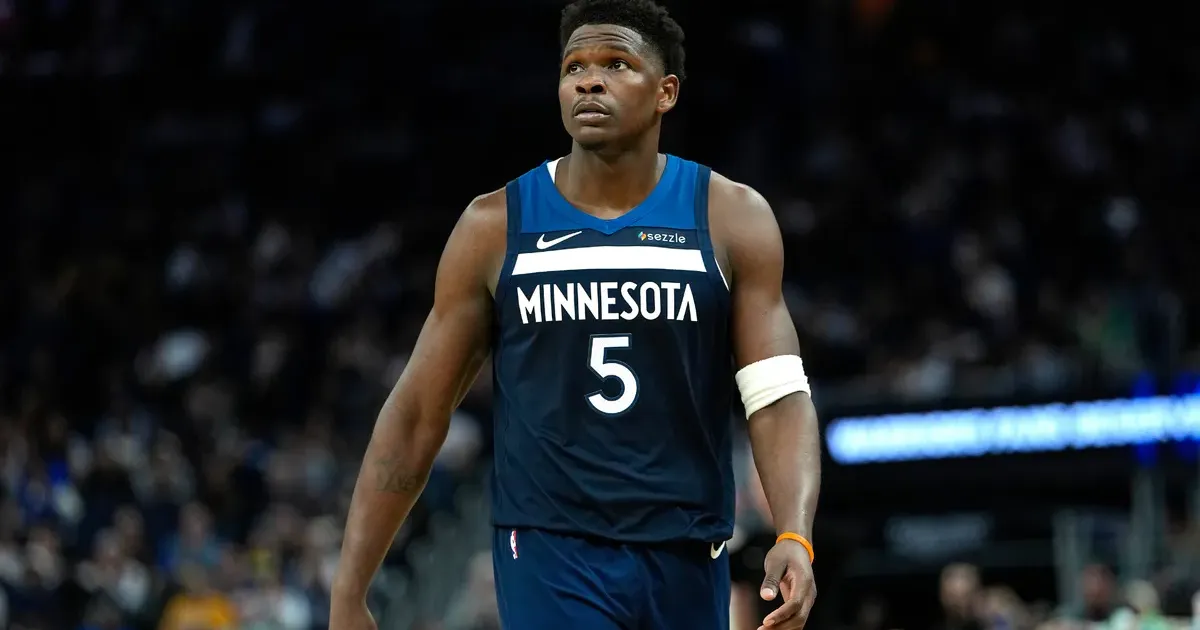
April 3, 2026, became a defining date for the Minnesota Timberwolves as the organization officially ruled out guard Anthony Edwards for a matchup against the Detroit Pistons. While the immediate concern involved a 113-108 loss to Detroit, the long-term implications for the franchise and its star player are far more meaningful. Missing this contest finalized his status as ineligible for postseason accolades, including the Most Valuable Player award and All-NBA honors. The league mandate requires players to participate in at least 65 games to qualify for these distinctions, a threshold Edwards can no longer reach.

Knee pain and a separate illness sidelined the guard at a critical juncture of the season. Statistics from the current campaign indicate Edwards was performing at a career-best level, maintaining an average of 29.3 points per game. His shooting efficiency also reached a personal high of 49.3% from the field. Such production typically secures a position on the All-NBA first or second teams, honors that Edwards achieved in each of the two previous seasons. Those paths are now closed due to the strict enforcement of the participation minimum.

Minnesota Guard Falls Short of Game Minimum

Absences for the Minnesota star began accumulating early in the year. A hamstring issue forced him to miss four games during the first month of the season, followed by a three-game stint on the bench in December because of a foot injury. Persistent discomfort in that foot led to three additional missed games in January. Despite these setbacks, Edwards stayed on a trajectory toward eligibility until a bout of knee inflammation in March forced him out for six consecutive games. He attempted a return on Monday but lasted only one game before his body failed to cooperate.

Technical details surrounding a game on October 26 sealed his fate. During that contest, Edwards logged only three minutes of playing time before leaving the court. Under the specific language of the league participation policy, a player must participate in at least 20 minutes for a game to count toward the 65-game requirement. Exceptions exist for games where a player logs 15 to 20 minutes, but only in limited circumstances. A three-minute appearance counts as a missed game in the eyes of the league office. This single night in October turned out to be the difference between eligibility and exclusion.

Injury management has become a point of contention between the front office and the league. While Minnesota Timberwolves officials aimed to preserve the health of their primary scoring threat for the playoffs, the rigid nature of the awards policy does not account for genuine medical setbacks. Team medical staff reported that the combination of lingering knee inflammation and a recent illness made his participation against Detroit impossible. His seventeenth official absence, when combined with the October technicality, pushed him over the limit.

Technicality Triggers Eligibility Crisis for Edwards

League officials implemented the 65-game rule to ensure that fans who purchase expensive tickets see the stars they paid to watch. This policy targeted the practice of load management, where healthy players sit out to rest. Edwards, however, has dealt with documented physiological issues rather than elective rest. His hamstring, foot, and knee injuries were verified by team physicians throughout the season. The current system fails to distinguish between a player seeking a night off and a player physically unable to perform.

Postseason awards carry more than prestige for players of his caliber. Many maximum-salary contracts include incentives that increase the total value of the deal if the player makes an All-NBA team. By falling short of the participation mark, Edwards potentially loses millions of dollars in future earnings. These financial stakes have created a rift between the players and the league office. Star athletes now face a choice between playing through pain to protect their earnings or prioritizing long-term health and sacrificing accolades.

The NBPA reached its breaking point last month, calling for the 65-game rule to be abolished after an injury to MVP candidate Cade Cunningham.

Opposition to the rule has intensified as more marquee names fall into the ineligible category. NBPA leaders have expressed frustration with a system they believe punishes athletes for the inherent risks of professional basketball. They argue that the 65-game floor is an arbitrary number that ignores the reality of an 82-game schedule. Recent statements from the union indicate that this policy will be a primary focus in future labor negotiations. The list of stars currently disqualified from awards consideration continues to grow as the regular season nears its conclusion.

Players Association Challenges Award Mandates

LeBron James and Stephen Curry are among the high-profile veterans who have already crossed the threshold of ineligibility this year. Other candidates including Nikola Jokić, Kawhi Leonard, and Devin Booker are currently within one or two games of the limit. If these players miss another week of action, the ballot for the Most Valuable Player award will be missing the majority of its traditional frontrunners. This trend threatens to diminish the historical significance of the awards if the best performers are excluded on a technicality.

Critics of the participation mandate point to the 2026 season as evidence of a flawed experiment. They suggest that the quality of the All-NBA teams will suffer if the voters are forced to select from a pool of available players instead of the most talented ones. Supporters of the league office maintain that the rule has successfully reduced the frequency of healthy scratches. Data from the first half of the season showed a slight increase in the participation of star players in back-to-back games. The gain in attendance comes at the cost of individual legacies and player salaries.

Timberwolves fans expressed disappointment on social media as news of the Detroit scratches broke. The team currently sits in a competitive position in the Western Conference, but the loss of individual recognition for Edwards is a blow to the franchise brand. Minnesota has rarely seen a player with his scoring prowess and charisma. Denying him a place in the history books for this season because of three minutes of play in October appears punitive to the local fan base.

Financial Fallout of the 65-Game Requirement

Financial analysts who follow the league note that the salary cap is directly affected by these award exclusions. When players fail to hit the benchmarks for supermax extensions, the team has more flexibility under the luxury tax apron. It creates a perverse incentive where organizations might feel less pressure to rush a player back from injury. If a star is ineligible for a raise, the team saves money on its future payroll. Such a dynamic complicates the relationship between a player and his team medical staff.

Professional basketball remains a business driven by availability. The league office believes that 65 games is a fair expectation for a full-time employee earning tens of millions of dollars. Commissioner Adam Silver has previously stated that the league owes it to the broadcast partners and the fans to put the best product on the floor every night. Edwards attempted to meet this expectation by playing through minor ailments in December and January. The cumulative physical toll simply became too high to sustain through the spring months.

Future rosters for the All-NBA teams will likely feature players with lower statistics who managed to stay healthy. The shift in selection criteria favors durability over peak performance. While some argue that staying on the floor is a skill in itself, others believe the awards should reflect who played the best basketball while they were active. Edwards produced the highest scoring average of his career while leading his team to a top-four seed. His name will be absent from the official ballot despite those achievements.

The Elite Tribune Strategic Analysis

Professional sports leagues increasingly prioritize consumer entertainment over physiological reality. The 65-game rule is not a measure of excellence but a blunt instrument of corporate compliance designed to appease broadcast partners who fear the absence of stars on Tuesday nights. By stripping Anthony Edwards of eligibility because he played three minutes instead of twenty in a random October game, the NBA has transitioned from a meritocracy to a bureaucracy. The integrity of historical records is being sacrificed to satisfy the demands of a television contract.

If the Most Valuable Player award no longer goes to the best player in the league, the trophy loses its meaning. We are entering a period where the history books will require an asterisk next to every award winner between 2024 and 2030. Fans in 20 years will look at the 2026 All-NBA teams and wonder why a player averaging 29 points was omitted in favor of a durable role player. It is a deliberate devaluation of the sport's highest honors.

The NBPA must refuse to renew this provision in the next collective bargaining agreement. Allowing the league to tie millions of dollars in earned incentives to an arbitrary game count is a failure of representation. Owners are the only winners in this scenario as they pocket the savings from unpaid bonuses. The league is teaching its stars that loyalty and playing through pain have no value if the clock stops at 19 minutes and 59 seconds. It is a cynical approach to a game that thrives on the brilliance of its individuals. Fans lose the stars, the stars lose the money, and the history loses its truth.