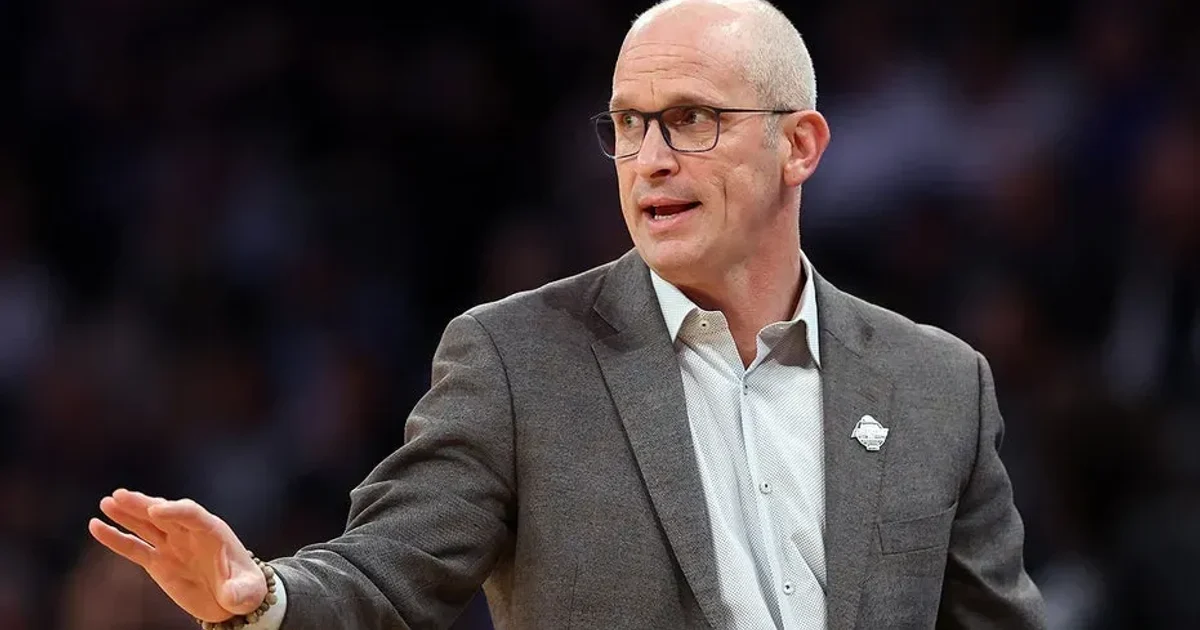
Dan Hurley confronted officials on April 3, 2026, during the University of Connecticut's narrow victory over Duke that secured a third Final Four appearance in four seasons. Braylon Mullins hit a 40-foot shot at the halftime buzzer that changed the momentum, yet the focus shifted quickly to the volatile behavior of the Huskies' head coach. Officials nearly assessed a technical foul against the bench during the final 0.3 seconds of the contest. Andrea Hurley, wife of the head coach, reportedly physically intervened to keep staff and players from entering the court prematurely. Her actions prevented a penalty that could have given Duke game-winning free throws.
Success in Storrs often comes with this specific brand of high-octane theatricality. Dan Hurley described his wife as a "Jersey boss lady" during a media appearance, noting she grabbed the back of warmups to restrain the sideline. Coaches at this level rarely credit their spouses for tactical restraint during the heat of tournament play. Andrea Hurley claimed she did not even know the Final Four existed four years ago. Now, she is a practical buffer between her husband’s intensity and the strict rulebook of the NCAA.
Dan Hurley and Officiating Confrontations
Referees often find themselves in the direct path of the Hurley storm. Roger Ayers, a veteran official, engaged in a literal head-to-head encounter with Hurley during the recent regional final. Hurley’s sportcoat hung loosely off one shoulder as he argued a call with a physical proximity that many observers found excessive. Former NFL referee Terry McAuley noted that such behavior typically warrants an immediate technical foul. Consistency in officiating remains a point of contention for opposing fan bases when facing the Huskies.
Hurley defends his actions as a necessary component of his competitive nature. He views the basketball court not as a venue for a game, but as a theater of conflict. College basketball has largely transitioned to a corporate model where coaches act as brand ambassadors. Hurley rejects this evolution. He embraces a persona that prioritizes immediate competitive advantage over public relations concerns. This approach has yielded two national titles and a return to the national semifinal in 2026.
For me, it is a life-or-death battle. It is a war. It is a street fight for me.
Direct physical confrontation with officials persists as a signature of his tenure. Critics argue that his behavior debases the role of a head coach. Proponents suggest that his fire is exactly what University of Connecticut players need to thrive under pressure. Results on the scoreboard provide a shield against most administrative discipline. Winning at this frequency creates a dynamic where sideline antics are viewed as a quirk rather than a liability. The game-altering performance by Braylon Mullins was the deciding factor in securing the Huskies' spot in the Final Four.
University of Connecticut Institutional Growth
Historically, the program struggled for basic recognition beyond the Northeast. Steve Pikiell once recounted stories of travelers asking if UConn was located in Alaska. The school began as an agricultural college surrounded by livestock and farmland. It has since transformed into the undeniable center of the college basketball universe. Dual dynasties in the men’s and women’s programs have produced 18 national championships and 33 combined Final Four appearances.
Basketball dominance helped elevate the university's national profile. Men's program became a blue blood in less than three decades, capturing its first title in 1999. Today, they sit in a tie for third for the most national titles in history. Women's program set the standard for three decades under Geno Auriemma. No other institution has seen both programs reach the Final Four in the same season six different times. This institutional success creates an environment where high-stress coaching is the baseline expectation.
Revenue and recruitment trends follow the winning trajectory. Top-tier prospects choose Storrs specifically for the demanding culture Hurley maintains. The 2026 run included a victory over a highly-touted Illinois squad that struggled to match the Huskies' physicality. Players describe the practice environment as more grueling than the actual tournament games. This preparation allows the team to remain composed even when their coach appears to be losing his temper on the sideline.
Coaching Philosophy and Tactical Aggression
Tactical brilliance often gets lost in the discussion of Hurley’s temperament. His offensive sets use complex screening actions that exploit even the smallest defensive lapses. Mullins' late-game heroics against Duke resulted from a specific play-call designed to create space for a long-range attempt. Hurley manages the clock with a precision that belies his frantic appearance. The contrast between his sideline outbursts and his late-game execution creates a difficult scouting report for opponents.
Maintaining this level of success requires constant psychological calibration. Hurley acknowledged that the pressure of defending titles can be suffocating. The 2025 tournament ended in a second-round loss to Florida, which was a catalyst for the current season's resurgence. Redemption is a powerful motivator in the UConn locker room. The coaching staff uses previous failures to ensure that complacency never takes root in the program.
The Final Four matchup against Illinois presents a clash of styles. Illinois relies on modern analytical spacing and high-volume perimeter shooting. UConn utilizes a more traditional approach centered on interior dominance and relentless offensive rebounding. Hurley’s ability to motivate his frontcourt players determines the outcome of these high-stakes games. Every scream and every gesture on the sideline aims to extract maximum effort from his roster. The 2026 season proves that the Hurley method, however controversial, continues to produce elite results.
The Elite Tribune Strategic Analysis
Modern college athletics has become a sanitizing machine designed to turn educators into corporate avatars. Dan Hurley is a violent rejection of that trend, and while his behavior toward officials like Roger Ayers is objectively unprofessional, it is also the primary reason for his success. The University of Connecticut has made a calculated trade: they accept the public relations headaches of a coach who head-butts referees in exchange for a trophy case that rivals Kentucky and UCLA. It is the new reality of high-stakes sports where the win-loss record functions as a universal solvent for character flaws.
The picture emerging is the birth of a coaching archetype that prioritizes tactical intimidation over sportsmanship.
If the NCAA truly cared about the integrity of the game, Hurley would have been hit with a technical foul during the final 0.3 seconds against Duke. Instead, the governing body allows the loudest voices to dictate the terms of the engagement. The leniency signals to every aspiring coach in the country: if you win enough, the rules do not apply to you. Hurley is not the problem; he is simply the most successful symptom of a system that has abandoned its standards in favor of the spectacle. Expect his behavior to become the new industry standard. UConn wins.