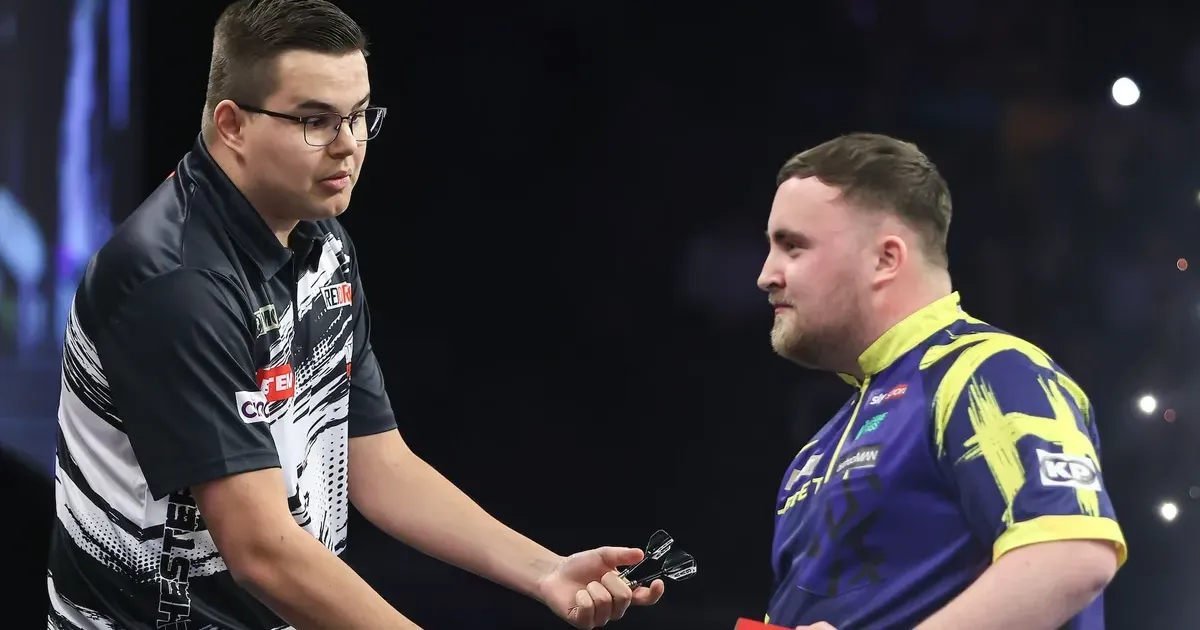
Gian van Veen's 6-5 win over Luke Littler gave Premier League Darts a flashpoint, but Gerwyn Price still owned Night Nine in Manchester. The quarter-final produced the clip everyone wanted to argue about: missed match darts, visible irritation, a brief handshake and Van Veen saying Littler had crossed a line during the finish.
The row traveled quickly because Littler is the sport's biggest young draw and Van Veen had just beaten the world No. 1 in a deciding leg. Even so, the night cannot be reduced to one exchange at the oche. Van Veen beat Littler, reached the final, and Price then beat Van Veen 6-2 at the AO Arena. The sequence matters because darts is still judged first by legs won, not by the loudest replay package.
The scoreline still leads
The Van Veen-Littler quarter-final already mattered before the handshake became part of the story. Littler entered the night as the player every opponent is measured against. Beating him on a televised Premier League stage gives Van Veen a result with value beyond one table movement.
The deciding leg gave the tension a real sporting base. The argument followed pressure darts rather than a forgettable match, a missed chance from Van Veen, missed chances from Littler and a finish that left both players exposed in front of a loud Manchester crowd.
"Out of order."
Van Veen's phrase became the headline hook, but the result made the phrase travel. Without the 6-5 win, the complaint would have had a shorter life.
Van Veen got more than a clip
For Van Veen, the useful part of the night was not the argument. The night proved that he could take a Premier League stage against Littler and leave with the win. Invitational darts can change a player's public position quickly because casual viewers often enter through one match, one opponent and one televised moment.
A Littler win gives future meetings an immediate hook without needing fake heat. It also gives Van Veen a discipline test. If the rivalry becomes only reaction clips, it shrinks the performance that created the attention in the first place. His darts have to remain the reason people care.
The conduct line is narrow
Darts needs personality, crowd noise and visible edge. It also needs a line between gamesmanship and disrespect, especially when television cameras turn a closing exchange into a package for the next broadcast. Van Veen's complaint should not be dismissed as theatre. Littler should not be flattened into one irritated moment either.
A credible standard leaves room for emotion without treating every celebration, stare or word as a disciplinary case. The PDC's job is to protect the contest from cheapening itself, not to make elite players look emotionless under pressure.
Price made the night his own
Gerwyn Price pulled the evening back toward form with his result. He beat Van Veen 6-2 in the final and turned Night Nine into a story about finishing, rhythm and recovery rather than only a social-media argument.
The weekly format punishes players who spend too much emotional energy on one match. Van Veen had the Littler result, but Price had the cleaner tournament arc. He handled the later rounds, kept the scoreboard moving and left Manchester with the title. In Premier League terms, sustained results are the currency that lasts.
The rivalry has to earn its next chapter
Van Veen and Littler now have a rivalry line broadcasters can use when they meet again. Darts sells personalities, and the sport is stronger when major matches carry memory. The danger is letting the memory become cheaper than the contest.
The next meeting should be sold on scoring pressure, checkouts and nerve under bright lights. Strong darts will make the tension feel real without extra staging. Weak darts will leave the argument stranded as a clip with no sporting weight behind it.