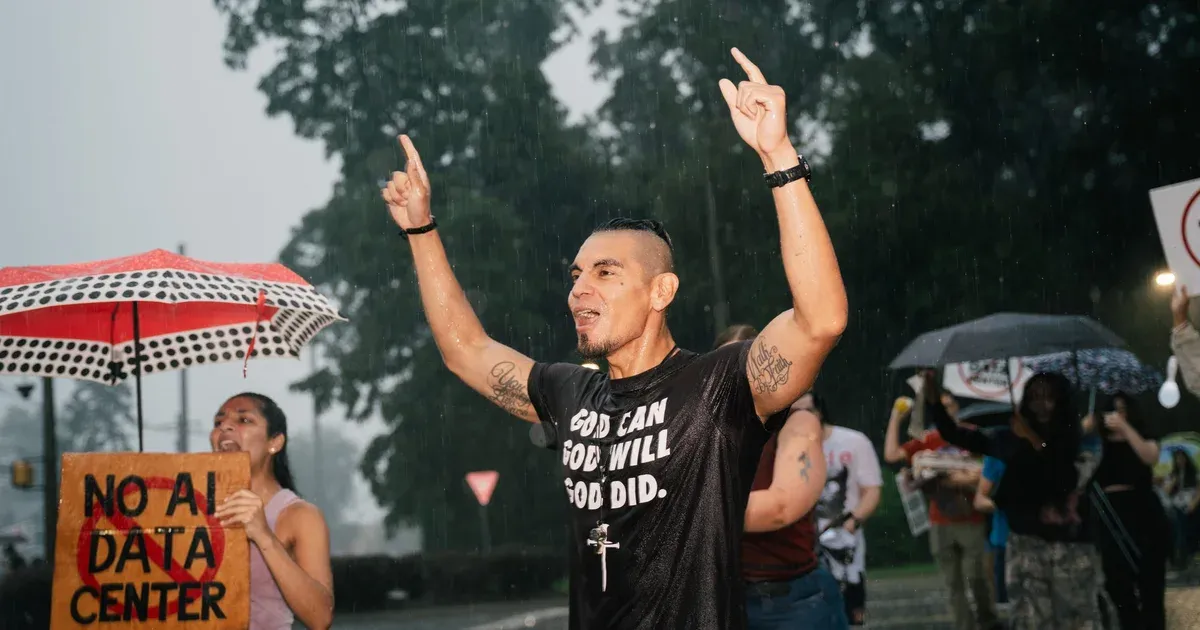
Opposition to AI data centers moved from planning meetings to a coordinated national protest on Saturday, with demonstrations held across the United States against the speed and local cost of the infrastructure buildout.
Humans First organized the events on July 18, 2026. Business Insider reported that the conservative-led nonprofit planned more than 100 demonstrations from Alaska to Florida, while Reuters counted at least 125 scheduled locations earlier in the day. The organizer’s map carried an important caveat: local volunteers ran the events independently, and a listing did not amount to a full endorsement or vetting by the national group.
The rallies did not rest on a single objection to artificial intelligence. Signs and speeches focused on electricity bills, water supplies, noise, tax incentives and closed-door development agreements. Other participants opposed AI systems themselves or the effect they could have on jobs and surveillance. That mix made the protest day broad, but it also left the coalition without one nationwide policy demand.
Kenilworth Turned a National Campaign Into a Local Fight
In Kenilworth, New Jersey, protesters gathered outside the municipal court in heavy rain to oppose a $1.8 billion data center planned for the former Merck campus. Business Insider described whistles, horns, a drum and sidewalk chalk as the crowd continued marching after the weather worsened. One sign warned about water pressure; another called for community investment instead of data centers.
The borough’s records say the redevelopment plan was approved by the council in October 2024 and by the planning board in May 2025. Opposition grew after those votes. Business Insider said an April petition to stop construction collected more than 12,000 signatures, compared with a borough population of about 8,500. The comparison does not show that every signer lived in Kenilworth, but it does show how far the dispute had spread beyond the original approval hearing.
Kenilworth is one example of a protest rooted in a specific project rather than a general fear of server buildings. Residents have pressed officials over the approval sequence, electricity demand, tax support and the number of permanent jobs attached to a large capital investment. Their leverage now lies in later permits, public meetings and political pressure because the principal land-use decision has already been made.
Power Bills, Water Use and Secrecy Joined Different Groups
Reuters found opposition in both Republican and Democratic areas. A June Reuters/Ipsos poll said only 14% of respondents would support an AI data center in their community, and about one-third approved of the current pace of US construction. Texas had the largest group of planned rallies as of Friday, while Georgia, California, Florida and Pennsylvania also had multiple events.
Local conditions change the argument. In California’s Imperial County, a proposed project sought access through litigation to 260 million gallons of Colorado River water per year after an earlier recycled-water plan failed, CalMatters reported. In cities with constrained electric systems, the conflict centers on generation and grid upgrades. Seattle had already imposed an emergency freeze on large data centers while officials studied utility, water and public-health effects.
Industry representatives argue that data centers can support construction jobs, economic growth and the computing capacity needed to compete with China. The Data Center Coalition did not immediately comment on the July 18 protests, according to Reuters, but had previously said its members were committed to acting as responsible neighbors. Protesters answered that promised benefits should be tested against enforceable terms, not accepted before a project’s load and subsidies are public.
Local Approval Rules Are the Movement’s Common Ground
Humans First is chaired by Amy Kremer, a former Tea Party organizer who also helped organize the rally that preceded the January 6, 2021, attack on the US Capitol. Business Insider noted that Kremer neither planned nor participated in the riot. Her leadership gives the national campaign a conservative base, although both the group and Reuters described data center opposition as crossing party lines. Kremer used the protest day to reject the idea that communities must accept every proposed facility:
“The data center boom has been sold as inevitable. It is not.”
The group’s formal position is narrower than a ban. It opposes national and state moratoria and says each community should decide whether and under what terms a data center is built. Its published platform also calls for ending corporate subsidies and protecting household bills, water supplies, neighborhoods, noise levels and air quality. That separates Humans First from federal proposals by Democrats including Alexandria Ocasio-Cortez and Bernie Sanders, who have called for a nationwide pause. It also places the campaign against the Trump administration’s push to accelerate AI infrastructure without making the organizer an opponent of President Donald Trump.
The protest day can increase turnout and attention, but permits, utility contracts and tax agreements are still decided through different state and local processes. Kenilworth’s opponents are contesting a project after approval; Imperial County residents are fighting over water and environmental review; Seattle acted before new permits advanced. The coalition will last only if those different communities can turn a shared demand for local authority over AI infrastructure into rules that apply before construction commitments become difficult to reverse.