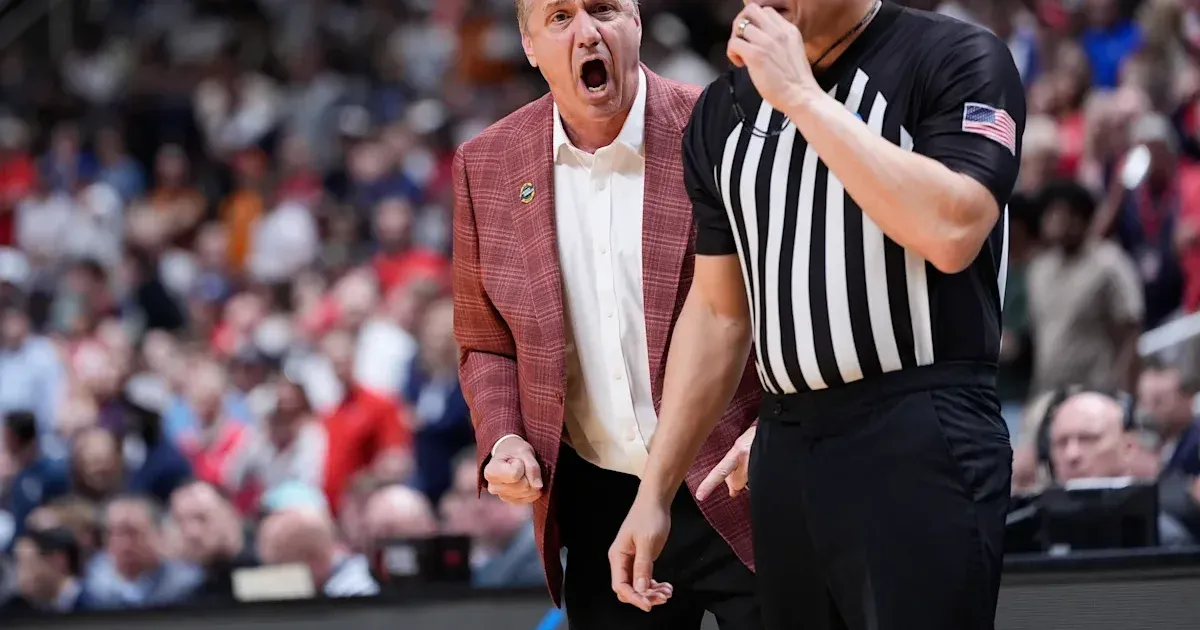
Arizona turned a Sweet 16 meeting with Arkansas into a statement about efficiency, depth and tournament control. The score was not built on a barrage of three-pointers. Arizona shot 64% from the field, attacked the paint and kept Arkansas chasing the game for most of the night. The Wildcats won 109-88 in San Jose on March 27, 2026, reaching the Elite Eight for the first time since 2015.
The result also changed the conversation around coach Tommy Lloyd, whose earlier teams had carried questions about March staying power. Against Arkansas, the Wildcats looked settled rather than rushed. They moved the ball quickly, found cutters, punished late rotations and forced John Calipari's team to defend longer than it wanted to on nearly every possession.
That control was visible before the margin became lopsided. Arizona did not need a frantic tempo to separate. It used early paint touches to make Arkansas collapse, then attacked the spaces that opened after the first rotation. The Razorbacks had enough scoring to avoid a full collapse, but they never forced the game into the kind of loose, turnover-heavy rhythm that might have favored a comeback.
Interior Scoring Set the Tone
Arizona's shot profile explained the margin. Only eight of the Wildcats' field-goal attempts came from three-point range, yet they still scored 109 points. That kind of output requires constant pressure near the rim, smart passing and enough mid-range touch to keep defenders from collapsing completely. Arkansas never found the balance. Five Arizona starters finished in double figures, giving the offense multiple release valves whenever the Razorbacks tried to adjust. Forward Brayden Burries led the scoring with 23 points, many of them created by movement before the catch. The Wildcats were not simply bigger. They were more connected possession by possession.
The low number of three-point attempts made the efficiency more striking. Arizona did not chase the modern tournament shortcut of trading threes for variance. It trusted screening angles, rim pressure and short-range touch. That approach forced Arkansas to defend without rest, because every missed assignment led to a layup, foul or clean mid-range attempt.
By early in the second half, the lead had grown large enough that Arkansas needed stops more than highlights. Those stops did not come. Arizona reached 80 points before the midpoint of the half and continued to generate clean looks even after the game became physical. The performance suggested a team comfortable winning without depending on one hot shooter.
Arkansas Lost Discipline Late
Arkansas had offensive stretches that would have kept it in many tournament games, but the defensive leaks were too large. The Razorbacks struggled to protect the paint, and foul trouble made the problem worse. Billy Richmond's ejection after a Flagrant 2 foul on Ivan Kharchenkov became the clearest sign that frustration had overtaken structure.
Billy Richmond was assessed a Flagrant 2 foul and ejected after the second-half collision.
Richmond had given Arkansas scoring and rebounding before leaving the game. Nick Pringle fouled out soon after, and the final minutes were shaped by whistles, technicals and stoppages. Those moments did not create the deficit by themselves, but they removed any chance of a controlled comeback. For Calipari, the loss raised familiar questions about defensive organization in March. Arkansas scored 88 points, enough to win on many nights. It still lost by 21 because Arizona's offense repeatedly reached the spots it wanted. The gap between talent and execution was the story.
That gap was not just tactical. It showed up in body language after missed rotations and in the fouls that followed late help. Arkansas had the athletes to contest shots, but Arizona kept making the first defender wrong and the second defender late. By the time the Razorbacks adjusted, the Wildcats had already turned the possession into a high-percentage look.
Purdue Awaits in the West Final
Arizona's reward is a West region final against No. 2 seed Purdue. That matchup should be more demanding inside, where Purdue has the size and structure to challenge the same paint attacks that overwhelmed Arkansas. Arizona will not be able to assume that early cuts and post entries will come as cleanly. The Wildcats can still carry real confidence into the Elite Eight. They broke an 11-year regional-final drought, answered pressure on Lloyd and showed they can produce elite offense without living behind the arc. That combination travels well in March because it is less vulnerable to one cold shooting night.
The win does not make Arizona the tournament favorite by itself. It does make the Wildcats harder to dismiss. A team that scores 109 in the Sweet 16 while taking only eight threes has a clear identity, and Arkansas could not disrupt it. Purdue now gets the next chance to find out whether that identity can survive a stronger interior test.
The next layer is roster confidence. Arizona did more than survive a bracket test; it showed a scoring profile that can travel into the regional final because the Wildcats created high-percentage looks while keeping pressure on Arkansas defensively. That makes the Purdue matchup less about one upset result and more about whether Arizona's interior control can hold against a more disciplined opponent.