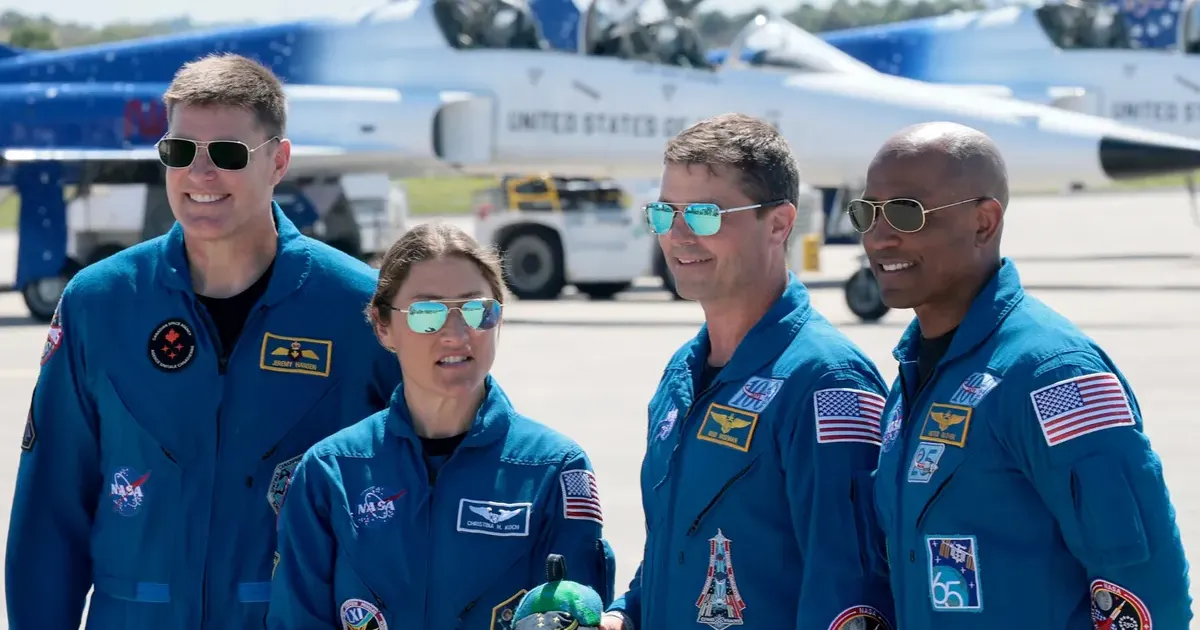
NASA astronauts entered final prelaunch quarantine to prepare for the Artemis II mission around the moon. The isolation period placed three Americans and one Canadian at Kennedy Space Center in Florida under strict health protocols before their scheduled launch. Medical personnel are monitoring every interaction to prevent common illnesses from entering the spacecraft environment. By March 29, 2026, preparations for this flight had reached a critical final 72-hour phase.
Quarantine protocols involve more than simple physical separation from the public. Flight surgeons oversee every meal and exercise session to maintain peak physical condition for the long journey. Family visits occur only behind glass or through digital interfaces during this final phase. Such measures ensure that no viral pathogens compromise the mission timeline or the safety of the Orion capsule interior. Astronauts use this time to review flight manuals and coordinate with ground controllers in Houston. Every minute of the upcoming ten-day mission is rehearsed with clinical precision.
Commander and pilot duties require absolute mental clarity during the lunar injection burn. Reports from the quarantine facility suggest the crew remains focused on the technical complexity of the mission trajectory. Personal belongings have been sterilized and packed into the small storage lockers of the Orion spacecraft. Mission planners designated April 1, 2026, as the primary launch window for the Space Launch System rocket. Success hinges on thousands of ground systems operating in perfect synchronization during the countdown.
Artemis II Launch Sequence and Trajectory Details
Engineers at Launch Complex 39B finalized fueling tests early this morning. Cryogenic oxygen and hydrogen will flow into the core stage during the final hours of the countdown. $11 billion in development costs represent the investment in the Space Launch System vehicle powering this ascent. Unlike the uncrewed Artemis I flight, this mission carries life-support systems improved for human respiration and temperature control. Technicians confirmed that the pressure vessel maintains its integrity under vacuum simulations. These tests provide the data necessary for the flight director to give the final launch authorization.
Flight dynamics for the mission involves a high Earth orbit before the trans-lunar injection maneuver. Astronauts will spend the first 24 hours checking systems in a high-altitude elliptical orbit. Once the upper stage sparks, the crew will accelerate toward the moon at speeds exceeding 25,000 miles per hour. Navigation relies on both automated star trackers and manual optical measurements. This flight path brings humans closer to the lunar surface than any mission since 1972. Orion will use lunar gravity to slingshot back toward Earth without a secondary engine burn.
Communication relays depend on the Deep Space Network stations in California, Spain, and Australia. Signal latency will increase as the spacecraft moves hundreds of thousands of miles away from terrestrial antennas. Crew members must manage several shipboard systems independently if communication drops occur during the lunar far-side transit. Redundancy remains a core requirement for every electronic component inside the cockpit. Software updates were uploaded last night to address minor sensor calibration issues found during the final simulation. Engineers expressed confidence in the current code stability.
International Partnerships Drive Lunar Flight Objectives
Canada provides critical technical support and personnel for this deep-space effort. The inclusion of a Canadian astronaut marks a meaningful expansion of the Artemis program beyond US borders. Collaboration between the Canadian Space Agency and NASA ensures that orbital logistics remain standardized across different modules. Future missions will rely on the Lunar Gateway, a station that requires international maintenance and docking protocols. Today, the focus is entirely on the performance of the Orion heat shield during reentry. Heat shield integrity was a primary concern for investigators after the previous uncrewed test flight.
Crew briefings have repeatedly emphasized trust among the four astronauts as a practical safety requirement rather than a ceremonial phrase.
Trust between the four individuals is essential for a mission of this duration and danger. Daily briefings from the quarantine quarters indicate the crew is satisfied with the hardware adjustments made over the last year. Stress levels are monitored through biometrics to ensure no member suffers from pre-launch fatigue. Psychological readiness is as important as technical proficiency when confined to a small capsule for over a week. Team members spent thousands of hours in simulators together before arriving at the Cape. This bond is the foundation for their decision-making process under pressure.
Ground crews at the Kennedy Space Center completed the final walk-around of the mobile launcher. External cameras and sensors show no signs of ice buildup or structural fatigue. Weather forecasts for the April 1 launch window suggest a 70% chance of favorable conditions. High-altitude winds are the primary concern for the safety of the solid rocket boosters. If winds exceed safety limits, the launch will be scrubbed and moved to a backup window. Launch controllers have three potential windows available over the next five days.
Science Payload and Deep Space Biological Research
Biological experiments occupy a portion of the Orion cargo space to study radiation effects. Humans traveling beyond the protection of the Earth's magnetic field face increased exposure to cosmic rays. Sensors placed throughout the cabin will record dosage levels at different stages of the flight. Data from these sensors will inform the design of future Mars-bound spacecraft. Scientists want to understand how deep-space radiation affects human tissue over long durations. This information is essential for the long-term goal of establishing a permanent lunar base.
Internal cameras will document every aspect of life aboard the spacecraft for historical and engineering records. High-definition video will be streamed back to Earth whenever bandwidth allows. These visuals help engineers analyze how the crew interacts with the new cockpit displays and controls. Physical ergonomics play a role in mission success, especially during high-G maneuvers. Seat dampers and restraint systems have been redesigned to improve crew comfort during splashdown. Impact forces in the Pacific Ocean can reach serious levels depending on wave height.
Recovery teams from the U.S. Navy are already in position in the Pacific recovery zone. Divers and helicopter crews practice retrieving a mockup of the Orion capsule daily. The ship tasked with recovery, the USS San Diego, features specialized medical facilities for the returning astronauts. Physiological changes after ten days in microgravity require immediate medical attention upon landing. Crew members may experience vertigo and muscle weakness until they readapt to Earth's gravity. NASA medical teams will lead the initial health assessments on the recovery deck.
What Artemis II Must Prove
NASA is betting its entire institutional reputation on the success of the Artemis II mission. While the agency presents a narrative of seamless cooperation and technical perfection, the reality is far more unstable. The transition from uncrewed testing to human flight involves risks that no simulator can fully replicate. Engineering reports from 2025 highlighted lingering concerns regarding the Orion heat shield charring patterns, yet the launch proceeds on a timeline dictated more by political necessity than technical absolute. Space exploration has always been a tool of soft power, and the 2026 deadline feels like a desperate attempt to maintain American dominance in a crowded lunar race.
Will the hardware hold? The Space Launch System is a magnificent piece of engineering, but it is also a relic of 20th-century design philosophy tethered to 21st-century expectations. If Artemis II encounters even a minor system failure, the political fallout will likely jeopardize the funding for Artemis III and the eventual moon landing. Critics of the program point to the rising costs and the reliance on legacy contractors as evidence of a bloated bureaucracy. NASA needs a flawless mission to justify its existence to a skeptical Congress. Anything less than a perfect return will be seen as a failure of the American aerospace complex.
Safety remains the stated priority, but the pressure to launch is undeniable. It is the gamble of the decade.