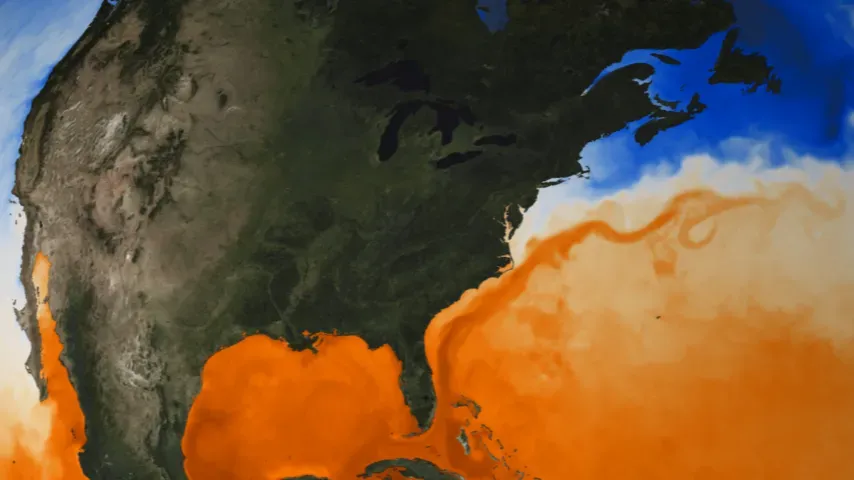
Scientists identified warning signals that may point to growing instability in the Atlantic Ocean current system, sharpening concern over one of climate science’s most consequential tipping risks. The focus is the Atlantic Meridional Overturning Circulation, often described as a heat-moving conveyor that helps regulate weather across the North Atlantic region. The warning signs are subtle. They matter because the system normally changes slowly. The report was published March 23, 2026. The system carries warm surface water northward and sends colder, denser water back south at depth. That movement affects rainfall, storm tracks, marine ecosystems and temperature patterns. A severe weakening would not look like a single disaster movie moment. It would appear through changed regional climates, altered fisheries and more volatile extremes.
What the Warning Signals Mean
Researchers look for signs such as reduced resilience, shifting salinity patterns and changes in how quickly the system recovers from disturbances. These indicators do not prove an immediate collapse. They suggest that the current may be moving closer to a less stable state. Climate systems can weaken gradually for years before crossing a threshold. Once a threshold is crossed, recovery may be slow or impossible on human planning timelines. Scientists therefore pay close attention to early-warning behavior even when uncertainty remains high. Atlantic current collapse is a high-impact, uncertain-risk problem. The uncertainty should not be read as comfort. It means policymakers are dealing with a risk that is difficult to time but too large to ignore.
Regional Effects Would Be Uneven
A major weakening could cool parts of the North Atlantic even as the planet warms overall. It could shift rainfall belts, affect European weather patterns and raise sea levels along parts of the North American coast. Tropical rainfall systems could also move, affecting agriculture far from the ocean itself. Marine ecosystems would face additional stress. Species distribution depends on temperature, nutrients and currents. If the circulation changes, fisheries may move or shrink, and coastal economies could face planning problems that current models do not fully capture.
Researchers described the signals as a warning of reduced stability rather than proof of an immediate shutdown.
The Policy Problem Is Timing
Governments prefer risks with deadlines. The Atlantic circulation does not offer one. That makes it tempting to delay action until evidence becomes undeniable. The danger is that undeniable evidence may arrive too late for prevention. Adaptation planning can still begin now. Coastal infrastructure, fisheries management, flood models and agricultural planning can incorporate scenarios where North Atlantic patterns shift faster than expected. The goal is not panic; it is avoiding a planning system that assumes the ocean will behave as it did in the twentieth century. Emissions cuts remain central because warming and freshwater input from melting ice are key stressors. Reducing the pressure on the system is the most direct way to lower long-term risk. Adaptation can manage consequences, but mitigation addresses the driver.
Science Is Moving From Detection to Risk Management
The latest warning signals show how climate science is changing. Researchers are not only documenting warming. They are trying to identify points where systems may reorganize. That work is messy because natural variability and limited historical data make certainty difficult. Still, the practical message is clear enough. A stable Atlantic circulation has been part of the background assumption for modern agriculture, coastal planning and European weather risk. If that assumption weakens, the consequences reach well beyond oceanography. The monitoring challenge is significant. Scientists need long records from floats, satellites, moorings and research cruises to distinguish lasting change from normal variability. Gaps in that record make the warning system weaker just when governments need more confidence in the data.
The risk also has a justice dimension. Fisheries, small coastal communities and rain-fed farming regions may face consequences even if they contributed little to the emissions driving the stress. That makes adaptation funding and open climate data part of the policy response, not a side issue. Communication will be just as important as measurement. A phrase like collapse can sound sudden, while the real concern may involve decades of weakening and regional disruption. The public needs language that conveys urgency without pretending scientists can name the exact year of a threshold.
Governments already plan for uncertain risks in insurance, public health and national security. The Atlantic circulation deserves the same treatment. Waiting for unmistakable proof would leave coastal planners, food systems and energy networks with fewer options. The science is still developing, and that uncertainty should be stated clearly. Different models can disagree on timing, sensitivity and the strength of feedback loops. But disagreement over the precise threshold is not the same as disagreement over vulnerability. A system can be hard to forecast and still be dangerous to stress.
For Europe, the stakes include winter weather patterns, storm behavior and agricultural planning. For North America, parts of the Atlantic coast could face additional sea-level pressure if circulation weakens. For the tropics, rainfall shifts could affect food security in regions with fewer resources to adapt. The warning signals therefore belong in more than academic journals. Port authorities, fisheries managers, insurers, grid planners and public health officials all make long-lived decisions. If those decisions assume a stable twentieth-century ocean, they may be poorly matched to a changing climate system.
The practical response is not panic. It is better monitoring, faster emissions reduction and adaptation plans that take ocean instability seriously. That is the difference between treating the warning as a headline and treating it as risk information. That kind of planning requires a longer political horizon than most governments prefer. Ocean systems do not move on election cycles, and infrastructure built today may still be exposed decades from now. The warning signals are a reason to bring that timeline into current budgets. The next stage of research will need to connect warning signals with local decisions. Coastal defenses, fisheries policy and emergency planning all require scenarios that are specific enough to use, not only global warnings.
The warning belongs in mainstream risk planning now. Governments do not need certainty about the exact timing of a circulation shift to invest in monitoring, coastal planning and emissions reduction. Waiting for unmistakable proof would leave too little time to prepare.