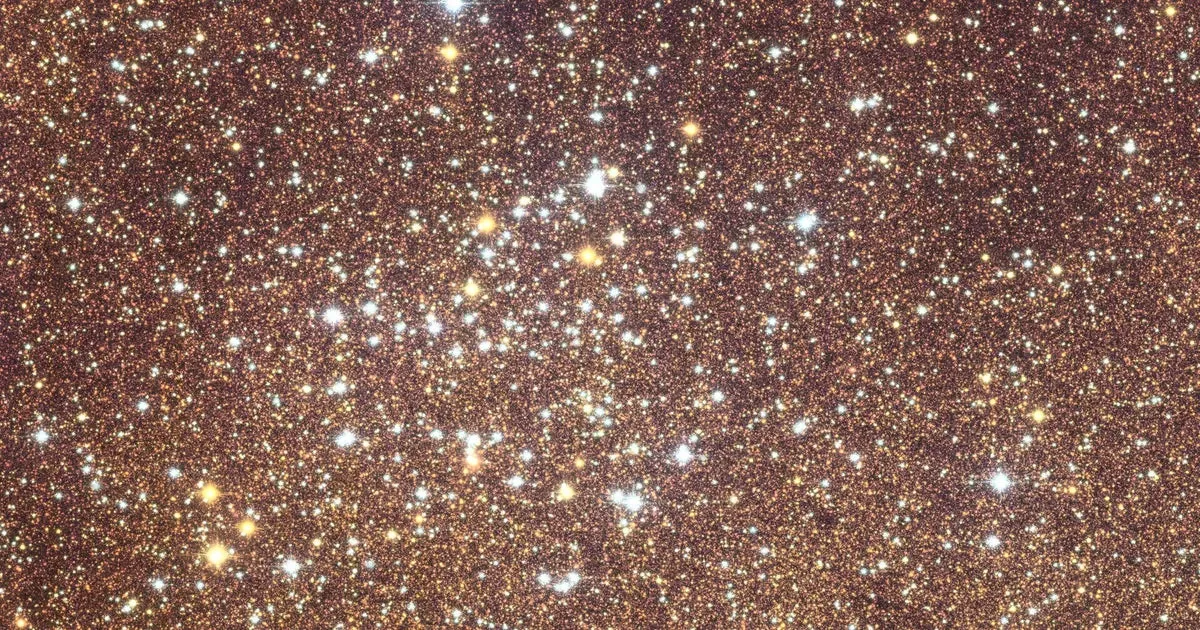
Europe's Euclid space telescope has turned a survey of the Milky Way's crowded center into a new tool for astronomers hunting planets beyond the solar system. The result is visually dramatic, but its scientific value comes from the way it gives researchers a sharper map of one of the most difficult parts of the sky. On June 24, 2026, the release also showed how a mission built for cosmology can strengthen a very different branch of astronomy.
The image released by the European Space Agency captures the galaxy's central bulge in unusual detail, giving researchers a clearer reference map for a dense star field where small changes in brightness can carry large meaning. In that region, stars overlap, dust complicates the view and faint signals can be lost without a careful baseline.
CBS News, citing AFP and ESA material, reported that the view contains about 60 million stars and covers a region where many known and future exoplanet detections can be checked. The image also includes dozens of known planetary systems, which gives scientists a useful comparison point for later observations.
The result matters because planet hunting often depends on tiny brightness changes that are easy to confuse in crowded skies. A cleaner reference image can help astronomers decide whether a signal belongs to a planet, a foreground star or another source of visual noise.
That dual use is important for researchers planning the next decade of sky surveys. Instruments are now expensive enough, and datasets large enough, that every major release is judged by how many questions it can help answer beyond the headline mission.
A Dark Matter Mission Finds A Planet Role
Euclid launched in 2023 to map a large share of the sky and help scientists study dark matter and dark energy, two of the biggest unsolved problems in physics. Its main job is not to find planets, and that is what makes the release more interesting: a strong dataset is proving useful outside its original mission brief.
Yet the same precision that helps Euclid map distant galaxies also helps it separate stars in the Milky Way's bulge. That is valuable because the center of the galaxy is bright, crowded and difficult to interpret from the ground, where atmosphere and viewing limits can blur the faint changes researchers want to measure.
The new mosaic was built from nine wide-field images taken over 26 hours in March 2025. ESA said the image includes 51 known planetary systems, creating a baseline that can help scientists study additional planet signals later as other telescopes collect new time-series observations.
A clearer map of the Milky Way's center gives planet hunters a better way to separate real signals from crowded starlight.
Microlensing Needs A Cleaner Map
The key technique is microlensing, a process that occurs when a foreground star passes in front of a more distant star and briefly magnifies its light. If a planet orbits the foreground star, it can add a small extra change in brightness that appears only for a limited window.
Those changes are brief and subtle, so the background field has to be understood carefully. A detailed Euclid image can help scientists decide whether a signal points to a planet, a stellar blend or another source of noise, and that distinction can affect later estimates of a planet's mass and orbit.
That makes the image useful even if it does not immediately produce a list of new worlds. Astronomers can use it as a reference when future observations from Euclid, ground telescopes or NASA's planned Nancy Grace Roman Space Telescope pick up possible microlensing events in the same crowded region.
Why The Image Carries Wider Value
The image also helps explain why astronomy increasingly depends on large, shared data products rather than single-purpose snapshots. Mapping millions of stars at once gives researchers a common frame for exoplanets, stellar structure and galactic evolution, which means the same release can support several research communities.
Exoplanet research has already moved beyond simple discovery counts. Scientists now want better estimates of planet masses, locations and host systems, and that requires sharper context around each detection rather than only a report that a brightness spike occurred.
The release arrives during a broader race to process enormous astronomical datasets. High-performance computing advances reveal the same pressure in another form: more sky data requires more computing power, better models and faster validation.
Euclid's Milky Way image is therefore more than a striking picture. It is a working reference layer that can help scientists compare observations, reduce false signals and prepare for the next wave of planet hunting across the crowded heart of the galaxy. The practical value will build over time as future surveys return to the same region and scientists test new candidate worlds against this cleaner baseline.