Liquid air, hot salt and crushed stone are being used to shift renewable energy from the hours when it is abundant to the hours when it is needed. Researchers have also made a paper patch that draws electricity from sweat. These devices are routinely grouped under the word battery. Their inputs, outputs and useful scales are so different that the shared label can mislead.
A Guardian survey published on July 19, 2026, brought the four approaches together as developers look beyond conventional lithium-ion packs. The comparison ranges from a 300 MWh grid installation to a patch producing milliwatts. Any useful comparison has to identify whether a system returns electricity, supplies heat or powers a sensor.
Liquid Air Returns Stored Energy to the Grid
Highview Power's Carrington project near Manchester uses surplus electricity to cool air to about -196C. At that temperature, the air becomes a liquid occupying roughly one seven-hundredth of its gaseous volume. Insulated tanks hold it until demand and prices rise. The liquid is then warmed, expands and drives a turbine, sending electricity back through a generator.
The plant is designed for 50 MW of output over six hours, giving it 300 MWh of storage. Construction formally began in November 2025 at the Trafford Low Carbon Energy Park. Highview calls it the largest commercial-scale liquid-air storage plant, while the Guardian reports that operations are targeted for the end of 2026. That timetable remains a project target until commissioning is complete.
Liquid air competes on duration and siting rather than compactness. Its tanks and turbines suit an industrial site, not a car or phone, and each conversion step loses some of the original electricity. In exchange, the working fluid is ordinary air and the equipment avoids the lithium, cobalt and nickel found in many electrochemical cells. A six-hour discharge can cover an evening demand period; it is not a seasonal reserve.
Salt and Sand Store Heat Instead of Charge
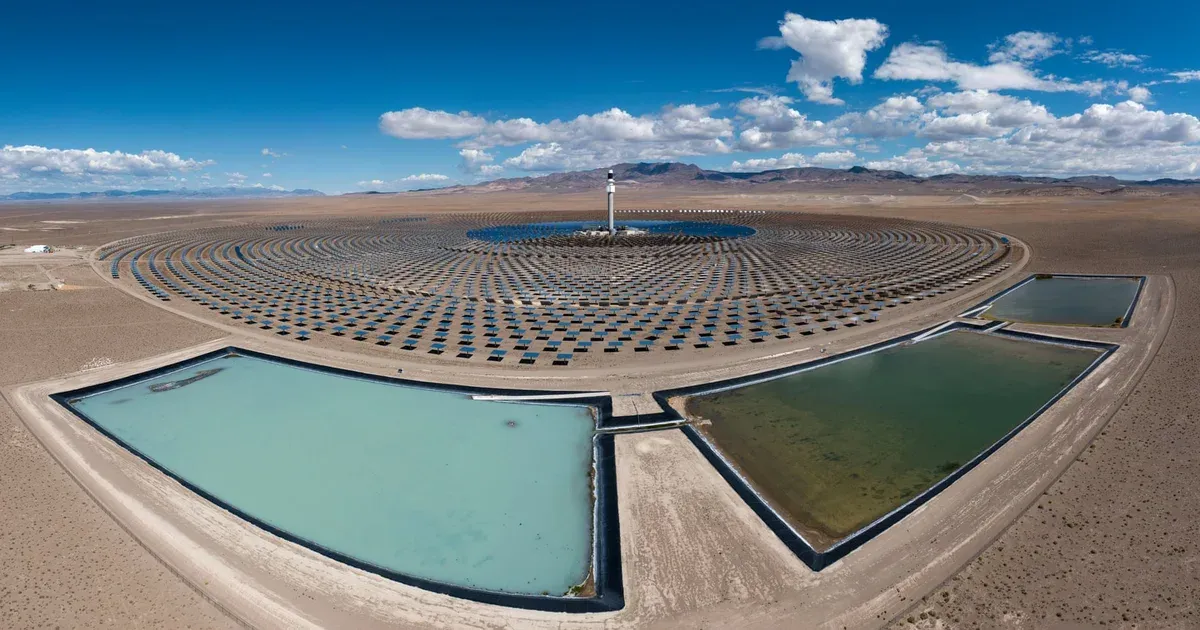
Crescent Dunes in Nevada was designed around a field of mirrors that concentrates sunlight on a central receiver. Potassium and sodium nitrate are heated to about 560C and stored in tanks. When electricity is required, that heat makes steam for a conventional turbine. The US Department of Energy describes the plant design as providing about 10 hours of thermal storage, allowing solar energy collected in daylight to produce power after sunset.
Calling this a molten-salt battery is convenient, but the storage medium holds heat rather than an electrochemical charge. That distinction affects where the technology makes sense. A power tower already needs high-temperature equipment and a steam cycle, so a hot tank fits the rest of the plant. An industrial user can also take steam or process heat directly and avoid converting it back into electricity.
Finland's Pornainen installation makes that direct-heat route explicit. Polar Night Energy commissioned a store containing about 2,000 tonnes of crushed soapstone in 2025. Electric heaters warm the material inside a silo 13 metres high and 15 metres wide. The system holds 100 MWh of thermal energy and supplies up to 1 MW to the town's district-heating network.
Guardian estimates indicate that the stored heat can cover close to a month of local demand in summer and nearly a week in winter. Those figures cannot be compared directly with Carrington's 300 MWh electrical rating. Heat delivered to buildings and electricity delivered to a grid are different products, and converting stored heat back into power would introduce losses that the Finnish district-heating system avoids.
Sweat Cells Generate Milliwatts Rather Than Storing Megawatts
The Tokyo University of Science device belongs to another category. Enzymes on a paper-based biofuel-cell array react with lactate in sweat and release electrons. In laboratory tests reported in 2021, the array produced 3.66 volts and 4.3 milliwatts. One drop of artificial sweat powered a commercial activity meter for about 90 minutes, and the researchers also demonstrated a self-powered lactate sensor that sent readings by low-energy Bluetooth.
That patch is an energy harvester, not a store for surplus solar or wind power. It generates electricity while fuel in the wearer's sweat reaches the enzymes. Its value lies in removing a rigid button cell from a skin sensor and allowing the same chemical reaction to measure lactate. The gap between milliwatts and megawatts is not a development shortfall; the devices serve unrelated loads.
Grid Electricity, District Heat and Wearable Power Need Separate Measures
Capacity alone cannot rank these projects. Carrington is intended to return electricity for six hours. Crescent Dunes couples stored heat to a generator for roughly 10 hours. Pornainen keeps energy as heat because its customers need hot water, while the sweat cell produces power at the point of use and has no storage cycle. Each avoids part of the conventional battery supply chain by accepting a different physical footprint or a narrower job.
Readiness also varies. Pornainen entered service in 2025, Carrington remains under construction, and the sweat array was demonstrated in laboratory work published in 2021. Crescent Dunes is a full-scale solar-thermal plant rather than a prototype, although design capacity alone cannot establish how reliably any project will operate.
Grid planners still have to compare construction cost, round-trip efficiency, response speed, land, operating life and commissioning risk. The output determines which efficiency calculation is relevant. Liquid air is judged on electricity returned to the grid, while Pornainen delivers stored heat without a turbine conversion. A single round-trip score would treat useful district heat as though it were failed electricity. Heat stores are strongest where heat is already the final product; liquid air is relevant where electricity must come back; biofuel cells fit electronics whose power demand is tiny. Engineering value comes from matching the form of stored energy to the machine that will consume it.