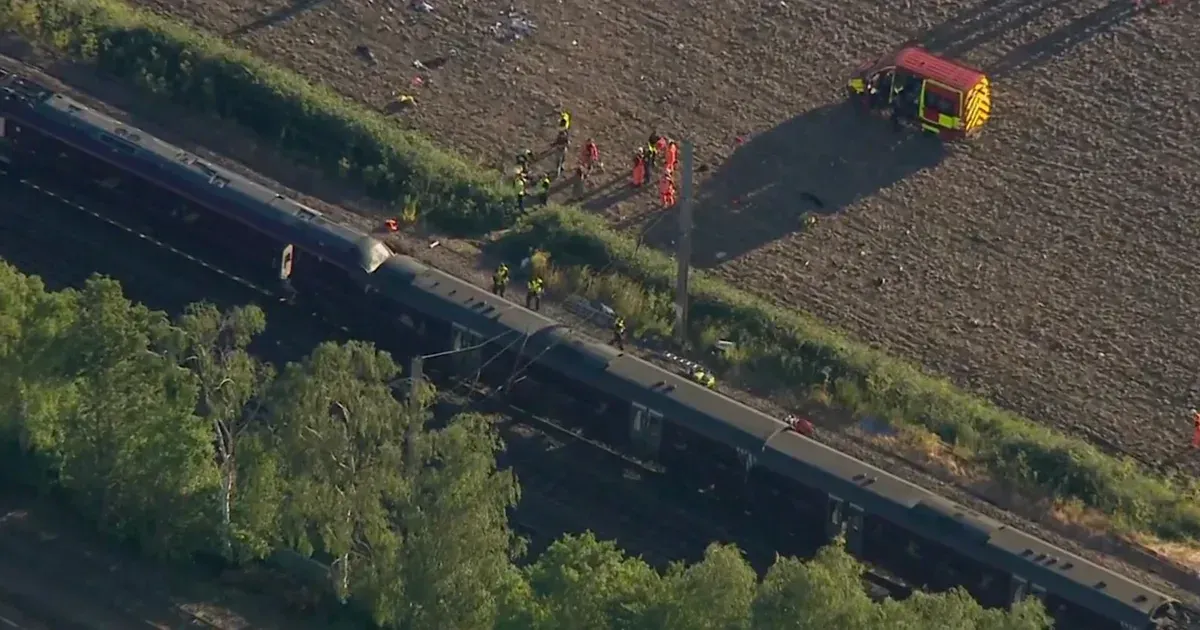
A passenger train collision near Bedford has left one person dead and nearly 90 people injured, turning a busy rail corridor north of London into the center of a major safety investigation. British authorities responded after two trains collided in the Bedford area during the Friday evening travel period. The crash occurred on June 19, 2026, with British Transport Police and emergency services treating the incident as a serious rail emergency. The person killed was reported to be a train driver, while dozens of passengers were assessed for injuries ranging from minor to critical. The Bedford train collision immediately disrupted routes that feed into London and surrounding towns. Rail operators warned passengers to avoid affected services while emergency teams secured the scene, evacuated those onboard and began the early evidence-gathering process.
Emergency Response Focuses on Passengers
The first operational priority was medical care and evacuation. Train collisions create complicated rescue conditions because passengers may be spread across carriages, platforms, trackside areas and blocked access points. Ambulance crews, fire services and police had to work around damaged equipment and live rail infrastructure. Nearly 90 injuries make the crash significant even before investigators determine the precise mechanical or signaling chain. Large casualty counts also place pressure on local hospitals, transport officials and rail staff trying to account for passengers and crews. The timing also complicates recovery because evening rail traffic creates knock-on disruption for passengers who may have no immediate road alternative.
The fatality being linked to a train driver gives the investigation a worker-safety dimension as well as a passenger-safety one.
That matters because rail safety reviews often separate public risk from staff risk. In a collision, the two are inseparable. Driver cab protection, signal visibility, route control and emergency communications all become part of the same inquiry.
Investigation Will Turn to Rail Control Systems
Investigators will need to establish whether the trains were on conflicting movements, whether signals or automated protections functioned properly and whether human decisions played any role. Those conclusions cannot be assumed from the casualty count alone. The inquiry will also have to account for weather, visibility, speed, dispatch timing and any temporary restrictions in place near Bedford at the time of impact. Those details will determine whether the crash reflects a rare sequence of errors or a preventable weakness in daily rail control.
The Bedford area is part of a heavily used network where scheduling pressure, maintenance windows and passenger demand leave little room for operational confusion. A single wrong movement can have consequences that extend across the wider rail timetable. That is why investigators will compare train data, driver communications, signal records and control-room decisions before narrowing the cause.
For commuters, the immediate impact is disruption. For rail staff, the crash is also a reminder that routine operations can become dangerous when layers of communication fail or when one safety barrier depends too heavily on the next. For regulators, the larger issue is whether the crash exposes a local failure or a wider risk in signaling, traffic management or route procedures.
One reason the inquiry will be closely watched is that Britain's rail safety system is designed around layers of prevention. Drivers follow signals, controllers manage movements, dispatchers handle platform activity and onboard staff respond when passengers need help. A collision involving passenger services means investigators will have to test each layer rather than assume a single point of failure.
The public-facing timeline also matters because major rail incidents often generate conflicting witness accounts before official evidence is complete. Passengers and families need clear information about who was on the trains, how injuries were classified and when service will resume. If official updates are slow or fragmented, operational uncertainty can quickly become public distrust.
Rail Safety Trust Is Hard to Rebuild
The most important question now is not only how the crash happened, but whether rail leaders can explain it quickly and credibly. Passengers accept delays more easily than uncertainty about whether the system is under control.
Britain's rail network depends on public trust in visible staff and invisible safeguards: signals, dispatch procedures, driver protocols and control-room decisions. When two passenger trains collide, that trust is shaken even if the eventual cause is narrow. The official response has to be detailed enough for passengers but careful enough not to outrun the evidence. The investigation therefore has to do more than assign blame. It has to produce recommendations that operators can implement without waiting for public attention to fade. That is the minimum standard after a fatal passenger-rail crash. It has to show passengers, rail workers and local communities that the failure has been isolated, understood and fixed before routine service is treated as routine again.