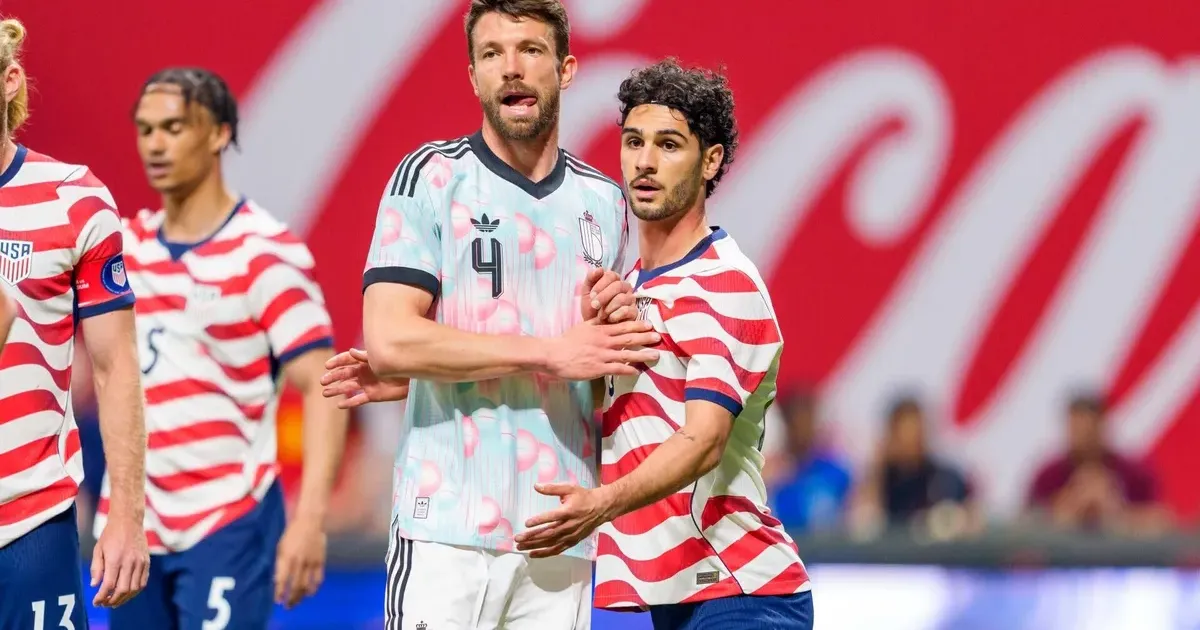
Belgium's March 28, 2026 friendly win over the USMNT was not really a wardrobe story. The kit confusion was visible, but the soccer problem was heavier: Belgium beat the United States 5-2 in Atlanta and turned a promising American first half into a defensive collapse.
The match at Mercedes-Benz Stadium began well enough for the United States. Weston McKennie put the U.S. ahead in the 39th minute. Belgium equalized just before halftime through Zeno Debast, then pulled away after the break. Amadou Onana made it 2-1, Charles De Ketelaere converted a penalty, and Dodi Lukebakio scored twice before Patrick Agyemang's late U.S. goal changed only the margin.
The shirts obscured the viewing. The defensive structure damaged trust.
The Kit Clash Was Real
The light-on-light kit issue deserved criticism. International soccer is too fast for poor visual contrast, and a World Cup warmup is exactly the kind of match where federations should be testing presentation details, not creating avoidable confusion. Players, officials, broadcasters and viewers all depend on instant recognition under pressure.
Even so, the jerseys did not create the gaps Belgium attacked. A kit clash can make a game look muddled. It does not explain why the U.S. midfield repeatedly failed to protect the space in front of the back line or why Belgian runners found clean releases after turnovers.
The danger in focusing too much on the shirts is that it gives the program a softer explanation than the score allowed. The visual problem was annoying. The tactical problem was structural.
Belgium Punished the Same Spaces
Jeremy Doku's threat was not only his dribbling. It was the panic he created when American help arrived late or from the wrong angle. Belgium did not need long spells of control to look dangerous. It needed one clean release into space, one missed recovery run or one U.S. defender forced to solve two problems at once.
Mauricio Pochettino needed to carry that lesson from March into the World Cup. A team can survive a bad kit matchup. It cannot survive repeated moments when center backs, fullbacks and holding midfielders appear to be answering different questions.
The five Belgian goals did not all come from the same action, but they came from the same general weakness: once the U.S. lost control of spacing, Belgium played faster than the American recovery. Repeated breakdowns were a serious warning for a team preparing to host a World Cup.
March Looked Worse After July
The friendly became more difficult to dismiss after Belgium eliminated the United States 4-1 in the World Cup round of 16 in Seattle on July 6. The scoreline was different, the stakes were higher and Matt Freese was in goal rather than Matt Turner, but the underlying theme was familiar.
Belgium punished U.S. mistakes, forced rushed decisions and made American confidence look fragile once the match turned. The World Cup loss had its own context, including selection controversy and knockout-stage pressure, but it also made the March warning feel less like a bad night and more like an early diagnosis.
The friendly did not predict every detail. It means the warning signs were visible before the tournament. The U.S. had talent, crowd energy and enough attacking quality to compete for stretches. What it lacked was a defensive floor when the game became chaotic.
Kit Confusion Was a Distraction
The kit clash gave the program an easy distraction from the central problem. The shirts were confusing, and the organizers deserved criticism for allowing that contrast. But the score did not become 5-2 because light fabric blurred on television.
Defensive Failures Outlasted the Friendly
It became 5-2 because Belgium found the same structural weaknesses again and again: rushed midfield cover, slow recovery angles, loose second-ball reactions and defenders exposed in transition. Those are not presentation errors. They are tournament errors.
A World Cup host cannot treat that as a one-night accident. It has to ask why a team with months of preparation still looked surprised by speed, pressure and second balls. The March friendly was not fatal by itself. It was a warning the July knockout made impossible to ignore.