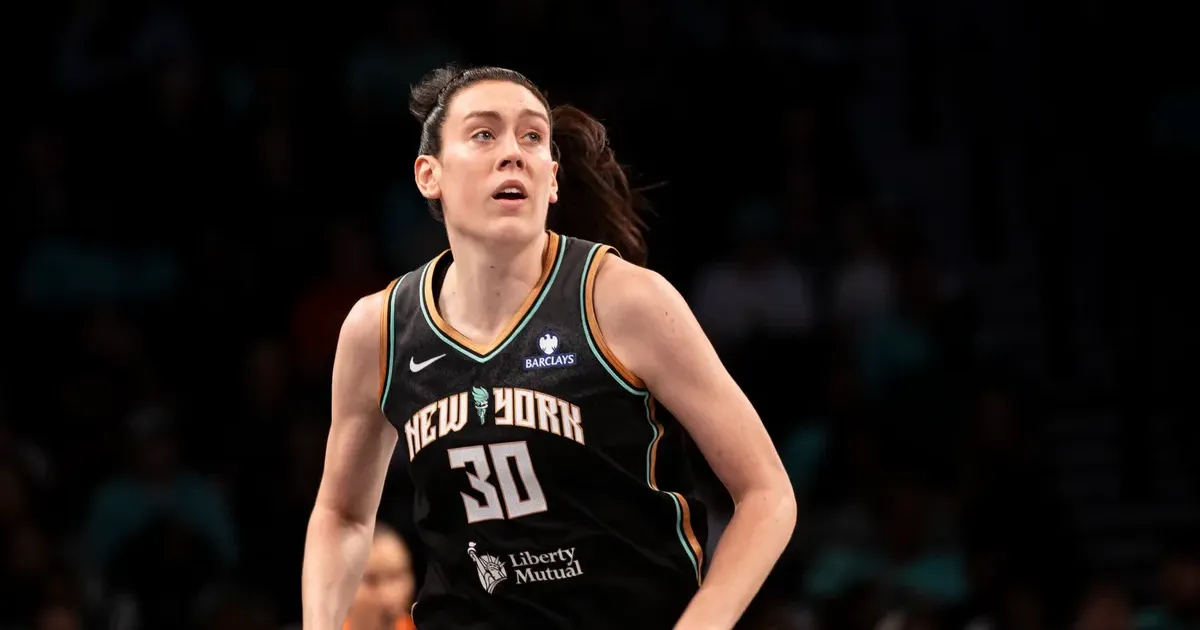
Breanna Stewart's spring declaration that she planned to stay with the New York Liberty removed the first layer of free-agency drama. The next layer arrived when the Liberty re-signed Stewart, Sabrina Ionescu and Jonquel Jones to multi-year deals, locking the championship core into a new WNBA economic era.
The core deals gave New York stability. It did not give New York simplicity. By mid-July, the Liberty's season had turned into a test of whether a star-heavy roster can protect Stewart's workload, survive injuries and still look like a team built for another title run.
The Contract Solved the Market Question
Stewart's podcast comments with Myles Turner mattered because she was an unrestricted free agent with the leverage to take meetings across the league. Instead, she made clear that her family was settled in New York and that she did not intend to turn free agency into a tour.
The official re-signing made that intention real. Stewart and Ionescu signed standard maximum structures, while Jones also committed on a multi-year deal. New York kept more than one star. It kept the spine of the franchise.
Contract continuity matters in a league where the new collective bargaining environment changed the scale of top contracts and gave elite players more reason to think about timing, market power and long-term control.
Continuity Became a Recruiting Tool
Once Stewart, Ionescu and Jones were secured, the Liberty could sell a clear basketball plan. Role players knew the top of the hierarchy. Free agents could see the late-game structure. Coaches could design around a core instead of waiting for the offseason to decide the team's identity.
The retained hierarchy helped New York stay aggressive. The Liberty added more star power and depth around the retained trio, trying to extend a window that began with the franchise's rise into a league power.
But continuity also raises expectations. A roster this expensive and this visible is not judged by whether it looks interesting in April. It is judged by whether it can absorb the stress of a long season.
The Workload Warning Is Now Real
The current problem is not whether Stewart belongs in New York. It is whether New York is asking too much of her. Recent reporting has pointed to a Liberty team leaning heavily on Stewart while injuries and uneven form have limited the roster's intended balance.
The workload is dangerous because Stewart's value is not only nightly scoring. She anchors defensive coverages, absorbs difficult matchups, rebounds, stretches the floor and becomes the emergency solution when possessions stall. When too many problems are routed through her, the roster's depth becomes theoretical.
A star can carry a team through a week. A title contender should not need that version of the star every night in July.
The New Core Still Has to Fit
New York's 2026 roster is talented, but talent does not automatically become rhythm. Injuries to players such as Sabrina Ionescu, Satou Sabally and Leonie Fiebich at different points have made lineups less stable. A new coaching staff also changes habits, spacing rules and substitution patterns.
Roster balance matters for Stewart because her best Liberty version is not simply high-usage rescue basketball. It is a version where Ionescu bends defenses, Jones punishes mismatches, Sabally adds another pressure point, and wings defend well enough that Stewart does not have to cover every crack.
If that balance returns, the re-signing looks like the foundation of a long window. If it does not, New York becomes a collection of famous names asking Stewart to clean up too much.
The CBA Changed the Stakes
The Liberty's core deals also sit inside a bigger WNBA labor shift. Rising salary caps, new contract structures and expansion pressure mean teams have to think differently about retention. Stewart staying was not only sentimental. It was a strategic bet that New York's market, resources and roster can keep matching her ambitions.
For the league, that has two sides. It is good to have stars committed to major franchises with strong audiences. It is less comfortable for rivals hoping free agency would redistribute top-end talent.
Stewart's decision helped New York. It also kept the league's power map tilted toward a club already built to win.
Staying Was Only the First Step
The real issue now is conversion. New York has the contracts, the names and the championship memory. It still has to manage minutes, solve rebounding and health problems, and make the offense less dependent on Stewart bailing out late-clock possessions.
Protecting workload is the harder version of roster clarity. Keeping Stewart settled the offseason. Protecting Stewart may decide the season.
The Liberty did the rational thing by locking in their core. Stewart did the rational thing by staying where her family, market and basketball opportunity aligned. The uncomfortable part is that a rational roster can still become fragile if the player at its center has to carry more than the plan promised.