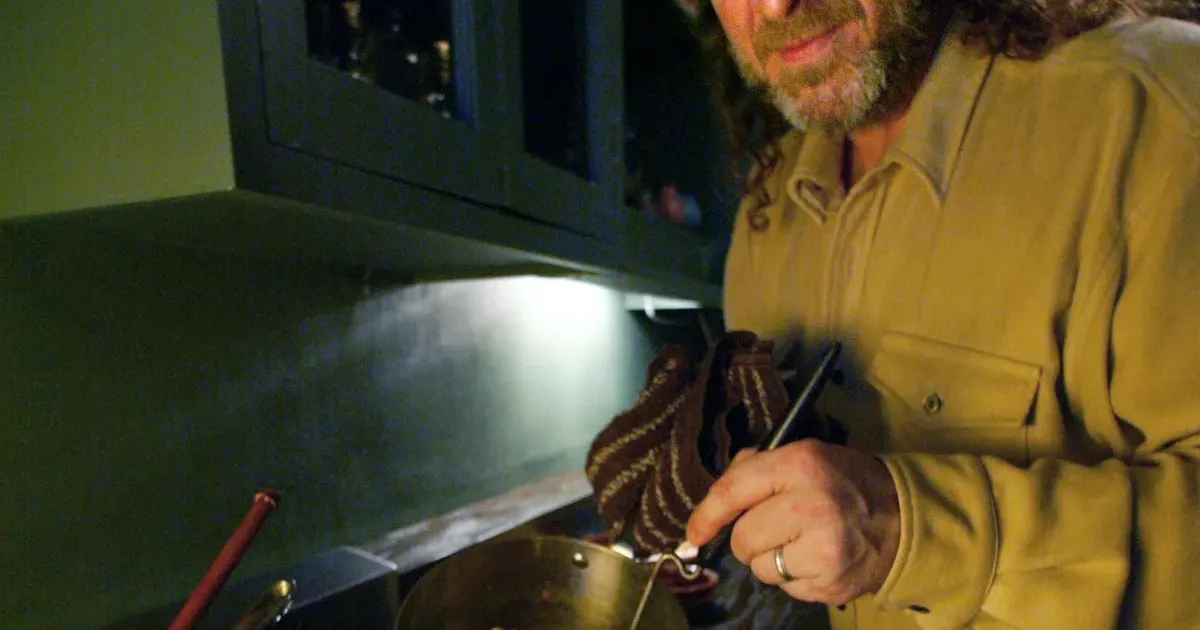
Tom Valenti, the culinary architect who transformed the Upper West Side into a premier dining destination, died on April 4, 2026, at the age of 67. Valenti earned international acclaim for elevating rustic, slow-cooked dishes to the heights of Manhattan fine dining during a career that spanned four decades. He was best known for his work at Ouest and Cesca, where he championed a style he famously described as haute cuisine with the grandma gene. Friends and colleagues confirmed his passing at his home, marking the end of an era for the New York restaurant community.
Valenti arrived on the New York scene during a period when fine dining was often defined by rigid French formalities and architectural plate presentations. He trained under Alfred Portale at Gotham Bar and Grill, absorbing the technical precision of the era before charting a different course toward soulful, flavor-forward comfort. Success first arrived at Alison on Dominick in the late 1980s, where his braised lamb shanks became a city-wide sensation. Critics from major publications noted that Valenti possessed a rare ability to extract deep depth from inexpensive cuts of meat, a skill that eventually reshaped industry economics.
Valenti Redefines Upper West Side Fine Dining
Ouest opened its doors at 2315 Broadway in 2001, providing an anchor for the neighborhood just months before the city faced the trauma of the September 11 attacks. While many downtown establishments struggled, Valenti created a sanctuary of red leather booths and dark wood that felt both exclusive and inclusive. $32 for a lamb shank seemed revolutionary at the time, offering luxury without the pretension typically found in Midtown. This location became a haunt for media titans and literary figures who lived in the surrounding brownstones, solidifying the chef's status as a local hero.
Neighborhood residents frequently saw Valenti at the pass, overseeing a kitchen that prioritized consistency over experimental trends. His approach relied on the slow transformation of collagen into silk, a process requiring hours of patience and specific temperature control. Ouest eventually generated annual revenues exceeding $10 million, proving that the neighborhood bistro model could achieve huge commercial scale if executed with high-level technique. Valenti maintained that the secret to a great restaurant was making people feel looked after, rather than simply fed.
Evolution of the Braised Lamb Shank Technique
Braising became the signature of the Valenti brand, a method he refined to a scientific degree of perfection. He insisted on searing meat until a deep mahogany crust formed, then submerging it in a bath of aromatic vegetables and wine.
This technique was not merely about flavor but about the emotional resonance of the resulting dish.
"My goal was always to take the food that made us feel safe as children and apply the rigorous standards of a four-star kitchen to every component on the plate," Valenti stated during a retrospective interview.
Technique drove every decision in his kitchen, from the way garlic was sliced to the specific vintage of vinegar used for deglazing. Aspiring chefs flocked to work under him, eager to learn how he balanced the heavy richness of braised meats with bright, acidic garnishes.
Valenti authored several influential cookbooks, including Welcome to My Kitchen, which brought his slow-cooking philosophy to home cooks across the United Kingdom and United States. He explained the professional kitchen, showing that the most impressive meals often began with the simplest ingredients and a heavy Dutch oven.
Commercial Success of Ouest and Cesca Models
Cesca followed the success of Ouest in 2003, further cementing Valenti's dominance of the Upper West Side market. This second venture focused on Italian-inspired flavors, yet it carried the same DNA of strong, hearty portions served in a sophisticated setting. Investors watched closely as Valenti managed to run two of the busiest restaurants in the city simultaneously, both located within a few blocks of each other. The density of his footprint in one specific zip code was a risky strategy that paid off through intense local loyalty. Business analysts at the time pointed to his restaurants as evidence that New Yorkers were moving away from the formality of white tablecloths in favor of high-quality comfort.
Manhattan dining shifted toward more casual formats in the late 2000s, but Valenti stayed true to his vision of the well-appointed dining room. He faced personal challenges, including a long battle with Parkinson's disease that began in his 40s, yet he stayed active in the industry for as long as possible. His resilience despite health issues earned him deep respect among his peers in the James Beard Foundation and beyond. The legacy of his kitchens persists through the dozens of chefs he mentored who now run their own acclaimed establishments throughout the country. Valenti proved that a chef could be both a neighborhood fixture and a national trendsetter.
The Elite Tribune Strategic Analysis
Nostalgia is a poor substitute for the visceral, soul-deep cooking Valenti mastered, yet the modern restaurant industry seems content to offer exactly that. Valenti succeeded because he understood a fundamental truth about human nature that current hospitality groups often ignore: people crave the familiar executed with impossible excellence. Today, the Upper West Side is increasingly dominated by corporate chains and soulless concept restaurants designed for Instagram engagement. Valenti's Ouest was the opposite of the modern trend, focusing on the sensory experience of a dark booth and a perfectly braised shank.
What is unfolding is the slow death of the independent, neighborhood-defining chef in favor of the celebrity brand. Valenti was a celebrity, certainly, but his fame was rooted in the sweat of the kitchen and the loyalty of the 84th Street resident. He did not build an empire of frozen foods or airport kiosks. He built a community centered around a table. His death is a hard fact that the era of the great New York neighborhood restaurant is ending, pushed out by rising rents and the commodification of the dining experience.
Luxury is now defined by scarcity and price, but Valenti defined it by the quality of the braise and the warmth of the welcome. If the industry continues to prioritize aesthetic over substance, it will lose the very grandma gene that Valenti spent his life protecting. A restaurant without a soul is just a room with food. Valenti never built a room without a soul.