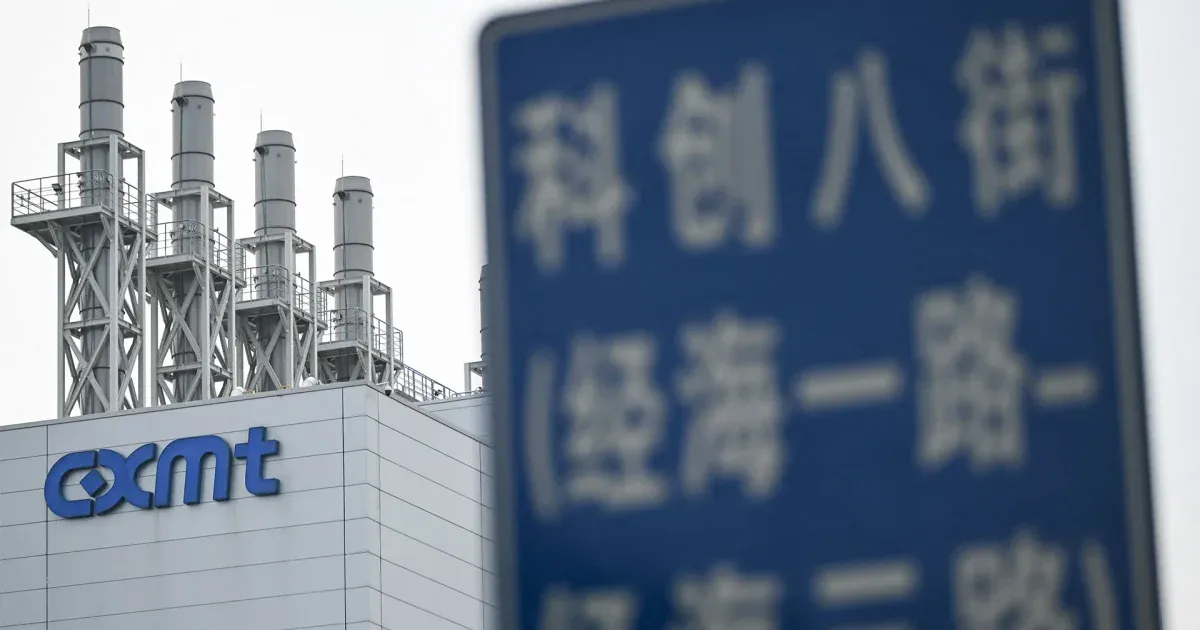
ChangXin Memory Technologies entered public markets with a price move large enough to recast China's memory-chip hierarchy in one session. CXMT shares climbed almost 466% on their Shanghai debut, giving the company a market value of roughly $487 billion and making it the most valuable name on the technology-focused STAR Market.
On July 27, 2026, the listing connected three investor narratives: rising memory prices, the buildout of artificial-intelligence data centers and China's push to reduce dependence on foreign semiconductor suppliers. The first-day valuation measures demand for that combination. It does not yet measure whether CXMT can close its manufacturing and market-share gap with established producers.
A 466% Debut Prices More Than Current Market Share
CXMT arrived at the exchange only a decade after its 2016 founding. That compressed history helped the flotation look like proof that a domestic Chinese memory challenger can reach global scale quickly. The stock move also supplied investors with a listed route into a part of the semiconductor cycle where supply constraints and AI infrastructure spending have pushed both product prices and company valuations higher. The STAR Market listing turns that industrial bet into a daily public price rather than a private funding judgment.
The $487 billion figure is therefore a claim on future position as much as a reading of present position. Public-market capital can support expansion and research, while a larger valuation raises the company's strategic visibility. But neither effect changes fabrication performance, product qualification or customer adoption overnight. Memory manufacturing demands sustained spending, and each production improvement must survive the discipline of volume output. A share price can revalue an ambition immediately; an operating system still advances through production cycles.
Demand provides the strongest part of the case. Large AI data-center projects are consuming more dynamic random access memory, while higher memory prices have increased the earnings expectations attached to producers. Micron's shares had risen more than 727% over the prior 12 months, showing that CXMT entered a market already rewarding exposure to the same cycle. That rally also means CXMT's debut did not create the enthusiasm; it concentrated an existing memory trade in a newly listed company.
Geopolitics adds a second premium. U.S. export controls limit the flow of some advanced semiconductor technology to China, increasing the policy value of domestic capacity. Investors are not only buying expected chip sales; they are pricing the possibility that memory production becomes strategic infrastructure inside the world's second-largest economy. That strategic value can support investment during a weak product cycle, but it cannot make customers ignore performance or reliability.
CXMT's 8% Share Still Sits Behind an 89% Bloc
The prospectus figures place the competitive gap in view. CXMT reported about 8% of the relevant global market. Samsung held 36%, SK Hynix 29% and Micron 24%. Together, those three incumbents controlled 89% of the market. Even Micron, the smallest of the trio by this measure, had three times CXMT's share. CXMT could double its portion and still remain below every named rival at their reported levels.
That comparison does not make CXMT's progress trivial. Fast Company reported that its share grew by about 3% over the previous year, an indication that the company is already taking some business rather than merely announcing capacity. It does show why valuation and industrial rank are different scoreboards. Market capitalization prices expectations across all future cash flows; market share records business already won in the period being measured.
The hardest segment may be high-bandwidth memory, where Counterpoint Research vice president Neil Shah described the competitive climb in direct terms.
It's going to be a steep hill to climb for CXMT in the high-bandwidth memory market.
The warning matters because demand alone does not assign demand evenly. Customers can favor suppliers that meet performance, yield and reliability requirements at scale. A shortage can create room for a challenger, but it can also strengthen incumbents already able to deliver qualified products. High-bandwidth memory therefore tests more than whether CXMT can add factories; it tests whether its output can enter the most demanding part of the AI supply chain. CXMT must turn the current market opening into repeatable supply, not simply a larger investor base.
A 466% Debut Cannot Manufacture High-Bandwidth Memory
The debut gives CXMT capital, attention and a powerful domestic-policy position. Those are real advantages. It also creates a demanding valuation benchmark before the company has matched the scale of any leading competitor. Future gains will have to come from the physical market: more usable output, better products and customers willing to shift orders. The evidence to watch is operational, including whether the reported share continues rising after the first-day excitement fades.
Investors may be right that AI demand and export restrictions make a Chinese memory champion more valuable than its current share suggests. The 89% held by Samsung, SK Hynix and Micron is the test that follows the celebration. That distinction is decisive. If CXMT converts strategic importance into competitive production, the listing will look like financing for an industrial shift. If not, the 466% jump will remain evidence of scarcity in the stock market, not proof of strength in the memory market.