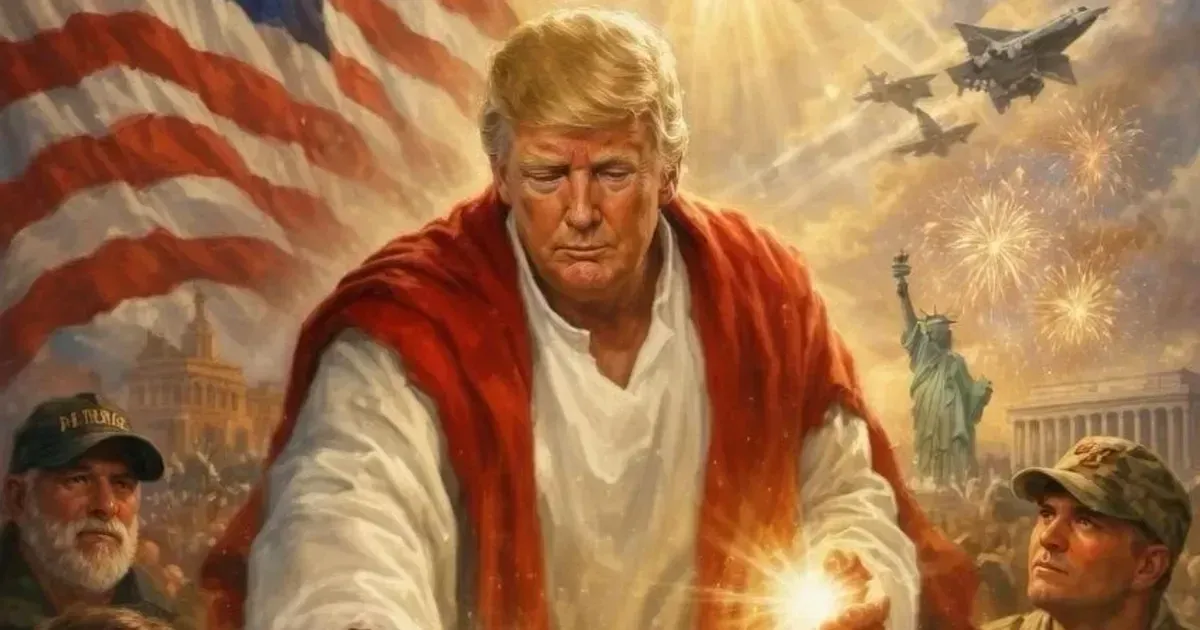
Donald Trump removed an AI-generated image that had depicted him as a Jesus-like figure after criticism from Christian allies. Campaign advisers expected some backlash, but the intensity of the reaction surprised several allies. The deletion came on April 13, 2026, as evangelical leaders called the image offensive and aides tried to contain the fallout.
Evangelical Backlash Inside the Campaign
Christian allies of the president labeled the visual content offensive and borderline sacrilegious. Reports from the BBC indicate that these influential figures found the messianic comparison inappropriate for a political candidate. One powerful evangelical adviser described the post as an unnecessary distraction from the campaign's core messaging on religious freedom. Campaign staffers reportedly viewed the religious backlash as a rare moment of friction with a demographic they cannot afford to alienate. Weijia Jiang of CBS News noted that the deletion occurred following hours of mounting pressure from social media influencers in the evangelical community. These groups argued that the image crossed a line between political admiration and theological transgression. Internal memos leaked to the press suggest that some campaign officials were unaware of the post before it went live. The rapid removal of the image indicates a high level of sensitivity to the concerns of the faith-based electorate. Messianic visuals represent a boundary that even the most populist political movements rarely cross without consequence. Theological experts point out that the use of such imagery often backfires when it crosses into direct visual mimicry of sacred figures. Public sentiment data from the morning of the deletion showed a sharp spike in negative mentions among self-identified evangelical social media users.
Trump tried to explain the image as a medical scene rather than a messianic one. Efforts to rebrand the image as a medical depiction failed to quell the online debate among theological traditionalists. Trump maintained his stance that the digital art was intended to show him in a healing role. Critics pointed to the lack of a stethoscope, hospital setting, or any recognizable medical equipment in the generated scene. AI software often blends cultural symbols based on the prompts provided, which can lead to the visual ambiguity Trump cited in his defense. The controversy over the AI image prompted swift condemnation from the U.S. Bishops regarding the president's use of religious imagery.
"Christian allies of the president call the AI-generated image offensive as Trump says he thought it showed him as a doctor," according to reporting from the BBC.
Artificial intelligence platforms used by political campaigns have previously generated heroic themes without triggering this specific level of denominational resistance. This instance, however, touched on deeply held beliefs regarding the sanctity of religious icons. Technological literacy among the general public has grown, making it more difficult for public figures to claim ignorance of an AI output's obvious themes.
Political communication experts argue that the "doctor" explanation was likely a strategic pivot designed to minimize the damage without admitting to intentional sacrilege. Statistics from major polling firms show that religious voters prioritize theological reverence alongside political policy. The attempt to redefine the image as medical in nature was met with skepticism across social media platforms.
Pope Leo Tension Deepens
Sky News identified a parallel conflict developing between the president and Pope Leo at the time the image was removed. Tension between the Vatican and the campaign has intensified as Trump maintains his public criticisms of the pontiff. This religious friction adds another layer of complexity to the campaign's relationship with Catholic voters in key swing states.
Trump doubled down on his criticism of the Pope even as he moved to delete the controversial AI post. Records from the campaign platform show the post was live for less than four hours before the deletion command was executed. Religious scholars argue that clashing with a global religious leader while simultaneously using messianic imagery creates a confusing narrative for the faithful. The timing of the two events suggests a broader struggle within the campaign to define its religious identity.
Diplomatic circles in Rome have remained silent on the specific AI image but have expressed ongoing concern regarding the president's rhetoric toward the Holy See. Previous interactions between the two leaders were marked by policy disagreements on immigration and environmental stewardship. The latest criticisms from Trump suggest a deepening rift that may impact the Catholic voting bloc in the upcoming election cycle.
ABC News confirmed the removal while noting the president provided no further context beyond the medical professional claim. Evidence of the backlash surfaced across multiple denominational leadership circles within hours of the post appearing online. The event highlights the risks associated with the rapid deployment of generative AI in high-stakes political environments.
Generative tools allow for the creation of vast amounts of content at negligible cost, yet they lack the inherent cultural sensitivity of human editors. Campaign oversight failures regarding AI content have become more frequent as the technology evolves. The religious community continues to monitor how digital tools are used to represent sacred themes in the political sphere.
Faith Politics After the Deletion
Clumsy attempts to pivot from sacrilege to surgery reveal a campaign struggling to control the very generative tools it once weaponized against its enemies. The claim that an image of a man in glowing robes and a halo was mistaken for a medical doctor is an insult to the intelligence of the American electorate. This was not a technical glitch; it was a deliberate test of the messianic boundaries of the MAGA movement. When the base barked back, the campaign blinked. The prompt-engineers in the Trump war room clearly overplayed their hand, forgetting that for the evangelical core, the image of Christ is not just another meme-able asset.
Feuding with Pope Leo while simultaneously flirting with divine iconography is a dangerous game of theological chicken. It suggests a campaign that believes it can redefine the sacred on its own terms. By deleting the post, Trump has admitted that his influence has limits, even within his own digital echo chamber. The "doctor" defense was a desperate, transparent lie. It was a tactical retreat disguised as a misunderstanding. The incident proves that even at a time of deepfakes and AI-driven populism, certain religious taboos stay unbroken. Political power remains second to the pulpit.