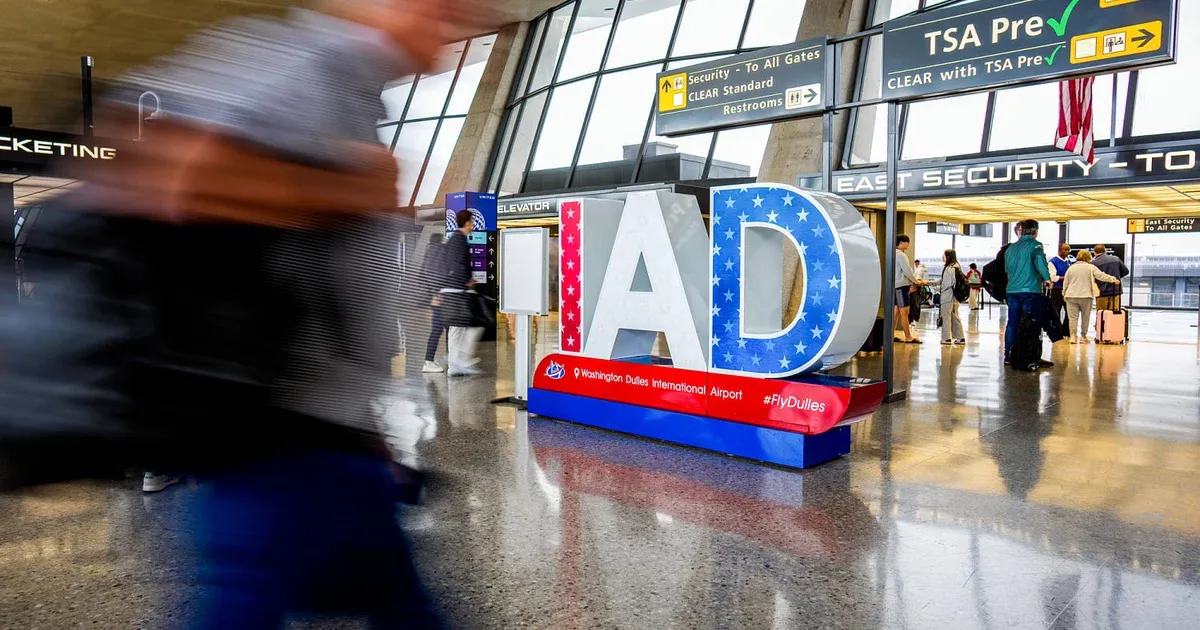
Washington Dulles International Airport could be rebuilt around a simple promise: passengers should spend less time waiting for a shuttle and more time moving directly toward their gates. The reported overhaul is much larger than a cosmetic refresh, with terminals, trains, tunnels and financing all tied to one long construction program.
Reporting published before a scheduled White House event on July 29, 2026, placed the plan at $22 billion. The Guardian said President Donald Trump was expected to present it with Transportation Secretary Sean Duffy, United Airlines chief executive Scott Kirby and officials from the Metropolitan Washington Airports Authority, which operates Dulles. NBC News separately reported that new terminals and the retirement of the airport's aging people movers were central elements.
The Reported Design Targets the Trip Between Terminal and Gate
The Guardian said the plan would replace four existing terminals with five. It also called for an expanded underground train, another pedestrian tunnel and additional moving walkways. Those pieces address the practical problem behind many complaints about Dulles: the trip after security can involve an extra vehicle ride across the airfield before a traveler reaches the correct concourse.
The mobile lounges are part of the airport's identity, but they have become a weak point in its daily operation. The slow airport vehicles carry passengers between terminals and gates across active tarmac. A November 2025 docking collision involving one such vehicle left at least 18 people hurt. Replacing them is therefore both a passenger-experience project and a safety decision.
Retiring the shuttles will not help if the replacement network creates a different bottleneck. A larger underground rail system must reach the new terminals, provide enough capacity during connection peaks and remain usable when one section is closed. The pedestrian tunnel and moving walkways offer a backup route, but only if distances, elevators and wayfinding work for passengers with luggage or limited mobility.
Dulles opened in 1962 and has grown far beyond its original scale. The airport recorded 29 million travelers during 2025, its busiest year, with traffic 6.4 percent above the prior year, according to The Guardian. An additional United facility with 14 gates is slated for service this fall. The rebuild will have to connect with that expansion rather than treat the airport as an empty site.
Building while the airport remains busy will be a separate engineering problem. Temporary gates and walking routes must absorb displaced traffic before old facilities close, and airlines will need enough notice to adjust schedules and ground crews. If mobile lounges are withdrawn before the train and tunnel network can carry the same passenger load, the project could make transfers slower during the years intended to improve them. Construction order is therefore part of the design, not an administrative detail to settle later. Scale models of rival bids were shown to Trump, who asked for alterations, The Guardian reported via CBS News.
A $22 Billion Price Tag Still Needs a Public Funding Map
The first reports describe a mixed financing structure rather than a single federal appropriation. United, which accounts for roughly 70 percent of Dulles traffic, has agreed to help finance the project, The Guardian reported. MWAA is expected to raise much of its share through new bonds. In 2025, the authority authorized another airport investment program worth $7 billion.
Those facts leave important numbers open. The reports did not set out how the $22 billion would be divided among airline commitments, bond proceeds, airport revenue or any federal contribution. They also did not explain whether the earlier capital plan is included in the larger figure. Until that breakdown is published, the headline price cannot show what passengers, airlines or public bodies will ultimately carry.
Bond financing spreads construction costs across years, but repayment still has an operating source. Airport charges, terminal rents and airline agreements can all influence ticket economics and the cost of using Dulles. United's large share of traffic gives it a strong reason to improve the hub, while also making the contract terms important to competing carriers and to passengers who need more route choice.
Design preferences will draw attention as well. People briefed on the proposal told The Guardian that glass, gold and mirrored ceilings feature in the selected concept. Those materials may shape the public image of the airport, but the measurable value will come from shorter transfers, reliable baggage handling, accessible routes and fewer bus-dependent gate movements.
Dulles Should Publish Service Benchmarks Before Construction Starts
The rebuild will take years, so the test begins before a new terminal opens. MWAA should publish a phased construction map showing which gates, train stations and roads will close, what temporary capacity will replace them and how each contract connects to the $22 billion total. Travelers need disruption dates; bondholders and airlines need cost milestones.
Each major phase should also have a passenger benchmark: average transfer time, train availability, missed-connection rates and the number of trips still requiring a mobile lounge. Without those measures, a large budget and striking design can be declared complete while the original journey remains slow. Dulles does not need a promise that it will look spectacular. It needs a public record showing that the rebuilt airport moves people more safely and predictably.