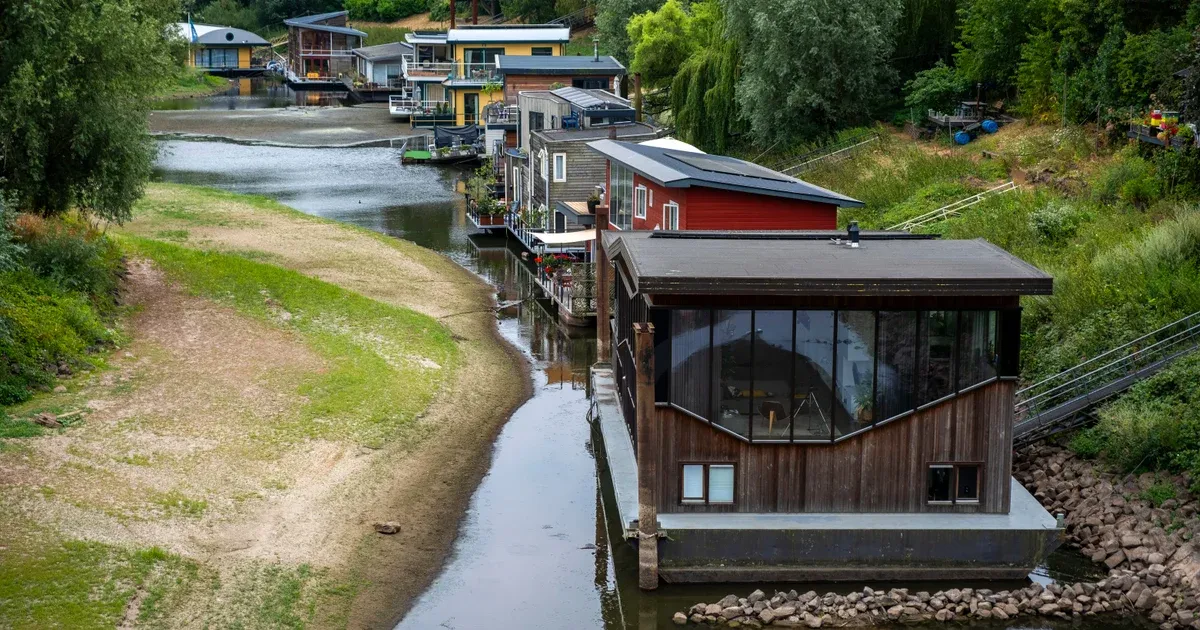
Europe's drought is turning river depth into an operating limit for freight carriers, power stations, factories and farms. On August 3, 2026, record-low readings were reported along sections of the Rhine in Germany and the Netherlands, while the Danube and Italy's Po were confronting separate lows with consequences far beyond navigation.
Measurements at Cologne and Lobith, where the Rhine enters the Netherlands, fell below every previous reading in their respective records. The European Union's Drought Observatories described conditions across most of the continent as stable and critical in mid-July, with further deterioration in central-western Europe. The forecast kept renewed heat over the continent for at least another week, with 40C-plus readings expected across a broad zone spanning central and southern Europe.
At July's close, the monitoring system classified 78% of Danube gauges and 44% of those along the Rhine as extremely low. Those figures matter because the rivers serve several systems at once: vessels move bulk cargo, industrial facilities draw cooling water and farms depend on connected waterways for irrigation. The Rhine runs from the Swiss Alps to the North Sea and ranks among Europe's busiest commercial waterways, so restrictions at a single shallow section can affect traffic well beyond the nearest port.
Kaub Converts Centimetres Into Cargo Capacity
The Rhine's most closely watched constraint sits at Kaub, near Koblenz. Navigable depth there reached 25cm on Friday, matching the record low set in 2018, before recovering slightly by Monday. That recovery did not change the operating calculation: each additional centimetre affects how much freight a vessel can move through the chokepoint. The gauge does not mean the entire river is only 25cm deep; it is used to calculate how deeply a vessel can safely sit in the water through a critical section.
When the gauge falls, operators cannot load barges to their normal weight. Cargo must be divided among additional vessels, so moving the same quantity requires a larger fleet. The river can remain open while its effective capacity shrinks, which is why a low-water episode can raise costs before it produces a complete navigation stoppage.
Martin Wolters of the Rhine Waterways and Shipping Authority said a full suspension of shipping was unlikely, but lighter loads would require precautions. A commodity trader described the commercial boundary to Reuters:
“There comes a time when loads are too small to be worthwhile or vessel owners are worried about damaging their ships.”
The immediate risk is therefore not a single closure notice. It is the point at which each voyage carries too little cargo to justify its cost, creating transport delays or supply bottlenecks even while vessels are still moving. Cargo capacity, not the river's open-or-closed status alone, becomes the useful measure for businesses that depend on the route.
Low Water Moves From Shipping Into the Power Grid
The Danube is exposing a different vulnerability. The river crosses 10 countries, widening the number of national systems exposed to the same low-flow problem. Levels fell to 30-year lows in several countries, bringing Hungary's only nuclear power plant close to a shutdown. The facility was operating at reduced capacity while officials monitored whether falling water availability would require it to be taken offline entirely.
Water shortages forced Serbian coal generators to lower production because their cooling needs could not be met. Romania used a controlled explosion to remove a large rock and redirect more water toward the Cernavoda nuclear plant. Both responses show that power-plant cooling can become an immediate constraint alongside reservoirs and drinking-water networks. The power shortage then reached manufacturing: Dacia and Ford plants in Romania agreed to stop production for more than two weeks to reduce electricity consumption. That sequence connects river level to cooling capacity, electricity supply and factory schedules.
Italy's Po presents a third channel. The river reached a historic low near Cremona in late July, prompting authorities to raise the drought alert to high across the Po Valley. Officials and experts warned of possible pressure on drinking-water supplies, while farmers faced reduced access to the water used for irrigation.
Lower flow at the river mouth also allowed seawater to move farther into the Po's bed. That saltwater intrusion disrupts ecosystems and can make available water less useful for crops. In this case, the risk is not measured only by the volume left in the river, but also by the quality of the water reaching agricultural users.
Across much of Europe, World Weather Attribution found that rainfall records did not establish a sustained downward trend. Its analysis instead identified a heat-driven mechanism: human-caused warming increases evaporation, removing moisture faster and making drought conditions more likely. Hot weather simultaneously raises household, farm and industrial demand, so supply can weaken as use intensifies.
River Gauges Now Set Three Operational Limits
The three rivers show why a continental drought cannot be reduced to one rainfall total. Kaub controls how much freight a vessel can carry; Danube flows influence whether generators can cool safely; the Po determines how much usable water reaches cities and fields. Each system reaches stress through a different operational threshold, even though high heat and low flow sit behind all three.
The next decisions will therefore arrive through separate institutions rather than a single European declaration. Shipping operators will decide when loads cease to pay, energy officials will judge whether cooling margins permit continued generation, and water authorities will manage drinking and irrigation demand as salt moves inland. Monitoring those control points reveals the economic impact sooner than waiting for a river to become completely unnavigable or a plant to shut down.