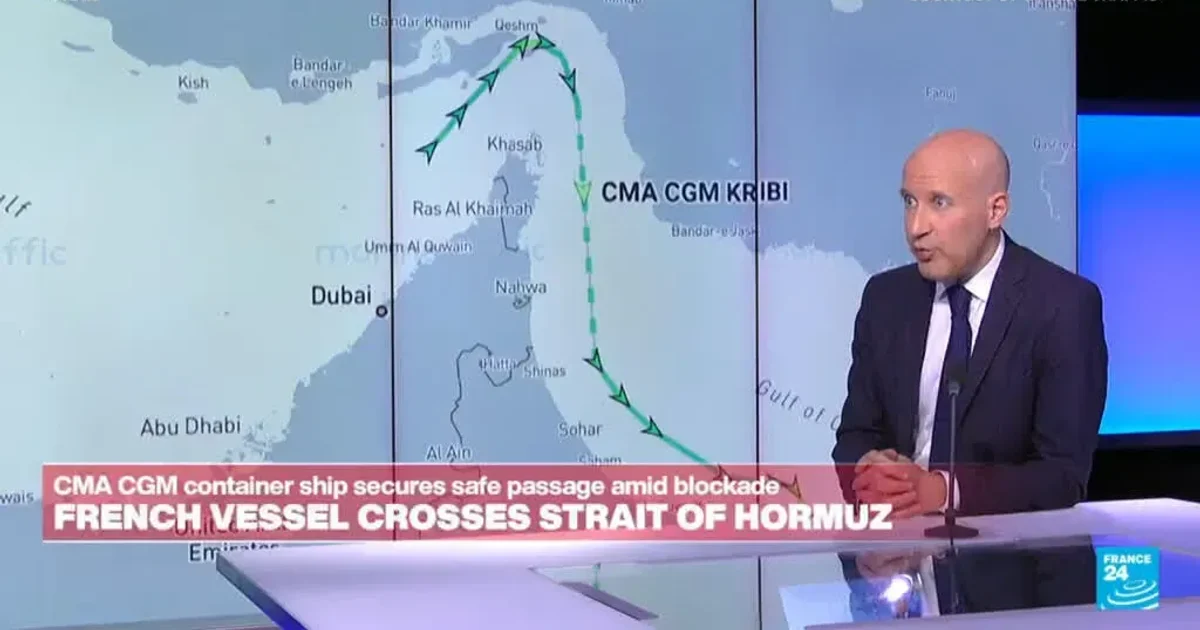
CMA CGM successfully sent a French-flagged container ship through the Strait of Hormuz, marking the first time a major European carrier has transited the chokepoint since hostilities began, as insurers and carriers watched for signs that commercial traffic could still move through the war-risk corridor. Maritime tracking services identified the vessel as it moved through the narrow waterway separating the Persian Gulf from the Gulf of Oman. Commercial traffic in the region has been largely paralyzed since the end of February 2026 when the US-Israeli conflict with Iran escalated into direct military strikes. French authorities have not issued a formal statement regarding the specific security arrangements for this voyage. The April 3, 2026, transit gave insurers and carriers a fresh signal about risk in the Gulf.
Vessel tracking data provided by MarineTraffic confirmed the ship's position as it cleared the Omani coast during the early morning hours. Industry analysts view the move as an important test of Iranian intentions toward European trade assets. Previous weeks saw a total cessation of Western-flagged or Western-owned shipping through the corridor. Risk assessments for the region were adjusted upwards in March after multiple tankers reported electronic interference and harassment from local patrol craft.
Lloyd's of London underwriters have kept war risk premiums at record highs for any tonnage entering the Persian Gulf. Insurance costs have risen so sharply that most commercial operators now require state-backed indemnities to justify the transit. French commercial interests appear to be operating on the assumption that Paris maintains a distinct diplomatic status in Tehran. MarineTraffic analysts noted that the vessel maintained a consistent speed of 18 knots while passing the Musandam Peninsula.
Maritime security firms in London observed that the ship did not disable its Automatic Identification System during the transit. Most captains have been turning off transponders to avoid detection by Iranian coastal batteries. The vessel remained visible to global tracking networks throughout its entire journey across the Strait of Hormuz. MarineTraffic confirmed the ship arrived at its destination safely without incident.
Washington Expands Maritime Insurance to $40 Billion
Officials in the United States recently doubled the value of shipping guarantees to $40 billion to support essential trade through the Middle East. Treasury Department spokespeople confirmed the expansion on April 3, 2026, as part of a broader package intended to prevent a global supply chain collapse. The guarantees serve as a backstop for shipping companies that cannot secure private insurance due to the ongoing war. American policymakers hope this financial cushion will stabilize energy prices by encouraging tankers to return to the region.
Shipping executives have expressed skepticism about whether financial guarantees alone can offset the physical risk of missile strikes. The US Navy continues to conduct patrols in the Gulf of Aden, but the interior of the Persian Gulf is currently considered a high-risk zone for any vessel associated with the coalition. Financial markets reacted to the insurance news with a slight decline in crude oil futures. Analysts at Goldman Sachs noted that the $40 billion pool covers roughly 150 large-scale voyages at current risk valuations.
Underwriters at major global firms have tightened their policy requirements despite the American financial injection. Most now demand that ships provide detailed manifests to ensure no dual-use technology is being transported to restricted ports. The insurance program excludes any vessel that has docked in an Iranian-controlled harbor within the last ninety days. Commercial shipping records show that the French transit did not use these US-backed guarantees.
French Neutrality Challenges Coalition War Objectives
Diplomatic tension has emerged between Paris and its Western allies over the perceived openness of the Iranian coastline to French trade. France 24 international affairs commentator Douglas Herbert explained the delicate balance during a broadcast earlier today. He suggested that the transit is a barometer for how Tehran categorizes European powers during active warfare. Iranian officials have hinted that they do not view France as a primary combatant in the current strikes.
The passage of a CMA CGM vessel suggests that Tehran may be attempting to drive a wedge between European nations and the US-Israeli coalition by granting selective access to the Strait of Hormuz.
French President Emmanuel Macron has consistently advocated for a de-escalation of the conflict through diplomatic mediation. While the US and Israel focus on degrading Iranian military infrastructure, France has prioritized the protection of maritime commerce. This policy has led to some friction within NATO regarding the enforcement of naval blockades. Tehran appears willing to enable French shipping as long as Paris remains critical of the broader military campaign. Intelligence reports suggest that no Iranian Revolutionary Guard vessels approached the French ship during its four-hour transit.
Naval planners in Washington are evaluating how the selective transits affect the effectiveness of regional sanctions. If certain nations continue to trade through Hormuz, the economic pressure on the Iranian government stays diluted. France maintains that its commercial activities are compliant with existing international law. Foreign ministry officials in Paris have declined to comment on whether any specific deal was struck with Iranian authorities before the CMA CGM transit.
Global Energy Markets Track Persian Gulf Volatility
One-fifth of the global oil supply passes through the narrow waters where the French ship was spotted. Energy security for Europe and East Asia depends heavily on the continuous flow of crude and liquefied natural gas from this region. Since the war began in late February, global oil prices have spiked by nearly 35 percent. Traders are watching the French transit as a potential sign that the strait will not face a total, indefinite closure. Any disruption to the flow of gas from Qatar would immediately threaten the heating and industrial capacity of several European nations.
Port authorities in the United Arab Emirates and Saudi Arabia have reported a 60 percent drop in commercial arrivals since the first week of March. Transshipment hubs in Jebel Ali are operating at a fraction of their normal capacity. Shipping routes that once took five days now take nearly three weeks as vessels navigate around the African continent. The cost of a single container shipment from Shanghai to Rotterdam has quintupled in the last six weeks. Global inflation figures for March 2026 reflected these rising logistics costs.
Energy analysts continue to warn that the situation remains extremely fluid and subject to sudden escalation. Any direct hit on a commercial vessel would likely lead to an immediate withdrawal of all remaining Western shipping. The French vessel's successful journey does not guarantee safety for subsequent attempts by other carriers. Market volatility persists as the international community awaits the next moves from the Iranian military command. Current stockpiles of oil in OECD nations are estimated to cover roughly ninety days of total disruption.
Hormuz Crossing Tests Wartime Shipping Confidence
The transit did not end the Strait of Hormuz risk; it showed that some carriers still see a workable lane when flag state, cargo profile and insurance coverage align. That is a narrower signal than a return to normal shipping, but it matters because energy markets price confidence as much as physical obstruction.
For Washington and Paris, the voyage also exposed the limits of coalition messaging. A French-flagged commercial ship moving through the strait gave Iran less propaganda value than a military escort would have, while still reminding Gulf governments that maritime commerce remains vulnerable to one miscalculation.