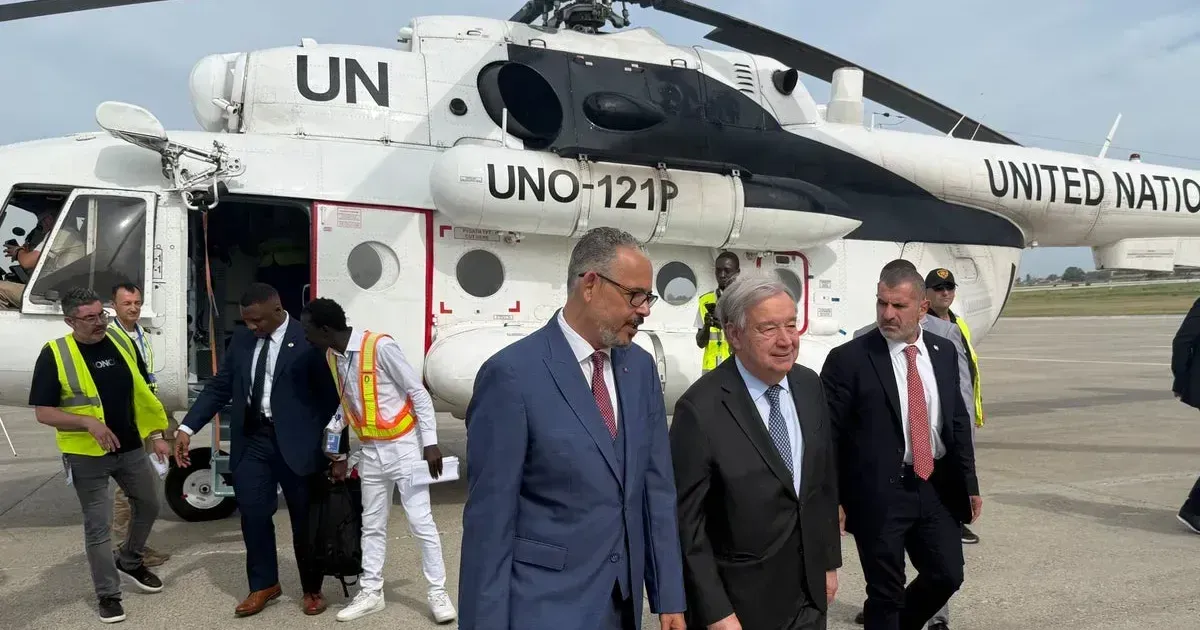
António Guterres touched down in Port-au-Prince to witness the humanitarian collapse firsthand as criminal cartels tighten their grip on the Caribbean nation. The visit put diplomatic attention on a crisis that has often been treated as permanent background noise. Aid groups wanted the trip to produce more than another warning about state failure. Haitian residents also needed to see whether international attention could translate into safer streets and open supply routes. The United Nations Secretary-General arrived on June 16, 2026, for a high-stakes assessment of the escalating urban warfare that has paralyzed the capital. Security details flanked the UN leader throughout his transit, reflecting the extreme volatility in a city where law enforcement presence has largely evaporated in favor of armed factions.
United Nations data confirms a catastrophic trajectory for the country, with 2,300 people killed since the start of the year. Criminal organizations have extended their reach beyond the slums, seizing control of essential supply routes and critical infrastructure. Port-au-Prince has become a patchwork of territories held by rival gangs, leaving residents caught in a constant crossfire. Records suggest that 100 people have been kidnapped for ransom in the first five and a half months of 2026, creating a climate of widespread fear among the remaining middle class and professional sectors.
Urban Warfare and the Displacement Crisis
Displacement figures have reached levels previously unseen in the history of the republic, with 1.5 million people currently homeless. This surge in internal migration has forced one in every ten Haitians to flee their primary residences. Families often abandon their belongings with minutes of notice when gang incursions begin, moving into overcrowded school buildings, public squares, or makeshift camps on the outskirts of the city. Conditions in these sites are severe, with limited access to clean water, sanitation, or medical services.
Violence in the capital has shifted from localized skirmishes to systematic territorial expansion. Armed groups now use heavy weaponry to clear entire neighborhoods, burning homes to ensure residents do not return. The United Nations reports that 15 percent of the national population is now effectively transient, moving between temporary shelters as front lines shift. Relief agencies struggle to reach these populations because gangs frequently block the roads leading to the most affected southern and northern districts.
International aid efforts remain hamstrung by the logistical impossibility of moving goods through gang-held checkpoints. Most humanitarian convoys require armed escorts, yet even these measures do not guarantee safe passage. Statistics provided by local NGOs indicate that food insecurity has deepened alongside the displacement, as agricultural products from the provinces cannot reach the urban markets of Port-au-Prince. The inability to secure these supply lines is the primary driver of the current famine warnings issued by the World Food Programme.
Security Failures and High-Profile Kidnappings
Security within the government apparatus has reached a breaking point, evidenced by the seizure of a senior defense ministry official last week. The abduction occurred in broad daylight, highlighting the audacity of criminal groups that no longer fear state retaliation. Law enforcement agencies in the capital are under-resourced and frequently outgunned, with many officers reportedly abandoning their posts to protect their own families. This institutional decay has allowed gangs to operate as a de facto government in several districts, collecting taxes and providing basic, albeit violent, dispute resolution.
Kidnappings have become a primary revenue stream for these organizations, targeting both the wealthy and the working class. While 100 cases are officially documented this year, the actual figure is likely much higher due to families negotiating directly with captors to avoid police involvement. The kidnapping of the defense official suggests a deliberate strategy to humiliate the transitional government and demonstrate the reach of the gang federations. Government buildings that once operated with minimal security now require heavy fortifications, further distancing the leadership from the citizenry.
Guterres met with local leaders and civil society representatives to discuss the potential for a more resilient international security intervention. Previous attempts to stabilize the country through foreign missions have met with mixed results, leading to serious skepticism among the local population. However, the sheer scale of the current death toll is forcing a reassessment of non-interventionist policies. Human rights organizations emphasize that without an immediate restoration of order, the upcoming electoral cycle will be impossible to conduct safely.
What Haiti Needs Next
The visit by António Guterres places immense pressure on the UN Security Council to authorize more aggressive measures against the Haitian gang federations. Diplomatic observers note that the Secretary-General rarely visits high-risk zones unless he intends to signal a major policy shift or a plea for increased funding. Regional stakes are rising as the displacement crisis begins to spill over into neighboring Caribbean nations and the United States, which has seen an uptick in maritime migration attempts from the Haitian coast.
Success for the United Nations now hinges on the ability to mobilize a multinational force that can secure the Port-au-Prince harbor and the main arterial roads. Failure to do so will likely result in the total collapse of the transitional government, leading to a vacuum that only the gangs are currently equipped to fill. The 1.5 million displaced citizens serve as evidence of the cost of international hesitation. Future stability in the region depends on whether the global community views the Haitian crisis as a localized conflict or a broader threat to Caribbean security. The path forward remains full of logistical and political obstacles that have thwarted previous administrations. International officials will also need to decide whether security assistance can be expanded without deepening public suspicion of outside control. Haiti's crisis has produced repeated promises, and each unmet promise has made the next appeal harder to sell. The visit also puts pressure on donor capitals to explain what they are willing to finance. Security support, humanitarian corridors and police training each require different timelines, and Haiti has little room for symbolic pledges.