Six major heatwaves recorded between 2003 and 2024 included periods that crossed physiology-based human survivability thresholds, according to a study published in Nature Communications. The result does not mean every person in the affected areas faced the same outcome. It identifies combinations of heat, humidity, age, sun exposure and duration that a human heat-balance model classified as capable of producing fatal heatstroke.
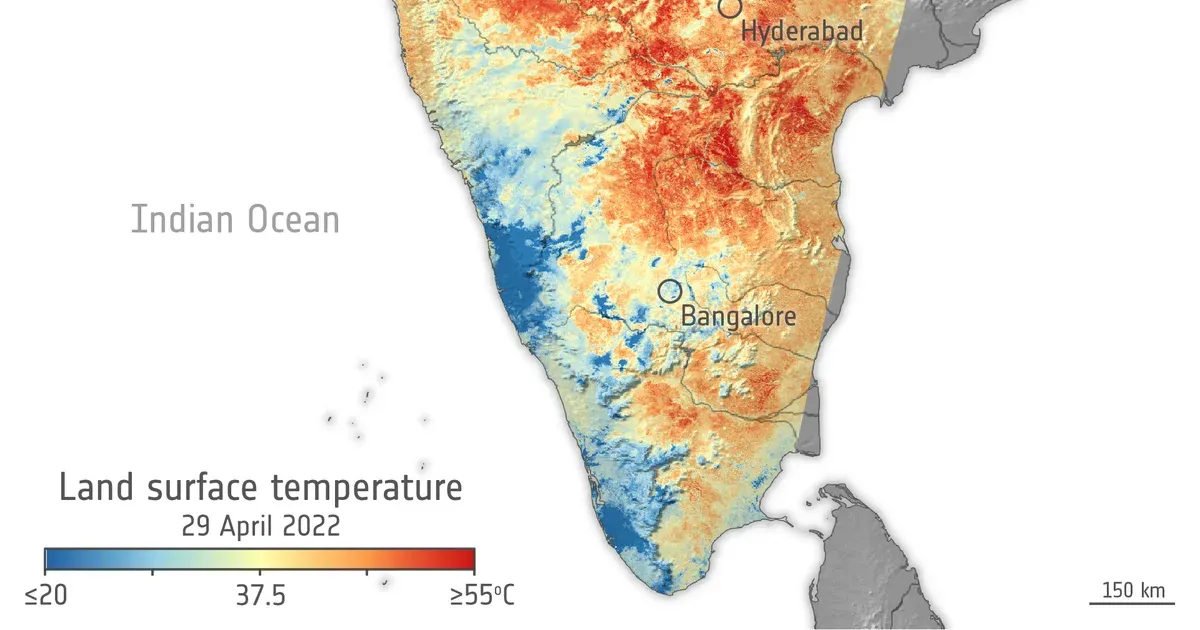
The researchers examined heat events across the Middle East in June 2024, South Asia in April 2024, North and Central America in July 2023, Australia in January 2019, India and Pakistan in May and June 2015, and Europe in August 2003. Their city-level examples were Mecca, Bangkok, Phoenix, Mount Isa, Larkana and Seville.
Every event contained at least one period modeled as non-survivable for people over 65 who remained outdoors in direct sun. The risk was not uniform. Age, access to shade, local temperature and humidity, the length of exposure and whether a person began the period at a normal core temperature all affected the result.
Why the 35°C Wet-Bulb Rule Is Not Enough
A long-used theoretical limit holds that a wet-bulb temperature of 35°C sustained for six hours marks the point at which the body can no longer shed enough heat to survive without cooling. Wet-bulb temperature combines heat and humidity, but the study argues that this single threshold does not fully represent human physiology.
The researchers used HEAT-Lim, a model developed by teams at Arizona State University and the University of Sydney. It incorporates age-related differences in sweating, the body's heat balance, humidity and solar exposure. Under that framework, dangerous limits can be reached in conditions that are cooler or drier than the traditional wet-bulb benchmark.
That distinction matters in very hot, dry places. Humidity can restrict the evaporation of sweat, but dry air does not remove every constraint: the body has a limited capacity to produce sweat, and direct sunlight adds radiant heat. The study found that extremely hot, dry conditions can be as dangerous as hot, humid conditions when exposure is long enough.
What the Six City Analyses Showed
Phoenix had the highest frequency of modeled deadly conditions for older people in direct sun. During the July 2023 event, 24% of rolling six-hour periods crossed the HEAT-Lim threshold using ERA5 reanalysis data; the figure rose to 28% when researchers used local weather-station data. One six-hour period also crossed the threshold for older people in shade.
In Larkana during the 2015 India-Pakistan heatwave, 18% of rolling six-hour periods exceeded the limit for older people in direct sun using ERA5, compared with 13% in station data. The study also identified a six-hour period that was non-survivable for older people in shade and an 18-hour window in which younger adults in direct sun were at risk.
Mecca recorded modeled threshold exceedances for older people in direct sun during 12% of the rolling six-hour periods in June 2024, or 10% using station observations. The timing overlapped with the Hajj, when large numbers of pilgrims, including many older adults, were outdoors and moving across long distances.
Bangkok, Mount Isa and Seville also crossed the older-adult threshold in direct sun, though less frequently than Phoenix, Larkana and Mecca. The researchers did not find non-survivable conditions for younger adults in those three city cases. Their day-to-night plots also showed nighttime relief across the events, another reason not to describe an entire heatwave or city as continuously unsurvivable.
Shade Reduced Risk, but Access Determines Protection
When the model assumed that older people could move into shade, the number of dangerous periods fell substantially across the six events. In the Middle East case, modeled non-survivable days for older adults dropped to no more than 50%, roughly half the exposure calculated for direct sun. Reductions were also pronounced in the South Asia and India-Pakistan events. Central America and Australia recorded no more than 25% of days above the older-adult threshold in shade, while the European event showed barely any.
Shade is therefore a measurable health intervention, not a cosmetic feature. Its protective effect also has limits. The Phoenix and Larkana results included isolated periods dangerous even for older people in shade, and the study stresses that access to behavioral cooling varies sharply. Outdoor work, pilgrimage, age, income and access to cooling can determine whether a person can act on a heat warning.
The findings make shaded rest areas, accessible cooling and exposure-specific heat alerts logical priorities. They also show why a citywide temperature alone cannot describe individual risk. A worker in direct sun, an older resident in a poorly cooled room and a healthy adult able to move indoors do not face the same exposure.
The Model Draws a Boundary, Not a Death Forecast
HEAT-Lim estimates the conditions that can drive core body temperature toward fatal heatstroke; it does not count deaths or prove that each person present crossed that physiological endpoint. The analysis assumes a normal starting core temperature for each six-hour window and does not model heat accumulated across successive periods. It also focuses on fatal heatstroke at a core temperature of 43°C, not cardiovascular or respiratory deaths that can occur at lower body temperatures.
The authors identify other uncertainties. ERA5 can understate urban heat; in Seville, the reanalysis was as much as 3°C cooler than the local station during the 2003 event. Evidence for applying some physiological models to older adults also remains limited. These constraints may push estimates in different directions and make local measurements essential.
The defensible warning is narrower and more useful than an apocalyptic one. Present-day heat has already crossed modeled survivability thresholds for specific people under specific exposure conditions, and the familiar 35°C wet-bulb line can miss that danger. The study does not establish inevitable mass casualties, urban depopulation or a universal biological deadline. It shows that heat policy built around a single weather number will leave predictable groups unprotected.