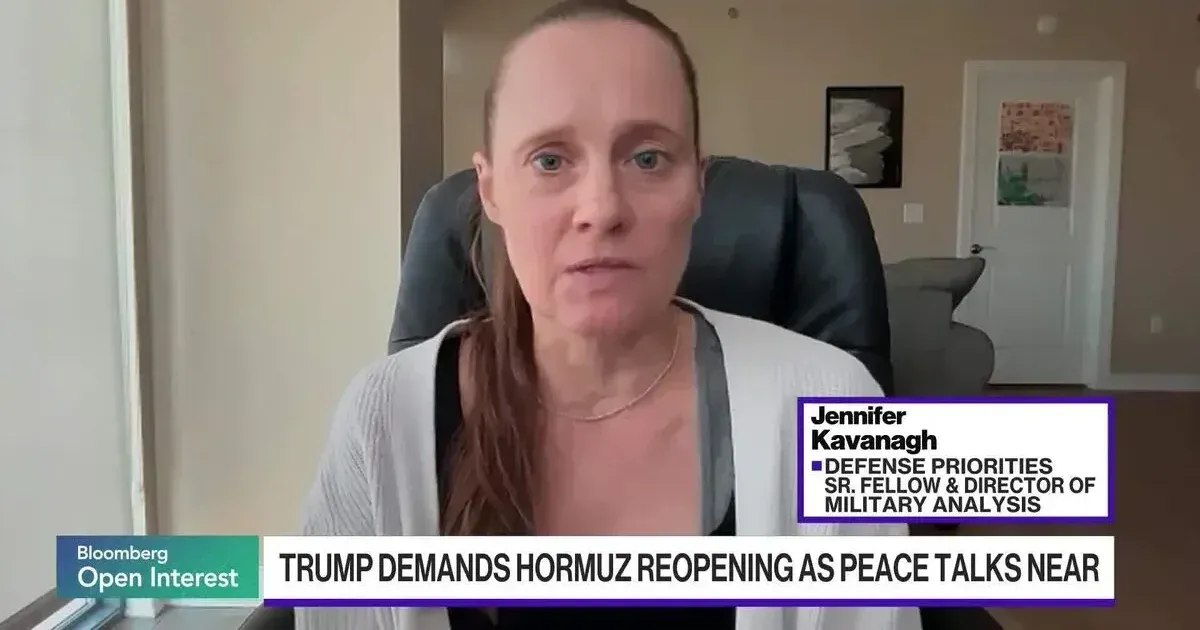
Jennifer Kavanagh arrived in Muscat to assess the fragile diplomatic efforts aimed at reopening the Strait of Hormuz. Iran maintains tight control over the narrow waterway, preventing 21 million barrels of daily crude oil from reaching international markets. Negotiators from the United States and the Islamic Republic meet this weekend to confront a crisis that has paralyzed international shipping lanes. Traders focused on the Strait of Hormuz on April 10, 2026, after the oil-supply warning. Jennifer Kavanagh, director of military analysis at Defense Priorities, provided an assessment of the situation during a recent discussion with Bloomberg Open Interest.
Energy markets remain fixated on the outcome of these high-stakes discussions. Financial Times reports indicate that Iran holds the keys to unlocking one-fifth of the global oil supply. Any prolonged closure of the Strait of Hormuz threatens to destabilize Western economies that rely on predictable energy flows. While regional powers seek a resolution, the structural obstacles to a comprehensive agreement appear overwhelming for the immediate future. Previous attempts at de-escalation have foundered on the rocks of mutual distrust and conflicting regional ambitions.
Experts at Defense Priorities suggest that no major breakthrough is expected from the Muscat meetings. Fragile ceasefires currently prevent a total regional fire, but these agreements are held together by little more than immediate survival instincts. Mutual incentives keep both Washington and Tehran from initiating a full-scale kinetic conflict. Both nations understand that an unrestricted naval war would result in catastrophic economic damage that neither side can afford. Crude oil prices reflect this tension, fluctuating with every rumor of a breakthrough or a breakdown in talks.
Iranian Influence Over Global Energy Flows
Tehran uses its geographic advantage to exert leverage over the international community. The Strait of Hormuz measures only 21 miles wide at its narrowest point, making it one of the most vulnerable chokepoints in the world. Tankers carrying crude from Saudi Arabia, Kuwait, and the United Arab Emirates must pass through Iranian-controlled waters to reach the Arabian Sea. Iranian naval assets, including fast-attack craft and submersible vehicles, monitor every vessel that enters the corridor. Recent incidents involving seized tankers have proven that conventional naval escorts cannot guarantee total safety for commercial fleets.
Global shipping firms have reacted by rerouting vessels or suspending operations entirely. Insurance premiums for transiting the Persian Gulf have skyrocketed by 400 percent since the beginning of the year. Such costs are passed directly to consumers in the form of higher fuel prices and increased freight charges for consumer goods. Some logistics companies have explored land-based pipelines as an alternative, but these routes lack the capacity to replace the large volumes moved by sea. Shipping lanes around the Cape of Good Hope offer a safer route but add two weeks to transit times. Bloomberg Economics notes that diplomacy is the primary path forward for global trade. Military solutions carry the risk of permanent damage to oil infrastructure and terminal facilities. Jennifer Kavanagh emphasized the necessity of a non-kinetic resolution during her analysis of the current military posture in the region.
The director of military analysis at Defense Priorities stated that diplomacy is the only realistic path to reopening one of the world’s most critical shipping lanes.
Washington has maintained a significant naval presence in the region to deter further aggression. Carriers and destroyers patrol the Gulf of Oman, yet their presence has not deterred Iranian shadow tactics. Tehran employs asymmetrical warfare strategies that make traditional power projection difficult to execute. Mines, drones, and coastal missile batteries create a high-risk environment for even the most advanced warships. This strategic reality forces the United States to prioritize diplomatic channels over direct military intervention.
Financial Impact of Closed Shipping Lanes
Economic data from the first quarter of 2026 shows a significant contraction in global GDP growth. Emerging markets in Asia are particularly vulnerable to these disruptions because they import the majority of their energy from the Persian Gulf. China and India have attempted to mediate between the two sides to protect their manufacturing sectors. Without a steady flow of crude, industrial output in these nations could fall by as much as 15 percent. European nations face similar pressures as they struggle to manage energy inflation during a period of sluggish economic recovery.
Brent crude prices spiked to $112 per barrel following the latest round of failed communications. Traders anticipate a long-term supply deficit if the Strait remains contested. Trade worth $100 billion evaporates for every month the passage is restricted. High-level bank analysts suggest that a permanent closure would trigger a global recession deeper than the 2008 financial crisis. Regional stock exchanges in Dubai and Riyadh have already seen double-digit declines as investors flee to safer assets like gold and U.S. Treasuries. Sovereign wealth funds in the Gulf are shifting their portfolios to reduce the impact of domestic instability.
Mutual incentives remain the only reason the situation has not devolved into total war. Iran needs to sell its oil to maintain domestic stability and fund its government operations. The United States needs to keep global energy prices low to prevent domestic political backlash and maintain the strength of the dollar. These shared economic requirements create a ceiling for the level of violence both parties are willing to tolerate. Each side tests the boundaries of this arrangement without crossing the threshold into a terminal conflict.
Military Restraint and Mutual Incentives
Defense analysts observe that neither side possesses a clear path to a decisive victory. A military strike on Iranian nuclear or oil facilities would likely lead to the total destruction of the Strait of Hormuz as a viable trade route. By contrast, an Iranian attempt to permanently close the Strait would lead to an international coalition response that could topple the regime. This balance of terror defines the current status quo in the Middle East. Negotiators in Muscat are working within these tight constraints to find a temporary modus vivendi. Small concessions on sanctions or maritime patrols could provide the breathing room needed for a more durable agreement.
Jennifer Kavanagh argues that the current military analysis favors a prolonged stalemate. Strategic patience has become the default policy for both the Pentagon and the Iranian Revolutionary Guard Corps. While some hawks in Washington call for a more aggressive posture, the reality of the global supply chain makes such moves prohibitive. Projections show that even a three-day closure of the Strait would take months for the global logistics network to resolve. Supply-chain managers are currently operating on a just-in-time basis that leaves zero margin for error. Shipments of liquefied natural gas are also at risk, threatening the heating and power needs of millions.
Future stability depends on the ability of the United States and Iran to separate their long-term geopolitical rivalries from the immediate need for maritime security. History suggests that such separations are difficult to maintain. The Tanker War of the 1980s showed how quickly localized skirmishes can expand into international crises. During that era, the U.S. Navy eventually intervened to escort tankers, but the modern threat environment is much more complex. Modern anti-ship missiles are more precise and lethal than the weapons used forty years ago. Energy security is no longer just about volume; it is about the safety of the technology that moves that volume.
Iranian Geography Constrains Western Naval Power
Western policymakers often hallucinate that naval superiority translates to economic stability in the Persian Gulf. The reality in 2026 is far more humbling. Despite the presence of high-tech carrier groups, the world’s energy security is effectively a hostage to Iranian geography and asymmetrical hardware. What is unfolding is the limits of conventional power in an age where a $50,000 drone can threaten a multi-billion dollar tanker and the global economy it supports. The weekend talks in Muscat will almost certainly fail to produce a complete peace because both sides find the status quo of controlled tension more useful than the risks of a genuine compromise.
Iran knows that the threat of closure is more powerful than the closure itself. Once the Strait is actually shut, Tehran loses its primary bargaining chip and invites its own destruction. Washington, meanwhile, is trapped in a reactive loop, unable to force a reopening without risking the very oil price spike it seeks to avoid. This is not a diplomatic puzzle to be solved but a strategic reality to be managed. Investors should prepare for a decade of maritime volatility. The era of cheap, safe passage through the world’s chokepoints is over. Global trade will increasingly fragment as nations seek shorter, albeit more expensive, supply lines that do not pass through the crosshairs of regional hegemons. The verdict is clear: geography has reclaimed its throne over global finance.