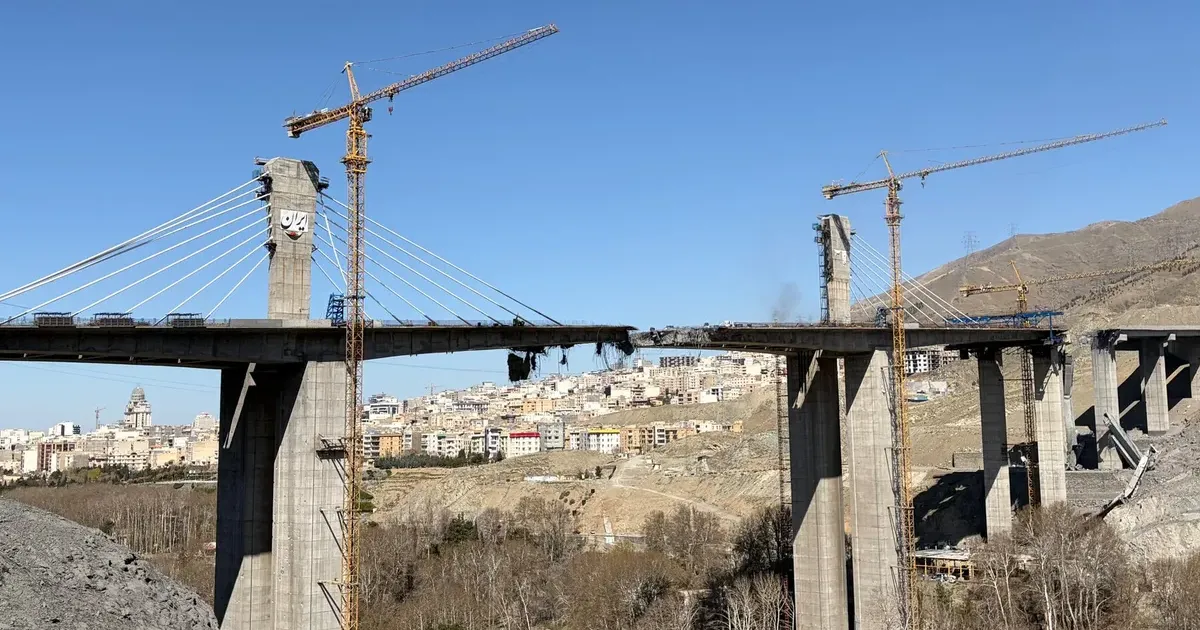
A drone strike on a major Kuwaiti oil refinery sharply escalated the conflict in the Persian Gulf, setting multiple processing units ablaze. Fire crews battled intense flames at the facility while the operator confirmed that the hit had compromised critical refinery infrastructure. Plumes of black smoke were visible from miles away, signaling a new phase of a conflict that has now entered its thirty-fifth day. The April 3, 2026, escalation pushed the conflict deeper into Gulf energy infrastructure. President Trump confirmed that American and Israeli forces participated in a series of coordinated strikes within Iran during this period. These military actions specifically targeted the tallest bridge in the country, an essential transportation artery near Tehran.
United States officials characterized the destruction of the bridge as a necessary strike against logistical nodes used by the Iranian military. Iranian state media identified the structure as the Karaj bridge, a facility of meaningful architectural and transport value. Engineers described the bridge as a masterpiece of local infrastructure before it was reduced to rubble by precision munitions. The bridge loss has paralyzed land travel between several major provinces and the capital city. Military analysts suggest that the demolition of such high-profile targets indicates a shift in strategy toward crippling internal Iranian mobility. Global oil prices reacted immediately to the news, climbing 4% within hours of the reported refinery hit in Kuwait.
Karaj Bridge Destruction and Infrastructure Targets
Tehran officials confirmed the total collapse of the Karaj bridge following what they described as a series of missile strikes. The structure was widely considered the tallest bridge in the nation, spanning a deep valley to connect the capital with western industrial zones. Photographs from the scene show enormous concrete sections resting in the gorge below. Witnesses reported hearing multiple explosions shortly before the central span gave way. Civil engineers estimate that replacing the structure will cost $11 billion and take years to complete. Traffic has been diverted to secondary roads that are incapable of handling heavy commercial volume.
Iranian military leaders met in an emergency session to discuss the implications of this strike on national security. They claim the bridge served almost exclusively civilian purposes and had no direct military utility. Satellite imagery provided by independent analysts shows a complete break in the transit line. Projectiles used in the attack were reportedly of a high-precision variety, leaving little collateral damage to nearby residential areas. Even with the reported precision, the economic impact of the severed connection is expected to be felt across the domestic manufacturing sector. Local authorities have declared a state of emergency in the Karaj region to manage the resulting transit chaos.
Tehran Medical Research Center Bombing
Medical professionals in Iran reported that a century-old research center was also hit during the latest round of US-Israeli air operations. This facility had been actively engaged in studying infectious diseases and domestic public health challenges. Laboratory equipment and decades of scientific records were lost when the main building caught fire. Staff members described the scene as one of total devastation, with specialized medical archives incinerated by the blasts. Tehran characterized the strike as a moral collapse of the Western-led coalition. Government ministers argued that hitting a scientific institution during a period of regional tension violated international norms regarding civilian safety. The global market remains volatile following the refinery hit in Kuwait, which contributed to skyrocketing oil prices.
"Iran condemns the US-Israeli moral collapse after these deliberate attacks on civilian sites and historical research institutions."
Israel has not provided a specific comment on the medical center but maintains that all targets have military significance. Intelligence reports previously suggested the site might have dual-use capabilities, though no evidence was presented to the public. Health officials warned that the destruction of the lab would delay critical vaccine development programs. International observers expressed concern over the widening scope of targets being selected by coalition forces. The facility, established in the early 20th century, was a point of pride for the Iranian scientific community. The center now sits in ruins alongside the bridge infrastructure.
Kuwaiti Refinery Fires and Global Supply
Flames erupted at the Kuwaiti oil refinery shortly after 10:00 AM local time following the drone incursion. Kuwait Petroleum Corporation officials stated that several refinery units were set on fire, leading to an immediate halt in production. Emergency responders worked through the night to prevent the blaze from spreading to nearby storage tanks. The facility is a foundation of the regional energy market, processing hundreds of thousands of barrels of crude daily. Security analysts believe the drone originated from territory controlled by Iranian-backed militias. The strike represents the most direct hit on Kuwaiti energy assets since the conflict began over a month ago.
President Trump responded to the refinery attack by threatening to destroy the entirety of Iran’s infrastructure if such actions continued. Washington has strengthened its naval presence in the region to protect shipping lanes. Traders in London and New York have factored in a serious risk premium for all Gulf-originating oil. Some tankers have begun to avoid the Hormuz Strait entirely, opting for longer and more expensive routes. Kuwaiti authorities have increased the security alert level to its highest point at all industrial ports. The loss of refinery output could lead to fuel shortages across parts of Asia that rely on Kuwaiti exports.
Tehran responded to the bridge demolition by releasing a list of seven potential targets across the Gulf. The document, published by state-aligned media outlets, specifically names strategic bridges in neighboring countries as legitimate targets for a tit-for-tat response. Military commanders in Iran stated that they would follow a bridge-for-bridge doctrine in future operations. The threat has caused alarm in capitals across the region, where infrastructure is often vulnerable to long-range drone or missile attacks. Each of the seven targets is an essential link for regional commerce or energy transport. Iranian media outlets displayed maps showing the precise coordinates of these Gulf bridges.
Diplomatic efforts to de-escalate the situation have so far yielded no results. United Nations representatives called for restraint, yet both sides have continued to intensify their rhetoric. Iran maintains that it has the right to defend its territory and retaliate against the destruction of its tallest bridge. Israel continues to conduct sorties over the region, maintaining that it will not allow Iran to threaten its security interests. The list of seven targets remains a primary concern for regional security planners. Military drills have been observed along the Iranian coastline, suggesting preparations for a possible maritime or aerial launch. The expansion of the target list suggests the conflict is no longer confined to the borders of the initial belligerents.
Target Lists Push Gulf War Risk Higher
Washington is currently entangled in a dangerous game of infrastructure brinkmanship that lacks a clear exit strategy. By sanctioning the destruction of the Karaj bridge, the Trump administration has effectively signaled that no civilian-adjacent target is off-limits. It is not a tactic of containment; it is a policy of deliberate economic strangulation designed to provoke a regime collapse from within. History suggests that such actions rarely produce a compliant adversary. Instead, they provide a desperate leadership with the domestic justification needed to export the violence. The refinery hit in Kuwait is a direct consequence of this escalatory spiral, proving that American air superiority cannot fully shield its regional partners from asymmetrical retaliation.
Could the global economy survive a sustained bridge-for-bridge war in the Persian Gulf? The answer is a decisive no. If Tehran executes its threat to strike seven strategic bridges in the Gulf, the physical movement of goods and oil will face historic disruptions. Tehran is no longer hiding its intentions. It has moved beyond the shadow war into a phase of explicit, documented targeting. The American insistence on infrastructure destruction has granted Iran the moral and tactical leeway to do the same. It is a strategic failure of the highest order. Policymakers in D.C. have traded long-term regional stability for short-term tactical displays of power. The price for this exchange will be paid at the pump and through the permanent destabilization of the world's most critical energy corridor. It is time to stop pretending this is a controlled escalation. The risk is no longer local.