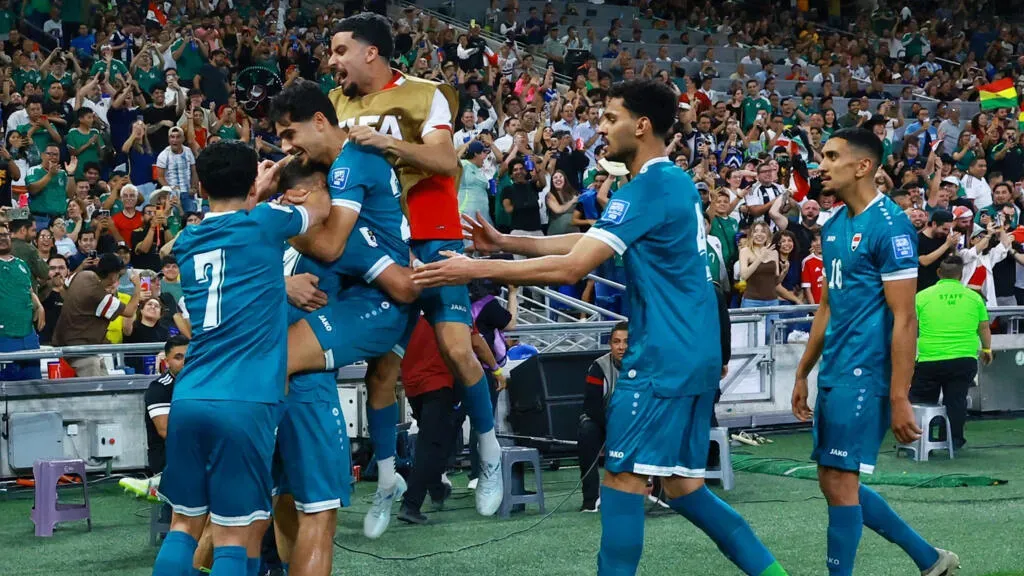
Iraq and DR Congo completed the 2026 World Cup field in March through the intercontinental playoffs. By mid-July, with the tournament down to its final four, their stories no longer belong only to qualification romance. They have become a cleaner test of what the expanded 48-team World Cup actually changed.
The answer is not as simple as celebration or dilution. Iraq's return after four decades ended in the group stage, bruised by the speed and depth of stronger opponents. DR Congo turned its playoff entry into a longer run, reaching the knockout phase before England ended it. One team showed how steep the climb remains. The other showed why the extra places matter. Together, they make the format harder to dismiss and harder to defend lazily.
The Playoff Door Was Not a Gift
Neither side arrived through charity. Congo DR beat Jamaica 1-0 after extra time in Guadalajara, with Axel Tuanzebe scoring the goal that sent the Leopards to their first World Cup since 1974, when they played as Zaire. Iraq beat Bolivia 2-1 in Monterrey, securing its first finals appearance since 1986. Those are not marginal droughts. They are football lifetimes.
The intercontinental playoff system can look like a narrow side entrance to the tournament, but winning it still requires pressure management. Bolivia brought South American qualifying credibility. Jamaica brought athleticism, speed and the possibility of turning one transition into a national breakthrough. Iraq and Congo DR had to handle the occasion, the travel, the neutral Mexican venues and the knowledge that one bad sequence could erase years of work.
Iraq Found the Ceiling Quickly
Iraq's finals campaign exposed the other side of expansion. The achievement of reaching the tournament did not make Group I kinder. France had too much quality. Norway's attack had too much force. Senegal's final group-stage surge left Iraq with the kind of scoreline that turns qualification pride into a harder review of squad depth, defensive recovery speed and tournament readiness.
The difficult group-stage exit does not make Iraq's place a mistake. It means the return should be judged in two layers. The first layer is historic: a national team that had waited since 1986 reached the World Cup again under a difficult qualifying road. The second is competitive: getting there did not remove the gap between a revived program and teams with deeper pipelines, more elite-level minutes and more recent World Cup experience. Both things can be true without cancelling each other.
DR Congo Made the Stronger Case
Congo DR gave the expanded tournament its sharper defense because it did more than appear. The Leopards survived the first wave of pressure, carried their qualification story into the knockout bracket and forced England into the kind of uncomfortable match that makes tournament favorites reveal something about themselves. A 48-team field is easier to criticize when new arrivals vanish quietly. It is harder when one of them pushes a contender on a global stage.
Their run also reflected a modern national-team model. Diaspora recruitment, better scouting and more coherent federation planning can quickly change a country's ceiling when the base talent is already there. Congo DR did not need to become a traditional power overnight. It needed enough structure to turn individual quality into a tournament identity. That is exactly the kind of development the bigger World Cup was supposed to encourage.
Expansion Still Has a Quality Problem
The criticism has not disappeared. A larger World Cup brings more matches, more travel, more uneven group games and a bigger commercial machine around the sport's most powerful event. Some blowouts were always likely. Iraq's group-stage exit gave skeptics an easy example. The tournament cannot pretend that access alone creates parity.
But the old 32-team field also protected familiar pathways. It made decades-long absences feel natural and left strong football cultures waiting outside because their confederation routes were narrow. Expansion opens the door. It does not guarantee that everyone walking through it is ready for the last rooms of the house. That is a flaw only if FIFA sells the format as instant equality. It is more defensible if the goal is broader participation with a brutally honest competitive test attached.
The Real Work Starts After the Applause
Iraq and Congo DR now face different internal questions. Iraq has to turn qualification into a development audit: player pool, defensive organization, conditioning, preparation matches and the ability to survive elite pace. The federation cannot treat the playoff win as a completed project. It has to ask why the finals exposed so much space between national pride and tournament resilience.
Congo DR has a different burden. A knockout appearance raises expectations. The next cycle will judge whether this was a one-tournament peak or the start of a more stable African contender. That means keeping the diaspora pipeline active, protecting coaching continuity and avoiding the federation turbulence that has hurt too many talented national teams.
Arrival Is Not the Same as Belonging
The expanded World Cup did not make Iraq and Congo DR equal to the giants. It gave them a stage on which equality could be tested rather than assumed. Iraq showed that the distance can still be punishing. Congo DR showed that a playoff qualifier can do more than decorate the schedule.
The harder and more useful verdict follows from both teams. The 48-team field is not automatically noble because more flags appear. It is not automatically cheap because some teams suffer. Its value depends on whether countries use access as the beginning of a football cycle, not the reward at the end of one. Iraq and DR Congo earned the final playoff places. What they did after that now becomes the evidence: the door opened, and the tournament told the truth about who was ready to walk further.