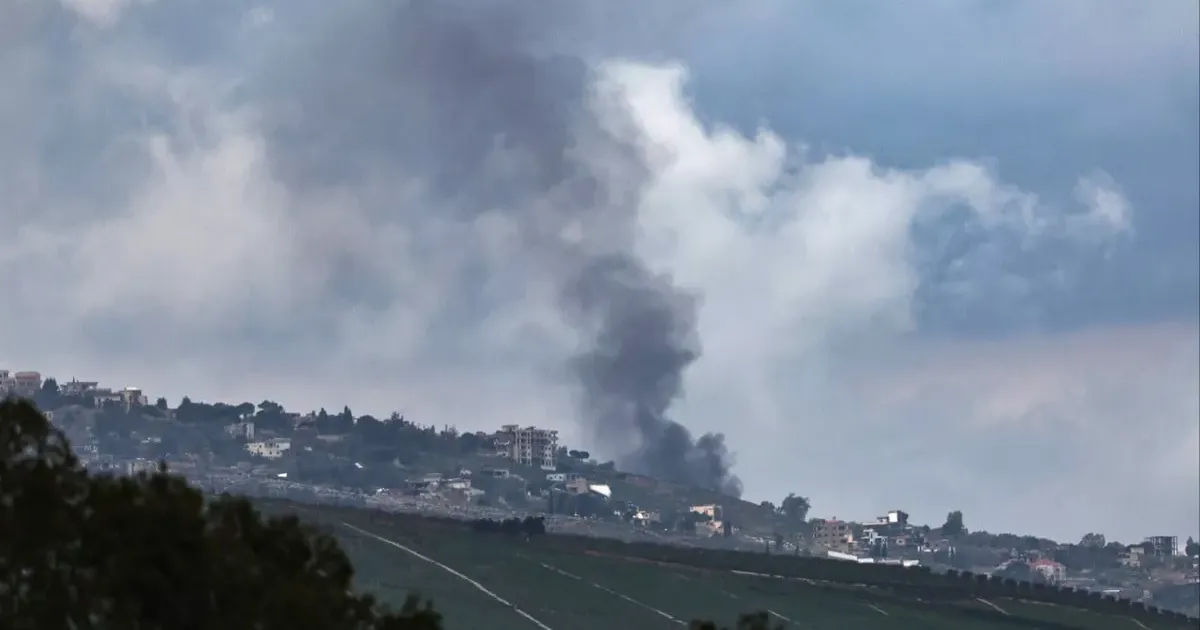
Yechiel Leiter, the Israeli Ambassador to the United States, asserted on March 22, 2026, that his government seeks a lasting peace with Lebanon even as cross-border violence claims more lives. Sunday’s events proved more volatile when a Hezbollah rocket struck northern Israel, killing one person in a region already under heavy fire. This death represents the first such fatality on Israeli soil since this specific phase of the war erupted. While Leiter spoke of diplomatic resolutions on Bloomberg This Weekend, the tactical reality on the ground shifted toward systematic infrastructure destruction.

But the dual tracks of diplomacy and demolition appear increasingly at odds. Israeli Defence Minister Israel Katz issued a directive to intensify military pressure along the southern Lebanese border. This order targets logistics networks that officials believe sustain militant operations. Military units received instructions to sever transportation routes by targeting key river crossings. Movement across the border zone has become nearly impossible for civilians and combatants alike.

Meanwhile, the Israeli army began a new phase of operations involving the systematic removal of structures in southern Lebanese villages. Defense officials contend that these buildings provide cover for anti-tank missile teams and rocket launch pads. South China Morning Post reported that the demolition of houses has stepped up greatly in the last twenty four hours. Soldiers moved into several border towns with heavy machinery to level blocks identified as military outposts. The Israeli government maintains that these measures are necessary to ensure the safe return of displaced northern residents.

Hezbollah Rocket Strikes Kill Israeli Citizen

Hezbollah militants confirmed they launched a barrage of rockets targeting military concentrations in northern Israel. One of these projectiles bypassed interception systems and impacted a residential area. Authorities confirmed the victim was a civilian who was unable to reach a shelter in time. In fact, the group claimed the attack was a direct response to the continued destruction of Lebanese homes. Rocket fire has been a constant feature of the border conflict, yet this specific fatality adds political pressure on the Israeli cabinet to deliver a decisive military outcome. Northern towns remain largely ghost cities, populated only by soldiers and essential workers.

Still, the militia shows no sign of withdrawing from the border area. According to SCMP Business, Hezbollah fighters have continued to engage Israeli ground forces despite the heavy aerial bombardment of their supply lines. Intelligence reports suggest that the group uses subterranean tunnels and heavily reinforced bunkers to survive initial strikes. Military analysts in Tel Aviv suggest that the intensity of these rocket volleys fluctuates based on the success of Israeli interdiction efforts. Current estimates indicate thousands of rockets remain in the group’s arsenal, including precision-guided munitions capable of reaching Tel Aviv.

Yet, the psychological impact of the northern death cannot be overstated for the Israeli public. For one, it challenges the narrative that current defensive measures are sufficient to protect the remaining population. Government critics have argued for a wider ground operation to push the militants further north. Supporters of the current strategy suggest that attrition will eventually force a diplomatic compromise. The funeral for the victim is scheduled for Monday in a town that remains under active red-alert warnings.

Israel Orders Destruction of Litani River Bridges

Bridges across the Litani River are now central targets for the Israeli Air Force and engineering corps. Israel Katz emphasized that destroying these structures is a strategic necessity to prevent the resupply of front-line units. He directed the army to dismantle any crossing that could enable the transport of heavy weaponry or personnel. By contrast, Lebanese authorities have condemned the destruction as a collective punishment of the civilian population. They argue that these bridges are essential for humanitarian aid and the transport of food to the isolated south.

Israeli Defence Minister Israel Katz said that the army had been ordered to destroy more bridges over Lebanon’s Litani River that are allegedly being used by Hezbollah in the country’s south, and to step up the demolition of houses.

Separately, the military impact of these bridge strikes has begun to manifest in reduced militant movement. Surveillance drones have recorded dozens of vehicles stranded on the northern banks of the river. Israeli commanders believe that by trapping Hezbollah units in the south, they can more easily identify and neutralize them. To that end, air strikes have focused on the southern bank to ensure that any temporary repairs are immediately destroyed. Engineers have also used specialized munitions to crater roads leading to these crossing points.

Diplomatic Initiatives and the Ambitions of Yechiel Leiter

Bloomberg hosts David Gura and Christina Ruffini questioned Yechiel Leiter regarding the endgame of these operations. Leiter insisted that the goal is a peaceful border where the sovereignty of both nations is respected. He spent considerable time discussing the broader threat posed by Iran, which is the primary financier for the Lebanese militia. Even so, the Ambassador did not provide a specific timeline for the cessation of hostilities. His rhetoric focused on the necessity of a security vacuum being filled by legitimate state actors rather than non-state militias. Peace, in his view, requires the total implementation of previous UN resolutions that have gone ignored for years.

In turn, the diplomatic community remains skeptical of a quick resolution. While Leiter portrays the war as a defensive necessity, international observers point to the growing humanitarian crisis in Lebanon. Over a million people have been displaced from their homes, and the destruction of the Litani bridges has complicated rescue efforts. In particular, the United States has urged restraint regarding the targeting of civilian infrastructure. Leiter countered these concerns by stating that any structure used for military purposes loses its civilian status under international law. The diplomatic stalemate continues as both sides wait for a tactical advantage.

At the same time, the Iranian connection remains the most complex variable in Leiter’s peace equation. He noted that the war in Lebanon is inseparable from the wider regional conflict involving Tehran. Israeli intelligence claims that Iranian advisors are actively assisting Hezbollah in coordinating their rocket barrages. Leiter argued that true peace with Lebanon can only occur when the influence of the Islamic Revolutionary Guard Corps is purged from the country. This position suggests that the current conflict is merely a theater in a much larger geopolitical struggle.

Geopolitical Risks of the Expanded House Demolition Policy

Lebanon now faces a landscape of ruin in its southernmost districts. Systematic house demolitions are intended to create a buffer zone that prevents militants from launching short-range attacks. For instance, the village of Mhaibib has reportedly seen its entire central district leveled by controlled explosions. Military officials state that these buildings were booby-trapped or contained hidden weapon caches. But the long-term impact of this scorched-earth policy may be the radicalization of a new generation of Lebanese citizens. Historical precedent shows that the destruction of property often fuels further insurgency rather than discouraging it.

Security experts have warned that leveling entire neighborhoods creates a political vacuum. If the Lebanese army is unable to move into these areas, Hezbollah will likely return to the rubble to rebuild. The Israeli strategy relies on the hope that the cost of the war will turn the Lebanese public against the militia. Evidence on the ground is mixed, as many civilians blame Israel for the destruction of their livelihoods. In fact, some reports indicate that local residents are providing even more assistance to the militants in defiance of the bombing campaign.

Israeli military units reported clearing three additional residential blocks near the border before sunset.

The Elite Tribune Perspective

Diplomacy is often the polite mask worn by those waiting for their artillery to finish the conversation. While Ambassador Yechiel Leiter speaks of peace on American television, his colleagues in the Israeli defense ministry are busy ordering the systematic erasure of Lebanese infrastructure. The split is not an accident. It is a calculated strategy designed to appease Western allies while executing a brutal, tactical necessity. The destruction of bridges across the Litani River is a clear signal that the goal is not a negotiated settlement, but a total military severance.

By leveling civilian homes and cutting off supply routes, Israel is attempting to create a de facto no-man’s land that makes the 1701 resolution irrelevant. The death of an Israeli civilian on Sunday only provides the domestic political cover needed to accelerate this destruction. We should not be fooled by talk of peace from an embassy in Washington when the actions in the Galilee and South Lebanon point toward a permanent transformation of the border. If the Litani River becomes the new iron curtain of the Middle East, the prospects for actual stability are non-existent.

The region is not moving toward peace; it is moving toward a more efficient form of permanent war.