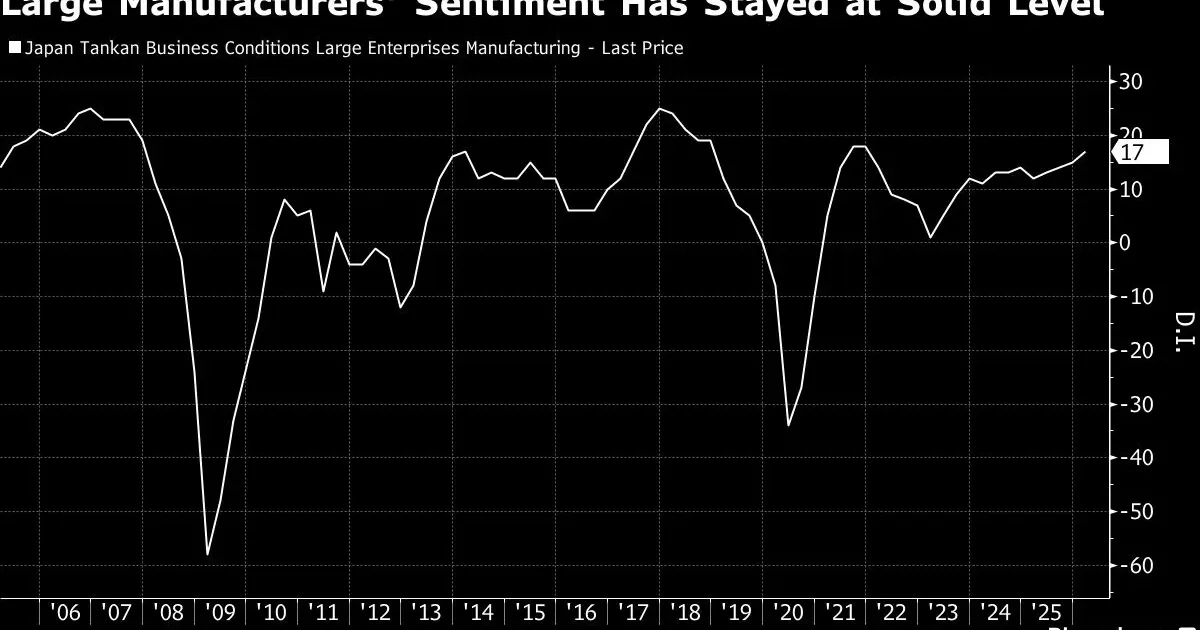
Japanese manufacturer sentiment improved for a fourth consecutive quarter despite energy volatility and geopolitical stress. The Tankan reading gave the Bank of Japan another sign that large industrial firms are adapting to higher costs and supply-chain uncertainty. Corporate executives pointed to automation spending, currency stability and resilient export demand in the April 1, 2026 survey.
Business conditions for large manufacturers have moved into positive territory with a consistency not seen in the previous decade. Successive quarters of growth in the sentiment index indicate that the post-pandemic recovery has transitioned into a more durable phase of expansion. Monetary policymakers view this trend as a green light to continue their departure from years of ultra-loose fiscal settings. Internal documents from the central bank emphasize that domestic industrial strength remains the primary driver for sustainable inflation targets.
Industrial Resilience Through External Supply-chain Pressures
Japanese factory owners have navigated a complex web of logistical hurdles caused by shipping disruptions and regional conflicts. Diversification of supply chains away from single-source dependencies helped major exporters maintain production schedules despite volatility in the Red Sea and surrounding areas. Inventory levels at major ports in Nagoya and Yokohama indicate that manufacturers have moved toward a just-in-case model to insulate themselves from sudden shocks. These strategic shifts in logistics management have provided a buffer that allowed sentiment to rise even when global headlines suggested imminent contraction.
Operating margins at companies like Toyota and Sony showed surprising durability throughout the first quarter of the year. Domestic manufacturers benefited from a weaker yen for much of the period, which boosted the value of repatriated profits from overseas markets. Export volumes stayed strong in the high-tech machinery and semiconductor equipment categories. Rising demand from Southeast Asian markets provided a necessary offset to cooling consumption in other major Western economies.
"Large manufacturers show greater confidence in the state of business conditions for a fourth straight quarter even as the Middle East crisis erupted," according to a summary by Bloomberg Economics.
Energy intensive industries like steel and chemicals faced the most serious headwinds during the start of 2026. Higher liquified natural gas prices forced several heavy industrial plants to implement sophisticated hedging strategies to protect their bottom lines. These firms still reported a net positive outlook in the latest survey, suggesting that the cost-push inflation of the past year has become manageable through price adjustments. Domestic customers have shown a surprising willingness to accept higher price points for industrial components.
Tankan Survey Results and Corporate Spending Projections
Quarterly Tankan results serve as the most detailed health check for the world's fourth largest economy. The survey, which polls approximately 10,000 companies across various sectors, showed that capital expenditure plans for the coming fiscal year are far higher than initial analyst forecasts. Large corporations signaled their intention to invest roughly $82 billion in automation and green energy transitions to combat a shrinking labor pool. This commitment to long-term capital spending proves that the current mood is not merely a reaction to temporary exchange rate advantages.
Digital transformation efforts have moved from the planning stages to full implementation in mid-sized manufacturing hubs across the Kansai region. Factory automation and the integration of advanced robotics have allowed firms to maintain output levels with fewer human workers. Productivity gains stemming from these investments are now showing up in the headline sentiment figures. The gap between large manufacturers and smaller subcontractors is beginning to narrow as technology diffuses through the broader industrial ecosystem.
Investment in research and development also reached new highs in the April reporting period. Corporations are prioritizing next-generation battery technology and hydrogen fuel cells as part of a national strategy to secure a dominant position in the future of transport. Government subsidies have played a role in de-risking these huge capital outlays for the private sector. Confidence in the regulatory environment appears to be at a five-year peak among C-suite executives.
Bank of Japan Policy Path Under Governor Kazuo Ueda
Governor Kazuo Ueda and his colleagues have monitored the manufacturing sector closely for signs that price hikes are translating into higher wages. The 2026 spring wage negotiations resulted in the largest pay increases for industrial workers in over thirty years. Central bank officials believe this wage-price spiral is essential for achieving a stable 2% inflation target without relying on external energy shocks. The positive Tankan data provides the necessary political and economic cover for the board to consider another incremental rate hike in the second half of the year.
Monetary normalization is a meaningful departure from the era of zero-interest rate policies that defined the Japanese financial system for decades. Commercial banks have already begun adjusting their lending rates for corporate borrowers in anticipation of further tightening. Largest manufacturers have spent the last several years deleveraging their balance sheets to prepare for this transition. Cash reserves at the top 100 listed companies remain at record levels, providing a serious cushion against higher borrowing costs.
Yield curve control has become a relic of a previous economic era as the Bank of Japan moves toward a more traditional framework. Market participants are now focused on the pace of quantitative tightening rather than the existence of negative rates. The steady hand of the central bank has prevented the kind of market volatility that often accompanies major shifts in monetary philosophy. Investors view the current manufacturing data as a validation of the steady, data-dependent approach taken by the board.
Policy Outlook
Is the apparent optimism of Japanese manufacturers a sign of genuine structural reform, or is it merely a hallucination born from a decade of subsidized credit? History suggests that the Bank of Japan has a tendency to wait too long before acknowledging a changing reality. By the time Kazuo Ueda finally pulls the trigger on meaningful rate hikes, the global economy may already be cooling, leaving Japan to tighten into a recession. The celebration of a fourth-quarter of rising sentiment feels premature in an environment where the Middle East could spark a global energy shock at any moment.
Large manufacturers are effectively feasting on the remains of a devalued yen while the domestic consumer is being hollowed out by the resulting imported inflation. A country cannot export its way to prosperity if its own citizens can no longer afford the goods being produced. The disconnect between corporate confidence and household reality is a ticking time bomb for the current administration. If the central bank does not move aggressively to protect the purchasing power of the average citizen, the manufacturing mood will eventually collapse alongside domestic demand. The current data reflects a corporate elite that is decoupled from the broader economic health of the nation. It is a fragile success built on the back of a weak currency.