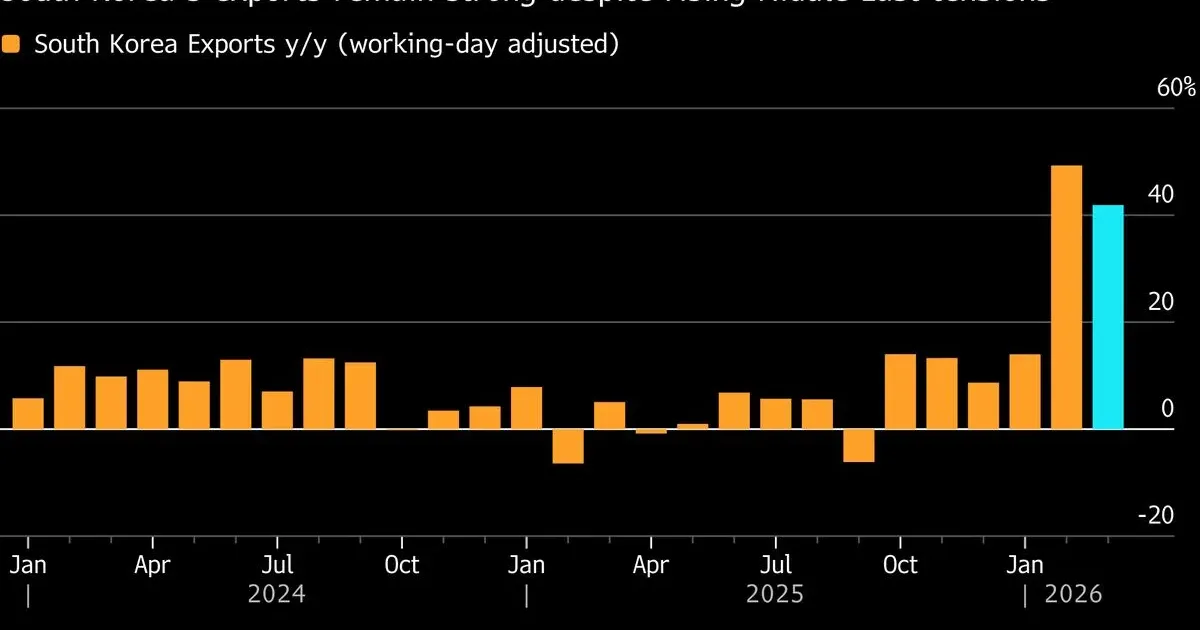
South Korea reported stronger-than-expected exports as semiconductor demand offset energy and shipping risks tied to the Iran conflict. Outbound shipments rose for a sixth consecutive month, according to preliminary trade data. Seoul's manufacturers are benefiting from artificial intelligence hardware demand even as fuel costs and maritime insurance premiums climb. The figures were released on April 1, 2026.
Bloomberg Economics noted that the resilience of the Korean trade engine suggests a decoupling from traditional geopolitical risk patterns. While the war in Iran has disrupted several major shipping lanes, the high value-to-weight ratio of microchips allows for air freight alternatives that bypass troubled waters. Silicon dominance remains the primary driver of this fiscal durability. Manufacturers in Suwon and Icheon reported that order backlogs for high-bandwidth memory reached new peaks in the first quarter.
Semiconductor Shipments Reach Record Highs in March
Data from the customs office indicate that semiconductor exports climbed over 35 percent compared to the previous year. This surge coincides with a global rush to secure Samsung Electronics and SK Hynix components. Analysts at Bloomberg Economics pointed out that the concentration of advanced chip manufacturing in East Asia makes the global economy uniquely dependent on Korean stability. Production lines operated at near-maximum capacity throughout the month to meet contractual obligations for AI accelerators.
Technological shifts have altered the composition of the nation's trade portfolio. Ten years ago, automotive and shipbuilding sectors dominated the balance sheet. Today, integrated circuits account for nearly one-fifth of all outbound value. High-bandwidth memory chips, essential for processing large data sets, saw the most serious price appreciation. Global tech giants appear willing to pay a premium to avoid delays in their data center expansions.
South Korea's exports continued to surge in March as record semiconductor shipments driven by the artificial intelligence boom and demand from China helped cushion the economy.
Logistics experts noted that air cargo demand at Incheon International Airport spiked during the final two weeks of March. Companies are increasingly opting for flight paths over the Pacific to ensure delivery timelines remain intact. Shipping via the Red Sea or the Strait of Hormuz has become too unpredictable for time-sensitive electronics. High-value cargo handles the increased cost of aviation fuel better than bulk commodities like steel or petrochemicals.
China Trade Recovery Strengthens Korean Manufacturing
China became a renewed buyer of Korean intermediate goods during this period. After several quarters of sluggish performance, Chinese demand for display panels and mobile components rebounded sharply. Factory activity in Shenzhen and Guangzhou suggest a broader industrial recovery is taking hold in the mainland. South Korean suppliers benefited from this renewed appetite for high-tech inputs used in consumer electronics assembly.
Trade officials in Seoul observed that the Chinese market remains essential despite efforts to diversify export destinations. Electronic components shipped to Chinese factories often find their way into finished products destined for the United States. Trade interdependency persists even as geopolitical friction complicates diplomatic relations. March figures showed a double-digit percentage increase in shipments to Chinese ports for the first time in eighteen months.
Industrial production within South Korea responded to these external signals with increased output. Steelmakers and chemical producers, however, faced stiffer headwinds due to the rising price of crude oil. Energy imports constitute a huge portion of the Korean trade ledger. Volatility in the Middle East pushed Brent crude prices higher, squeezing the profit margins of energy-intensive industries. Domestic refineries reported higher input costs that threatened to erase gains made in the electronics sector.
Middle East Tensions Threaten Global Energy Supplies
Energy security dominates the list of concerns for policymakers in Seoul. South Korea imports nearly all its petroleum requirements, much of it originating from the Persian Gulf region. Hostilities involving Iran have led to a sharp increase in insurance premiums for oil tankers. These costs inevitably trickle down to the manufacturing floor. The government has tapped into strategic reserves to stabilize domestic fuel prices during the current period of instability.
Market participants are monitoring the Strait of Hormuz closely for signs of a total blockade. Approximately one-third of the world's liquefied natural gas passes through this narrow waterway. Any prolonged closure would devastate the Korean energy grid. Heavy industries like shipbuilding and automobile manufacturing rely on stable electricity costs to remain competitive against regional rivals. Current stockpiles provide a temporary cushion, but a long-term conflict remains a potent threat to the broader economy.
Currency fluctuations added another layer of complexity to the March trade data. The Korean won weakened against the US dollar as investors sought safe-haven assets. A cheaper won typically makes exports more competitive on the global stage. It also makes the cost of importing essential raw materials much higher. Economic planners must balance these competing factors to maintain the current growth trajectory.
Market Readout
South Korea is currently walking an economic tightrope that the broader market seems to be ignoring. While the March export numbers are clearly strong, they rely almost entirely on a fragile semiconductor monoculture. Relying on AI hype to mask the structural decay caused by Middle Eastern energy wars is a dangerous gamble for Seoul. If the artificial intelligence bubble experiences even a minor correction, the Korean economy will find itself without its only reliable life raft.
History suggests that technological booms eventually plateau. When the current infrastructure build-out for data centers reaches saturation, South Korea will be left exposed to the raw volatility of the energy markets. The current trade surplus is an illusion built on high-margin chips and high-risk geography. Investors should look past the $60 billion export headlines and focus on the soaring costs of the Busan logistics chain. The resilience of the won is being tested, and the government's ability to subsidize energy costs is not infinite.
The export surge is not a sign of fundamental health. It is a desperate sprint to outrun a gathering storm of oil shortages and shipping blockades. Bet on the silicon, but prepare for the crude reality. The expansion cannot survive a sustained closure of the Strait of Hormuz. Seoul is winning the tech war while losing the logistics battle.